Tag Archive for: Wildlife Encounters

Whale season is coming: Hervey Bay’s 2026 season runs July–October, with peak sightings in August–September. If you’re ready to plan, jump straight into Whale Watching Hervey Bay to compare tour operators, departure times and package options. Book early to secure your spot.

Whale Watching in Hervey Bay: A First-Time Visitor’s Guide

TO STAND on the deck of a boat while a 40-tonne humpback whale surfaces nearby has a way of putting everyday worries into perspective. You arrive hoping to see whales. You often leave with a renewed appreciation for the natural world.

Every winter, thousands of humpback whales visit the calm waters of Hervey Bay during their annual migration along Australia’s east coast. For many visitors, it’s a bucket-list experience. For locals, it’s one of the highlights of the year.

If you’re planning your first whale-watching cruise, here are 11 things worth knowing before you go.

  • This article contains affiliate links. If you purchase through these links, Jocelyn Magazine may earn a small commission at no extra cost to you.
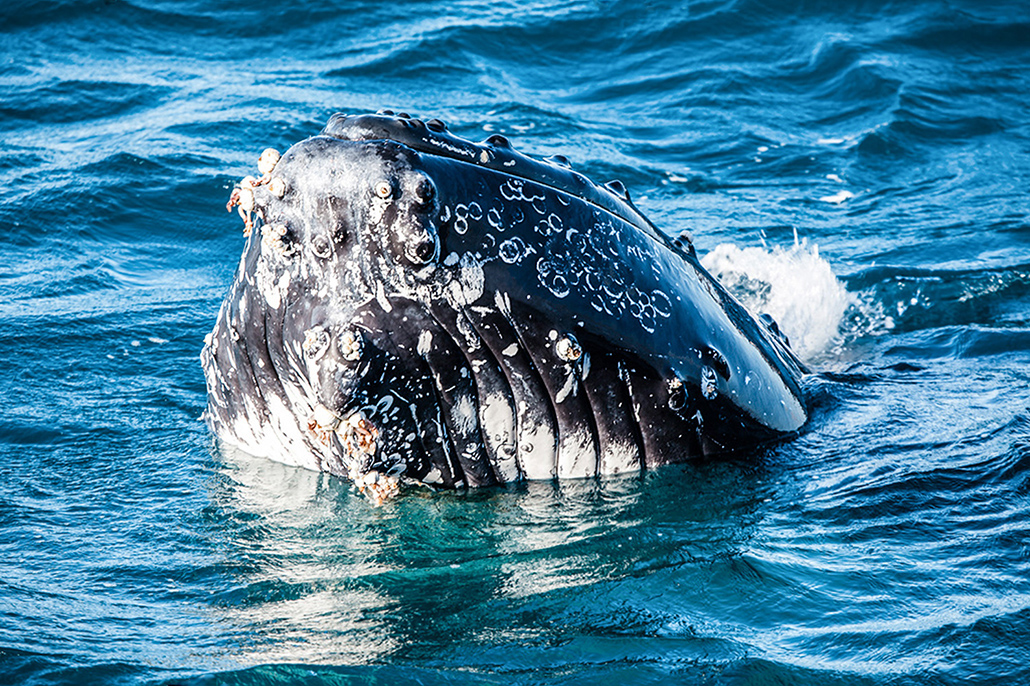
Close-up of a humpback whale surfacing near a boat in Hervey Bay

Close-up of a humpback whale surfacing near a whale watching vessel in Hervey Bay, showing barnacles and distinctive markings.


1. Hervey Bay is one of the world’s best whale watching destinations

Whale watching is available in many parts of Australia, but Hervey Bay is unique.

The bay’s sheltered waters provide a resting place for humpback whales during their migration. Unlike many locations where whales simply pass by, whales often spend days or even weeks in the bay, giving visitors exceptional viewing opportunities.

It’s one of the reasons Hervey Bay has earned an international reputation as a premier whale-watching destination.

2. The season runs from July to October

Whales can begin arriving from mid-July, with numbers generally increasing through August and September.

October often brings excellent opportunities to see mothers travelling south with young calves.

While sightings are possible throughout the season, August and September are usually considered peak whale-watching months.

3. Thousands of humpback whales visit each year

The annual migration is one of nature’s great journeys.

Humpback whales travel thousands of kilometres between their Antarctic feeding grounds and the warmer breeding waters of Queensland and further north.

Many pause in Hervey Bay waters along the way, creating one of Australia’s most spectacular wildlife experiences.

4. The whales aren’t just passing through

One of the most fascinating things about Hervey Bay is that whales often stop here rather than simply continuing their migration.

Researchers have observed whales resting, socialising and caring for calves in the protected waters between the Fraser Coast and K’gari.

That means encounters can be longer and more interactive than in destinations where whales remain constantly on the move.

5. Mothers and calves are often the stars of the show

By late season, many visitors are lucky enough to see mothers travelling with young calves.

Watching a calf surface beside its mother or practise breaching for the first time is something few people forget.

These gentle interactions are among the reasons photographers and wildlife enthusiasts return year after year.
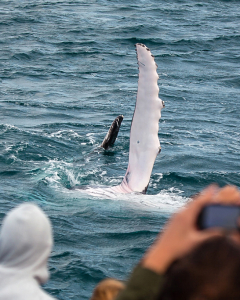
Passengers watching a humpback whale lift its pectoral fin in Hervey Bay

Passengers onboard a whale watching cruise witness a humpback whale surfacing close to the vessel in Hervey Bay.

6. Every whale-watching trip is different

No two cruises are ever quite the same.

One day you might see whales breaching repeatedly. Another day they may approach the vessel, circle beneath the boat or spend time resting near the surface.

Part of the excitement is never knowing exactly what behaviour you’ll witness.

7. Winter is actually the best time to visit

For travellers from southern Australia, this may come as a pleasant surprise.

While much of the country is experiencing cold weather, Hervey Bay often enjoys mild winter days, clear skies and comfortable temperatures.

Whale season coincides with some of the most pleasant weather of the year on the Fraser Coast.

8. You don’t need expensive camera gear

Professional cameras can certainly help, but they’re not essential.

Visitors often capture wonderful memories using smartphones or compact cameras.

In fact, some of the best whale watching experiences happen when you put the camera down for a moment and simply enjoy the encounter.

9. Most tours have excellent sighting success

One of the questions visitors ask most often is whether they’ll actually see whales.

While nature can never offer guarantees, Hervey Bay’s whale-watching operators enjoy very high sighting rates during the season.

Operators often have policies in place should sightings unexpectedly not occur.

10. You may see more than whales

Keep your eyes open throughout the cruise.

Depending on conditions, you may also encounter dolphins, turtles, seabirds and other marine life.

For wildlife lovers, the journey itself can be just as rewarding as the whale encounters.

11. Whale watching has a way of staying with you

Most people book a whale-watching cruise expecting a memorable day on the water.

What often surprises them is the emotional impact.

Seeing a humpback whale in its natural environment creates a sense of scale that’s difficult to describe. Standing beside an animal larger than a bus yet moving with remarkable grace can leave you feeling both humbled and inspired.

It’s one of the reasons so many visitors return to Hervey Bay for whale season year after year.
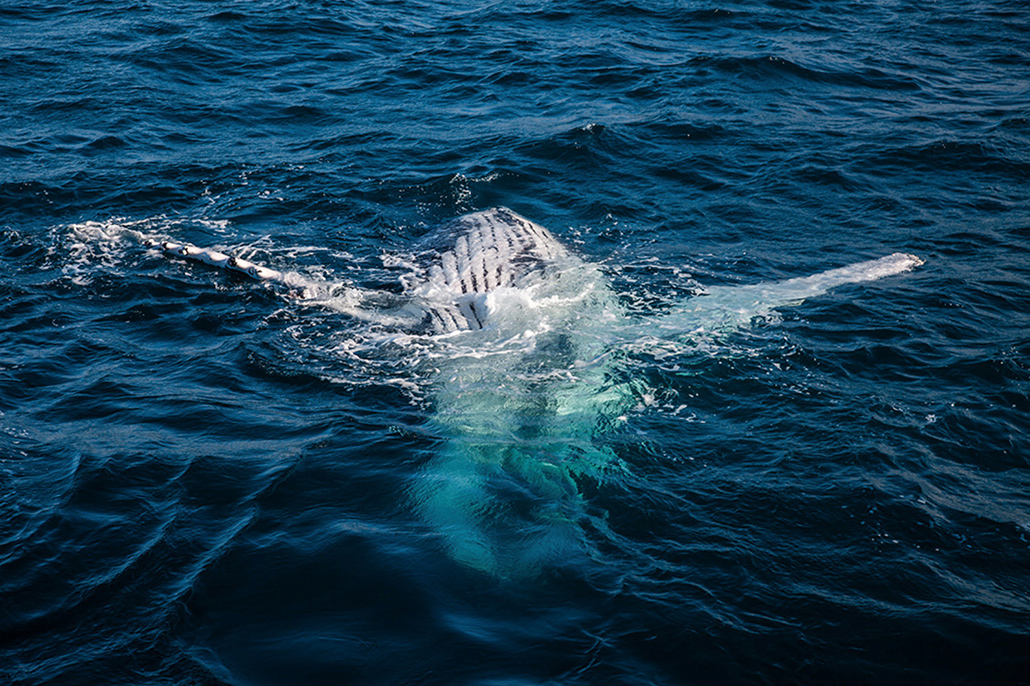
Humpback whale rolling beneath the surface in Hervey Bay

A humpback whale moves just below the waterline in Hervey Bay, offering a glimpse of its striped underside.

Don’t wait until peak season: many tours start filling in August. Visit Whale Watching Hervey Bay to choose your tour below and book now to get the best spot and price.


Planning a Whale Watching Trip to Hervey Bay?

Whether you’re visiting the Fraser Coast for a weekend or a longer Queensland road trip, whale season offers a chance to witness one of Australia’s most remarkable natural spectacles.

Bring a camera, pack a light jacket, and don’t forget to look up from the viewfinder occasionally. Sometimes the most memorable moments are the ones you simply experience.

Make the most of your Fraser Coast getaway with these travel essentials:

Stay Near the Marina

Many whale watching tours depart from Urangan Marina, making nearby accommodation a convenient choice.

Oaks Hotels & Resorts offers a range of accommodation options within easy reach of Hervey Bay’s waterfront, restaurants and tour departure points.

OAKS HOTEL

Explore Beyond the Whales

Planning to discover more of the Fraser Coast before or after your cruise? A hire car makes it easy to visit Maryborough, Toogoom, Burrum Heads and other local attractions.

Avis Car Rental offers vehicle hire options for travellers arriving by air, rail or road.

AVIS CAR RENTAL

Travel With Confidence

Travel plans don’t always go exactly as expected. Travel insurance may help protect against unexpected disruptions, cancellations and medical expenses.

AllClear Travel Insurance specialises in cover for travellers, including many pre-existing medical conditions.

ALLCLEAR TRAVEL INSURNCE


Disclosure: This article contains affiliate links. If you purchase through these links, Jocelyn Magazine may earn a small commission at no extra cost to you. Thank you for supporting independent publishing.

Photos: Jocelyn Watts


Beyond Silence: Inclusivity in Travel

EMBARK on an immersive journey beyond sound, and indulge in all-encompassing Queensland experiences.

Statistics reveal that one in six Australians grapple with hearing impairment, while approximately 30,000 Deaf Auslan users face total hearing loss.

As our population ages, projections suggest that by 2050, one in every four Australians will encounter some form of hearing loss.

Queensland, however, is breaking barriers by extending a warm invitation to travellers of all hearing abilities.

In the Sunshine State, from world-class art galleries and theatre productions to ancient rainforests and wildlife encounters, there’s an array of experiences designed to captivate all the senses.

Join us on a sensory-rich exploration of eight extraordinary Queensland adventures, where the beauty of the journey lies in inclusivity.

  • This article may contain affiliate links and advertisements. If you click on these links, make a purchase, or share this content, we may earn a small commission at no extra cost to you. This helps us continue creating valuable content for you. Thank you for your support.
Queensland experiences - entertainment theatre

QPAC at South Bank offers an assistive listening system. Photo: Tourism & Events Queensland.

World-class performances in the heart of Brisbane

Brisbane’s exciting calendar of theatre, cultural exhibitions and performing arts is accessible through a range of hearing technologies and Auslan-interpreted shows.

The Queensland Performing Arts Centre (QPAC) offers an assistive listening system (ALS) to send audio directly to headphones, hearing aids, or cochlear implants – with ListenTech available free of charge.

Select performances are professionally signed by Auslan interpreters, with theatregoers encouraged to download the GoTheatrical app to access live captions on mobile or tablet devices.

Further down the river, Brisbane Powerhouse offers a range of select Auslan performances throughout the year, as well as hearing loops for everyone to enjoy the year-round festivities.

Queensland Experiences - Brisbane Powerhouse

Aerial view of the Brisbane Powerhouse, on the banks of the Brisbane River. Photo: Tourism & Events Queensland.

Wander through the rainforest in Cairns & Great Barrier Reef

As the world’s oldest continually surviving rainforest, the Daintree Rainforest in the Wet Tropics is home to an impressively diverse environment and thousands of distinctive wildlife species that must be experienced to be believed.

The Daintree Discovery Centre is a great place to do just this.

Spark curiosity in this ancient landscape at the Interpretive Display Centre, featuring interactive touch-screen kiosks to help set bearings, before setting off on a self-guided tour.

Guides are fitted with a T switch suitable for hearing aids. Ascend the Aerial Walkway to take in canopy views, complete with interpretive guidebooks highlighting not to miss points of interest.

Queensland experiences - rainforest

A rainforest park nestled in the Daintree National Park. Photo: Tourism & Events Queensland.

Be inspired by art in South East Queensland

In the state’s capital, QAGOMA’s (Queensland Art Gallery and Gallery of Modern Art) award-winning accessibility program offers customised programs for low-hearing and deaf art lovers.

Free volunteer guided tours for members of the Deaf community are scheduled on the last Sunday of the month from January to November, with a NAATI-accredited Auslan interpreter accompanying the gallery guide.

Visitors with cochlear implants, hearing aids or hearing loss are invited to join a small group tour led by a volunteer guide on the fourth Friday of the month between January and November, with assistive listening devices (FM system) available.

Visitors can also enjoy rare film viewings at the Queensland Art Gallery and Gallery of Modern Art’s Australian Cinémathèque, with a hearing loop system to support those with hearing aids and implants.

On the Gold Coast, HOTA (Home of the Arts) is committed to bringing art to the hearts of all, with Auslan assistive listening carrier devices and Auslan-interpreted programs, including tours with the HOTA Gallery Artist Educator, regularly scheduled.

Queensland experiences - art gallery

A Queensland Art Gallery and Gallery of Modern Art guide talks with a group next to some artwork. Photo: Tourism & Events Queensland.

Queensland experiences - gallery

A family walks to the entrance of HOTA (Home of the Arts). Photo: Tourism & Events Queensland.

Say hello to a wild world of wildlife on the Gold Coast

Twenty-seven hectares of rainforest and animal encounters await at the Gold Coast’s iconic Currumbin Wildlife Sanctuary.

Meet native animals, tour the animal hospital, and catch the Wild Skies Free Flight Bird Show which has hearing augmentation via an assisted listening service, amplifying sound through headphones (hired from Visitor and Member Services).

Queensland experiences - birds

Daily lorikeet feeding encounter at the Currumbin Wildlife Sanctuary. Photo: Tourism & Events Queensland.

Festival fun on the Sunshine Coast

Art and culture shine on the Sunshine Coast during the annual Horizon Festival.

This 10-day multi-arts festival celebrates music, arts, theatre, dance and more, from the beach to the hinterland and the townships.

Bringing art experiences to those with low hearing or deafness, some performances feature Auslan-interpreted shows on select dates.

At the same time, the festival also offers an interpreting service, meaning eventgoers can request an Auslan interpreter for events, where possible.

Visitors who would like an Auslan interpreter and seating with clear sightlines to interpreters are asked to contact the festival organisers to book.

Queensland experiences - Aboriginal dn

Aboriginal dancers perform at the 2022 Horizon Festival on the Sunshine Coast. Photo: Nic Morley, Tourism & Events Queensland.

Discover the magic of the stars, planets and universe beyond

Located in the Brisbane Botanic Gardens at the base of iconic Mt Coot-tha, Sir Thomas Brisbane Planetarium skyrockets wonder in space and astronomy.

Learn about the solar system and human space exploration in the Display Zone, which includes written and pictorial information, while glow-in-the-dark gloves are available for Auslan interpretation.

Queensland experiences - planetarium

A family walks past the Sir Thomas Brisbane Planetarium. Photo: Tourism & Events Queensland.

Resonating Diversity: Queensland’s Inclusive Overture

As we draw the curtain on our Queensland exploration, it’s evident that inclusivity is the melody that resonates throughout the Sunshine State.

From the theatres of Brisbane hosting accessible performances to the ancient serenades of the Daintree Rainforest, each encounter extends an open invitation, regardless of one’s hearing capabilities.

South East Queensland’s art scene paints a vivid tapestry of diversity, while the Currumbin Wildlife Sanctuary on the Gold Coast amplifies the wonders of the wild.

The Horizon Festival on the Sunshine Coast is a testament to accessibility in the arts, ensuring that the cultural celebration embraces all participants.

At the Sir Thomas Brisbane Planetarium, the universe unfolds its wonders for everyone, underlining the boundless magic of exploration.

Queensland’s commitment to inclusivity is resounding – every traveller is embraced in the shared symphony of wonder.

For more information on accessible Queensland holidays, explore queensland.com/foreveryone.

Story and photos contributed by Tourism & Events Queensland.
Published 3 December 2023. 

***

IF YOU ENJOYED THIS STORY, YOU MIGHT ALSO LIKE 15 LESSER-KNOWN NATIONAL PARKS IN QLD

***

Hervey Bay is one of the world’s best places to see humpback whales up close. If you’re ready to plan your trip, these whale tours will float you into the best viewing zones and often get inquisitive, close encounters.

How to Optimise Your Voyage to see Humpback Whales

ARE YOU looking to go whale-watching? You’re not alone! Every year, more and more tourists flock to Australia’s east coast to see the annual humpback whale migration.

But, before you make the trip down to your desired destination, it’s important to understand the migration system of these creatures first.

Knowing when they are most likely to be around will help ensure that your experience is memorable; after all, who wouldn’t want to witness something so awe-inspiring?

In this blog post, we’ll take a deep dive into humpback migrations, what they mean, where they go, and why choosing the right time is so important for getting the most out of your next whale-watching voyage.

  • This article may contain affiliate links and advertisements. If you click on these links, make a purchase, or share this content, we may earn a small commission at no extra cost to you. This helps us continue creating valuable content for you. Thank you for your support.
Humpbacks - whale watching

Humpback whale in Hervey Bay, Qld.

Meet Humpback Whale Researcher Dr Wally Franklin

Humpback whales are fascinating creatures, and renowned marine scientist and Oceania Project co-founder Dr Wally Franklin can attest to that.

Dr Wally and his late wife, Dr Trish Franklin, dedicated more than three decades to studying humpbacks. While Dr Trish focused on their behaviour, Dr Wally delved into the statistics and scientific data behind their lives.

humpbacks - Dr Wally Franklin

Dr Wally Franklin. Contributed photo.

Humpbacks evolved into their present form millions of years ago and belong to the baleen whale group. Unlike land animals, they experience neutral buoyancy in the ocean, Dr Wally explained, only feeling the weight of their enormous bodies when they breach.

Their lives are largely governed by two things: breeding and feeding.

Female humpbacks generally give birth every two years and don’t experience menopause. Some, including Hervey Bay favourite Nala, have continued producing calves for decades.

Humpbacks breed in tropical waters around the Great Barrier Reef before migrating south to their Antarctic feeding grounds, where nutrient-rich waters support phytoplankton and Antarctic krill.

Eastern Australian humpbacks usually migrate alone or in small groups. In Hervey Bay, however, larger groups form as whales congregate to rest, socialise and care for calves and younger whales.

Understanding this annual journey between breeding and feeding grounds is key to understanding humpback behaviour.

Humpbacks - whale watching

Humpback whale in Hervey Bay, Qld.

How Humpback Whale Society Differs from Ours

There is a significant difference between the social organisation of humpback whales and humans, Dr Wally said.

Dr Trish completed a piece of work based on 361 whales, in which she documented sighting histories ranging from two to 25 years, that showed the migration was dominated by two groups of mature females.

First, there’s a group of mature females who lead the migration early. These females are either pregnant or taking a break from caring for their calves. They leave the breeding area first, usually in August and September, and they are accompanied by a young cohort of whales. These young whales are between one and six years old.

So, during the early part of the migration, these mature females travel and socialise with the immature whales. They all leave Hervey Bay by the end of August.

The next group to arrive in Hervey Bay was the mature females with new calves. They don’t start coming into the Bay until early September because it’s the peak breeding month up in the Barrier Reef and the mothers keep the calves up there until they are strong enough and developed enough to begin the migration south. By the time the females bring their calves into Hervey Bay, they are already a few months old. So, these mature females are at the back end of the migration.

There are also three groups of mature males mixed in with the females. There are mature males without lactating females, mature males with lactating females, and males of unknown maturity without lactating females.

The calves are sighted in Hervey Bay in September and October.

Dr Trish discovered these calves return as yearlings in August of the following year. As they grow older, they begin to join the migration later each year until they reach the age of six, when they become socially and sexually mature. By the age of seven, they start mirroring what the adult whales do.

Isn’t that incredible? Humpback whales have such an interesting social structure, and it’s so different from what we experience as humans.

Humpbacks - whale watching

Humpback whale in Hervey Bay, Qld.

The Matriarchal World of Humpback Whales

There is a significant difference between the social organisation of humpback whales and humans, Dr Wally said.

Research by Dr Trish, based on the sighting histories of 361 whales tracked over periods ranging from two to 25 years, revealed a migration largely shaped by two groups of mature females.

The first are females that are pregnant or taking a break from caring for calves. They lead the southern migration, arriving in Hervey Bay during August accompanied by younger whales aged between one and six. Here, the mature females travel and socialise with the immature whales before leaving the Bay by the end of August.

Next come the mothers with new calves. They generally arrive from early September, after spending the peak breeding period farther north near the Great Barrier Reef while their calves grow strong enough for the journey south. Mature males are also present throughout the migration, mixing with the female groups.

Dr Trish found another intriguing pattern. Calves seen in Hervey Bay during September and October return as yearlings the following August. As they grow older, they progressively join the migration later each year.

By six, they are socially and sexually mature; by seven, their migration patterns begin to mirror those of adult whales.

Isn’t that incredible? Humpback whales have a fascinating social structure, and one remarkably different from our own.

Humpbacks - whale watching

Humpback whale in Hervey Bay, Qld.

Why Female Humpbacks Remain Unmarked

Another discovery made by Dr Trish is the behaviour of humpback whales in groups.

There is a particular group known as the competitive group, believed to be a group of males vying for a single female. Dr Trish noticed something fascinating: the males in these groups exhibited strong agonistic behavior towards each other, which resulted in horizontal and lateral marks on the males’ bodies, but the female participating in the group remained unmarked.

This led Trish to identify non-agonistic social groups consisting mostly of young whales. These groups interacted with each other as they developed socially and also interacted with mature females. In Hervey Bay, these non-agonistic groups are present before the arrival of mature females with calves, who primarily interact with mature males who are seeking mating opportunities.

Dr Wally said the social organisation of humpback whales was comparable to nomadic indigenous groups in Australia. It lacks the traditional family structure found in our modern societies.

There is no evidence to suggest that humpback whales form family groupings, as do dolphins, orca whales, and humans. However, the bond between mother and calf humpbacks is well-documented.

Calves stay with their mothers for a full year, learning important skills such as how to feed on the Krill in Antarctica, and bringing them back to the point of origin so they complete a cycle of migration in their early life.

By the time the mothers get back with the calves towards Hervey Bay again, the calves are separated from their mothers and join the young cohort. Then it appears all the females are involved in looking after the whole of that young cohort.

It’s truly remarkable how humpback whales navigate their annual migration cycle, ensuring their calves thrive in their early life.

Unforgettable Encounters with the Humpback Whales

Whale-watching is an incredible experience that allows you to become enveloped in the fascinating world of these majestic creatures.

Specific steps can be taken to make your voyage even more memorable, from picking the perfect tour and time of day to properly preparing yourself beforehand so that you can make the most out of your experience.

Through strategic planning and some luck, you will be rewarded with a thrilling and unique encounter with humpback whales. Who knows? Maybe you’ll have one of those once-in-a-lifetime moments when a whale swims by only a few metres away from you.

Now, if that doesn’t sound like an unforgettable experience worth having, we just don’t know what does.

Be sure to check out The Oceania Project website at https://www.oceania.org.au/ for more fascinating information on humpback whales before embarking on your journey.


Humpbacks - whale watching

Whale watching in Hervey Bay, Qld.

Photos by Jocelyn Watts, Hervey Bay, 2014.

Humpback Whale Migration Questions & Answers

Q: Where’s the best spot for whale watching in Queensland?
A: Hervey Bay is the ultimate place to witness whales in Queensland. It’s even considered the world’s first official Whale Heritage site, setting the standard for whale watching everywhere. However, humpback whales can be seen right along the Australian east coast from Antarctica to the Great Barrier Reef.

Q: When is the perfect time for whale watching?
A: Humpback whales migrate to Queensland between June and November. In the early part of the season, they travel north to the shallow waters of the Great Barrier Reef to give birth to their calves. Towards the end of the season, they bring their calves back to Antarctica. So, their return journey is when you’re most likely to see the calves.

Q: Do whales breach in the shallow waters of Hervey Bay?
A: Absolutely! Mothers use the shallow waters of Hervey Bay to teach their calves essential skills they’ll need in the deep and cold waters of Antarctica, so, in the latter part of the season, you’re likely to see mothers teaching their calves to breach.

Q: When is the best time of day to see humpback whales?
A: Humpback whales are most active in the morning and late afternoon, so those are the ideal times to catch them in action.

Q: What can I expect to see on a whale watch tour?
A: Whether from the coast or a whale-watching boat, you’ll be amazed by their impressive displays, like blowing, breaching, and tail-slapping. Sometimes, the whales may even come close to the boats and swim around them. While the boats maintain a safe distance, the whales might just come by to say hello!

See Vimeo film for examples of tail-slapping at  https://vimeo.com/106634103  and breaching in Hervey Bay at  https://vimeo.com/59781809

Whale season is short: July–October 2026, with peak sightings in August–September. Book your tour now to secure your date and avoid the rush.

Plan Your Whale-Watching Getaway

If you’re heading to Hervey Bay or another whale-watching destination, these trusted travel partners may help you plan your trip.

Stay Close to the Action

Oaks Hotels & Resorts offers comfortable accommodation in popular coastal destinations, including Hervey Bay, making it easy to enjoy whale-watching tours, waterfront dining and local attractions.

OAKS HOTEL

Explore at Your Own Pace

Whether you’re flying in or planning a regional road trip, Hertz Car Rental can help you discover more of the Fraser Coast and beyond.

HERTZ CAR RENTALS

Travel with Confidence

Unexpected disruptions can happen when travelling. AllClear Travel Insurance offers cover options, including for many travellers with pre-existing medical conditions.

ALLCLEAR TRAVEL INSURNCE


Disclosure: Jocelyn Magazine may earn a commission if you purchase through affiliate links on this page, at no additional cost to you. This helps support the creation of independent travel and lifestyle content.