
There are train journeys, and there are high teas. Put the two together and send the whole affair rattling through the Mary Valley.
Travel stories, regional discoveries and slow journeys across Australia, New Zealand and beyond. From rail travel, art and culture, to lesser-known destinations, this is where the experience of getting there becomes part of the story.
A Day on Magnetic Island: Rock Wallabies, Beaches and Island Time
SOMETIMES the best way to explore somewhere new is not to arrive with a long list of things to tick off, but simply to see where the day takes you.
That was our approach to Magnetic Island while I was staying with family in Townsville. We took a car across on the vehicle ferry and spent the day exploring some of the island’s best-known bays. Along the way, we stopped for lunch and met the little rock-wallabies living among the granite boulders at Geoffrey Bay.
Magnetic Island — or Yunbenun, its traditional name — lies only about eight kilometres north-east of Townsville. Yet once you’ve crossed Cleveland Bay, it feels considerably further removed from the city.
The Wulgurukaba people, known as the ‘canoe people’, are the Traditional Custodians of Yunbenun. Their enduring connection extends across the island and nearby mainland. Today, 78 per cent of Magnetic Island’s 5184 hectares is protected as national or conservation park, within the Great Barrier Reef World Heritage Area.
Its landscape is striking, with open eucalypt woodland, sandy beaches and hoop pines. Enormous weathered granite boulders seem to have been casually scattered around the coastline.
Affiliate Disclosure: This article is based on my own day trip to Magnetic Island. It contains affiliate links to selected travel partners. If you book through one of these links, I may receive a small commission at no extra cost to you. This helps support Jocelyn Magazine and the independent travel stories I share here.

Taking a car across from Townsville makes exploring Magnetic Island easy on a day trip.
Getting to Magnetic Island from Townsville
There are two straightforward ways to make the crossing.
We chose to take a car on the vehicle ferry, which worked particularly well for a family day out with a three-year-old. Once ashore, we could set our own pace and move easily between the bays.
Alternatively, passenger ferries make the crossing from Townsville in about 20 minutes. Public buses connect with ferry arrivals on the island. Hire cars are also available for visitors who would rather travel across as foot passengers and pick up wheels when they arrive.
While Magnetic Island is an easy day trip, there’s certainly no requirement to leave at sunset. Accommodation ranges from resorts and holiday apartments to backpacker-style and other short-stay options. So, an overnight stay, or several nights, is an easy alternative.

Granite headlands and calm blue water make Alma Bay one of Magnetic Island’s inviting beach stops.
First stop: Alma Bay
Our first stop was Alma Bay, near Arcadia. It was a lovely introduction to the landscape we would see throughout the day. Calm blue water met a sandy beach, with great, rounded granite formations rising around the shoreline.
Magnetic Island is actually a continental island. It was once connected to the mainland before rising sea levels separated it about 7500 years ago. That helps explain why the island shares much of its wildlife with the nearby North Queensland mainland, including the creatures we were about to meet.

Massive granite boulders are a defining feature of Magnetic Island’s landscape and ideal habitat for its rock-wallabies.
Meeting the rock-wallabies at Geoffrey Bay

An allied rock-wallaby and joey among the granite boulders at Geoffrey Bay.
From Alma Bay we continued to Geoffrey Bay at Arcadia. Here, the granite boulders provide habitat for one of Magnetic Island’s most engaging residents: the allied rock-wallaby.
This was easily the highlight of my day. Or, more accurately, watching my three-year-old grandson discover them was.

A rock-wallaby accepts approved food pellets from a visitor at Geoffrey Bay.
There is something rather magical about seeing a small child encounter a wild animal at close range. One moment you’re looking at a jumble of enormous grey-brown rocks; the next, a pair of ears appears. Then a little face. And suddenly there is a wallaby standing almost impossibly securely on a sloping slab of granite.
Allied rock-wallabies (Petrogale assimilis) occur naturally across parts of north-eastern Queensland, including Magnetic and Palm islands. Magnetic Island itself was once part of the mainland. Its wallabies weren’t introduced as a tourist attraction; they are part of the island’s native fauna.
They’re beautifully adapted to this rugged environment. Their colouring makes them surprisingly difficult to pick out against the rocks, while their feet allow them to move quickly and confidently across steep, uneven surfaces.
Queensland Parks recommends looking for them around places such as Geoffrey Bay in the early morning or late afternoon.
The Geoffrey Bay wallabies have also become accustomed to human visitors. We hand-fed them wallaby pellets, which was especially exciting for the smallest member of our party.
Current local wildlife guidance would prefer visitors to let the wallabies forage naturally. For those who do feed them, only appropriate foods should be offered. These include wallaby pellets and certain fruits and vegetables; never processed human food.
Watching the wallabies emerge from their rocky hideaways was fascinating. Watching a three-year-old’s face as they did so was even better.

Taking time out at Geoffrey Bay during a family day trip around Magnetic Island.
Hiring a car in Townsville?
If you’re flying into Townsville, hiring a car can make it easy to explore the city before taking your vehicle across to Magnetic Island. Avis permits eligible rentals from Townsville to travel to Magnetic Island, subject to its island travel conditions. Check the current terms when booking.
Lunch in Arcadia, then on to Horseshoe Bay

Lunch at Bikini Tree Café in Arcadia Village Hotel during our Magnetic Island day trip.
After our wildlife encounter, we stopped for a casual lunch at Bikini Tree Café at Arcadia Village Hotel before continuing across the island to Horseshoe Bay.
Horseshoe Bay has a different feel again. It’s the island’s largest bay and one of its main visitor hubs. Cafés and water activities line the bay, while boats sit offshore. It would be easy to spend a good part of the day here. You could swim, eat or simply find some shade and look across the water.
For visitors with more time than we had, Magnetic Island offers plenty of other reasons to linger. There are walking tracks, snorkelling, fishing and opportunities to see more wildlife.
The best known is the Forts Walk, with its sweeping views and Second World War history. There’s also the chance of seeing wild koalas. The remains are part of a coastal defence complex built in 1942–43 when Townsville was an important military base and Cleveland Bay a strategically significant shipping area.
That’s one for another visit.

Outrigger canoes beside the beach add to the laid-back tropical atmosphere at Horseshoe Bay.
Finishing the day at Picnic Bay

Years of tides and marine life have left their mark on the old Picnic Bay jetty.
Our final stop was Picnic Bay, at the southern end of the island.
By then the day had taken on that pleasantly unhurried feeling that comes when you’ve stopped trying to fit anything else in.
Picnic Bay has its own place in Magnetic Island’s tourism history. The island became popular with visitors from Townsville during the 1800s. Its first resort was established at Picnic Bay in the late 1890s.
We walked along the old timber jetty, looking back towards the mainland across Cleveland Bay. It was a fitting place to finish a day that had begun only a short ferry ride away.
There’s another little piece of history behind the island’s English name. When Lieutenant James Cook sailed through the area in 1770, he recorded that his compass did not behave properly. He named the island for the magnetic effect he thought the land was having on it.
More than 250 years later, Magnetic Island still has a certain pulling power, although perhaps not quite the sort Cook had in mind.
For me, though, the lasting memory isn’t the compass story, the beaches or even those extraordinary granite boulders.
It’s a three-year-old discovering that if you look carefully between the rocks at Geoffrey Bay, something might be looking back.

Walking the Picnic Bay jetty during a family day trip to Magnetic Island.
Make Townsville your base
Staying in Townsville and planning a Magnetic Island day trip? Oaks has two centrally located properties, putting you within easy reach of the waterfront and ferry connections.
Photos: © Jocelyn Watts 4/6/2026
Whale Watching in Hervey Bay: The Complete Seasonal Guide
From lively juveniles in July and August to mothers teaching their calves the ways of the whale in spring, every stage of Hervey Bay’s whale-watching season has something different to offer. Here’s how to choose when to go, find the right cruise and make the most of your day on the water.
- This article contains affiliate links. If you make a booking or purchase an item through one of these links, Jocelyn Magazine may receive a commission at no extra cost to you.
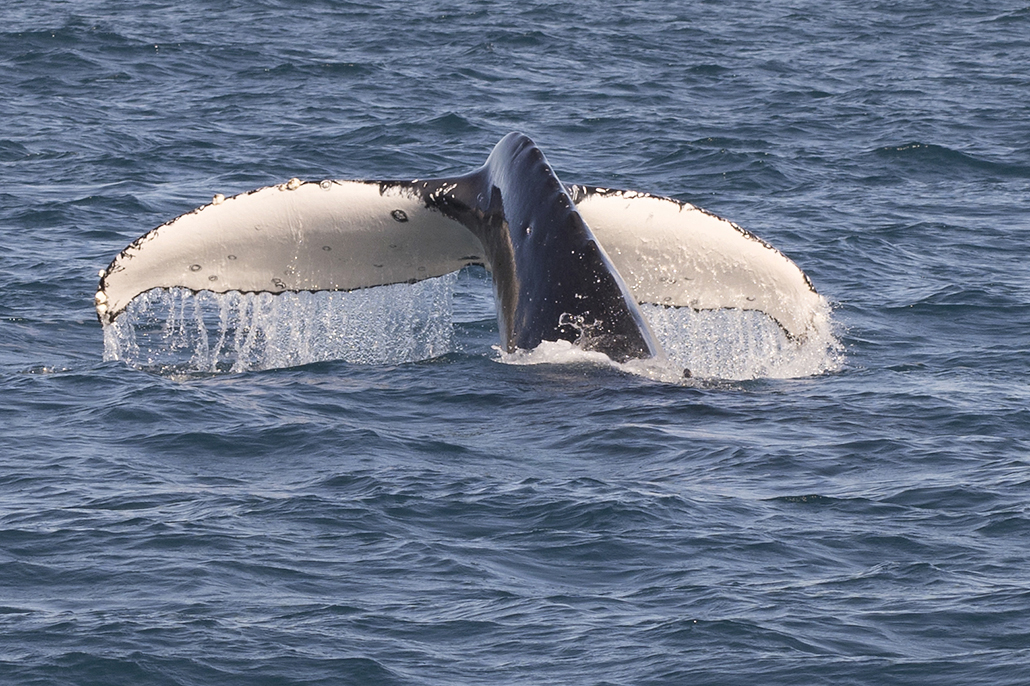
A humpback whale slips beneath the surface during the annual whale-watching season in Hervey Bay.
THE FIRST sign may be little more than a puff of white on the horizon, or it may appear right behind you.
On a recent tour with Whalesong Cruises, many of the other passengers had gathered at what is often considered the best vantage point: the bow. It offers exciting, unobstructed views of whales surfacing ahead, although it can also be the bumpiest part of the boat.
As someone prone to seasickness, I played it safe. Even though I’d taken medication beforehand, I found a seat at the stern, where the ride tends to be smoother. It was closer to the engines and a little louder, but I was in for a lovely surprise.
With my Canon EOS R5 and 100–400mm lens poised, I was scanning the side horizon when I heard a sudden blow behind my seat and saw spray shoot into the air. I turned to find a humpback had approached us from behind.
Whale-watching boats must follow laws governing how closely they can approach the whales. The whales, however, are curious creatures and sometimes decide to come closer to investigate us.
At that distance, my 100–400mm lens was far too long to capture the whole whale. Fortunately, my Samsung Galaxy S22 Ultra was dangling from my wrist, ready to catch what remained of the moment.
It was also a timely reminder that there is no single “best” place to stand on a whale-watching boat. While everyone is scanning the water ahead, a whale may surface beside you, or sneak up from behind.
Sometimes, the first sign is that fleeting puff of spray. Then comes the curve of a dark back, a fin raised above the water or, if luck and a lively whale are on your side, 40 tonnes of humpback launching into the air before landing in an explosion of white water.
Whale watching is always unpredictable. That is part of its magic. Yet in Hervey Bay, the experience is different from watching whales hurry past a headland on their annual migration.
The humpbacks that enter the bay often stay for days rather than merely passing through. In the comparatively calm, sheltered waters between the mainland and K’gari (Fraser Island), they rest, socialise and investigate their surroundings. Later in the season, mothers bring their calves into the bay to nurse and gather strength for the long journey south.
This special relationship between the whales and the local community helped Hervey Bay become the world’s first designated Whale Heritage Site in 2019. It remains one of Australia’s most rewarding places to see humpback whales in the wild; not simply because they visit in considerable numbers, but because they often appear to be in no great hurry to leave.
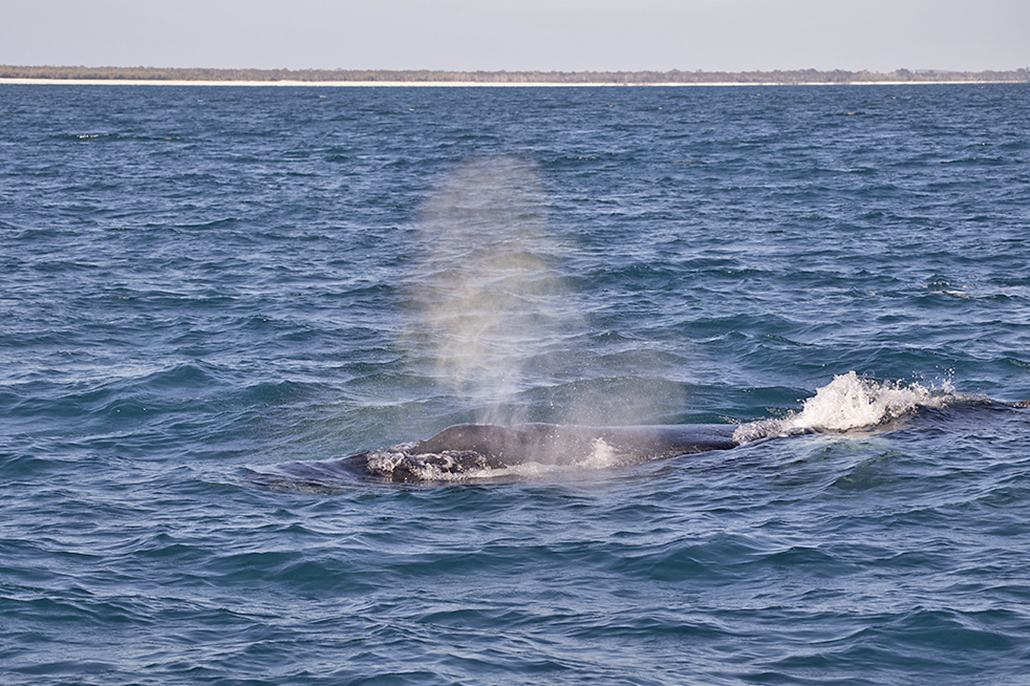
A puff of white spray is often the first sign that a humpback whale has surfaced nearby.
When is whale-watching season in Hervey Bay?
Hervey Bay’s whale-watching season generally runs from mid-July until late October, although whales are wild travellers and do not consult a calendar before setting off.
The timing and behaviour of the whales vary throughout the season. Early arrivals tend to include younger whales and lively social groups. As winter gives way to spring, mothers and calves become the main attraction on their southern migration.
There is no single “wrong” month to go. The best time depends on what you most hope to see.
July: the first arrivals
The first humpbacks usually begin entering Hervey Bay in July, with numbers building as the month progresses.
These early visitors are often juveniles, sub-adults and adults making their way south from the breeding grounds. They may form social groups, practise surface behaviours or show a healthy curiosity about the boats around them.
July has a pleasing sense of anticipation. The season is gathering momentum, crews are back on the water and every new arrival feels like a small announcement that the whales have returned.
It can also be a good time for energetic displays such as:
- breaching;
- tail slapping;
- pectoral-fin slapping;
- spy-hopping, when a whale raises its head vertically above the surface; and
- close approaches to vessels.
Not every operator begins on the same date, and early-season sighting guarantees may not yet apply, so check the details before booking.
August: peak numbers and social activity
By August, the season is in full swing. Whale numbers are generally high, cruise choices are plentiful, and the bay can be alive with social activity.
Young humpbacks are among the most entertaining visitors. Curious sub-adults sometimes approach a stationary boat and remain nearby, occasionally circling or swimming beneath it. This is commonly called mugging, although, unlike its city namesake, it generally leaves passengers delighted and still in possession of their valuables.
August is an excellent choice for first-time whale watchers and photographers hoping to see a variety of behaviours. It is also popular, particularly during weekends and major events, so it pays to book cruises and accommodation ahead.
September: mothers and calves take centre stage
If July is the overture and August the lively middle act, September brings a change in mood.
Mothers and their calves arrive in greater numbers as they migrate south. Hervey Bay’s protected waters provide a valuable place to rest, nurse and prepare for the journey towards the Southern Ocean.
For whale watchers, this can be one of the most endearing stages of the season. Calves must learn the physical and social skills they will need as adult whales, and their early efforts can be exuberant. You may see a young whale practising breaches, tail slaps and pectoral-fin slaps while its mother rests nearby.
The smaller whale is still an impressive animal, of course. ‘Baby’ is a relative term when the baby in question is several metres long and capable of drenching half a viewing deck.
September often offers the most dependable combination of strong whale numbers, mothers and calves, comfortable spring weather and a full choice of tours. It is also one of the most popular times to visit.
October: the final journey south
During October, mothers and their increasingly strong calves continue south. The season gradually winds down, but that does not make its final weeks an afterthought.
Early October can still produce beautiful encounters with family pairs lingering in the bay. There may be fewer boats on the water, too, giving the day a quieter feel.
As the month progresses, whale numbers and cruise choices generally decline. Operators finish their seasons on different dates, and sighting guarantees may end before the final scheduled tour. Confirm that your chosen cruise is operating and read its current terms before arranging the rest of your visit.
The short answer: August is hard to beat for high numbers and energetic social whales, while September is the spring sweet spot for mothers and calves. Early October can reward travellers seeking a quieter experience, provided tours are still running.
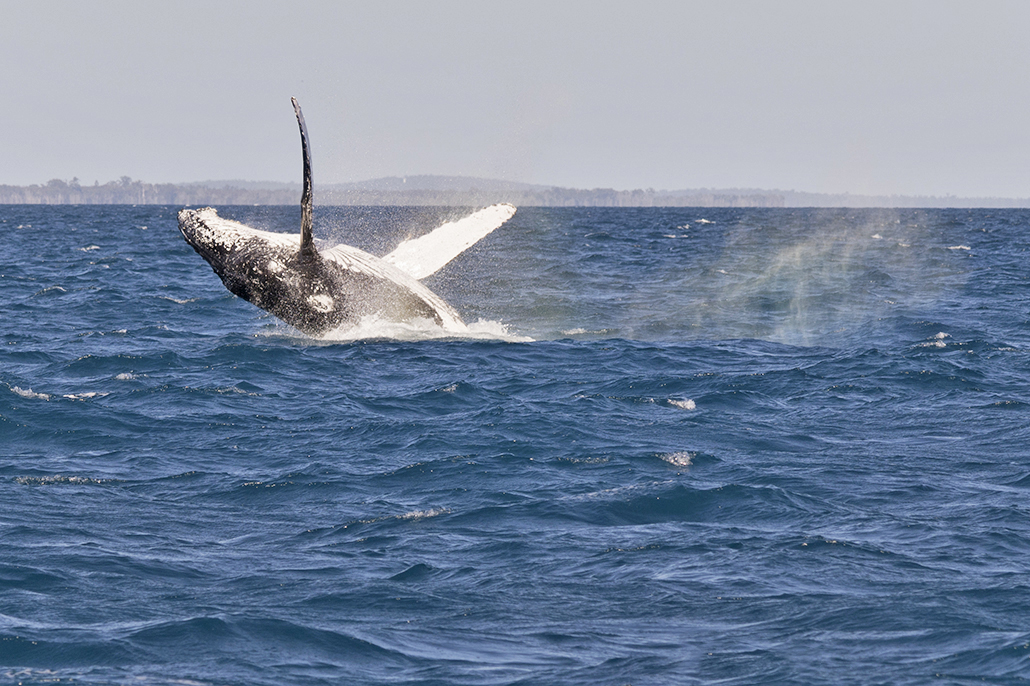
A lively humpback launches from the water, one of the whale season’s most exhilarating sights.
Why do humpback whales stop in Hervey Bay?
Humpback whales migrate along Australia’s east coast each year between the cold, food-rich waters of Antarctica and their warmer breeding grounds to the north.
Hervey Bay sits beside this migratory route, but its importance goes beyond geography. K’gari helps shelter the bay from the open ocean, creating comparatively calm, shallow waters where whales can pause.
The stopover serves different purposes throughout the season. Younger whales socialise and appear to practise adult behaviours. Mature animals rest and interact. Mothers later use the bay as a nursery, nursing their calves and allowing them time to develop before continuing south.
Research cited by Fraser Coast Tourism & Events indicates that mature females may remain for just over a week, while mothers with calves can stay for up to two weeks. For visitors, that means the possibility of longer, more relaxed encounters than those experienced at locations where whales are mainly travelling past.
It is important, though, to allow the whales to set the terms. Responsible operators must follow approach rules, reduce speed and maintain required distances. If a whale chooses to come closer, the vessel may need to remain stationary until it moves away.
That is when a scheduled cruise can suddenly become wonderfully unscheduled.
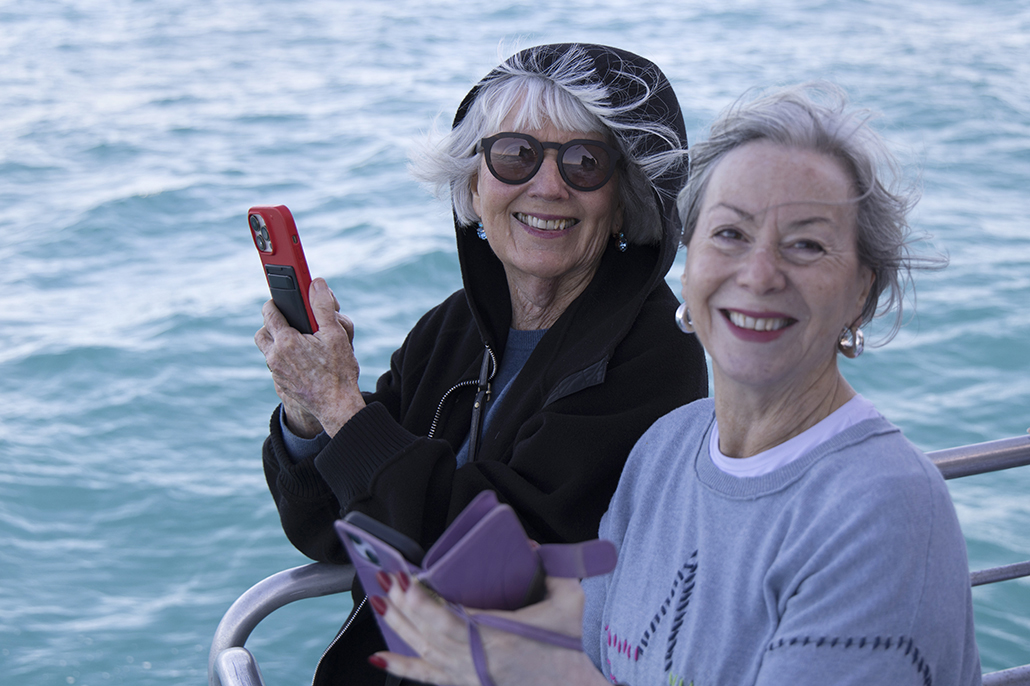
Paris Ink co-authors Penelope Jools and Julia Audova enjoy some time on the water during CWIP Publishing’s Hervey Bay writers’ retreat.
What might you see on a whale-watching cruise?
No two trips are the same, and no ethical operator can promise a breach on cue. Depending on the day and the stage of the season, you may see:
- a blow as the whale exhales at the surface;
- the arched back and dorsal fin as it swims;
- a tail fluke lifted before a deeper dive;
- breaching;
- tail and pectoral-fin slapping;
- spy-hopping;
- mothers resting or travelling with calves;
- calves nursing or practising surface behaviours;
- social groups interacting; or
- curious whales approaching and lingering near the boat.
Keep an eye out for other wildlife as well. Dolphins, turtles, seabirds and, with a little luck, dugongs may also be seen in the Great Sandy Strait and surrounding waters.
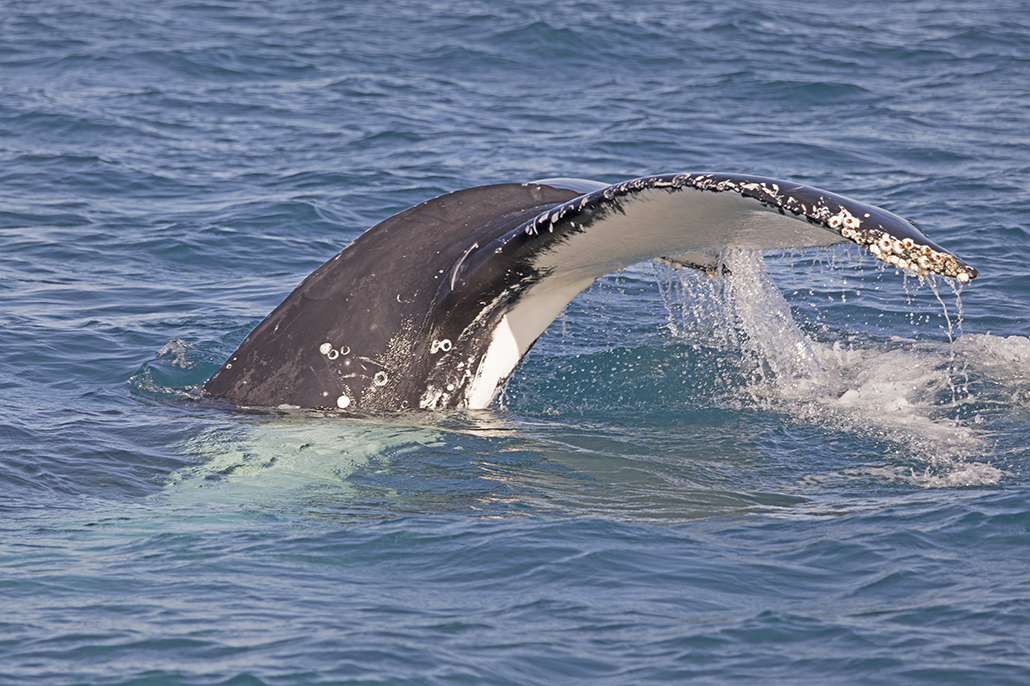
A close encounter reveals the markings and barnacles on the underside of a humpback whale’s tail.
How to choose the best Hervey Bay whale-watching cruise
There is no single cruise that will be “best” for everybody. A keen photographer, a family with young children and a traveller using a wheelchair may each need something quite different.
Hervey Bay’s fleet ranges from smaller vessels and sailing catamarans to larger boats with several viewing levels. Tours can run for around three hours, a half-day or a full day, and some combine whale watching with time on or around K’gari.
Before booking, compare:
- cruise duration;
- passenger capacity;
- viewing areas and rail height;
- indoor seating, shade and protection from wind;
- food and drinks included;
- toilets and accessibility;
- minimum ages;
- transfers from local accommodation;
- conservation or research programs;
- sighting-guarantee dates and conditions; and
- cancellation arrangements if weather intervenes.
Which style of cruise may suit you?
| If you are… | Look for… |
| A first-time whale-watcher | A half-day cruise with good commentary, several viewing areas and shelter |
| A keen photographer | Clear sightlines, space to move, a lower viewing deck and manageable passenger numbers |
| Travelling with children | Shade, toilets, food, a suitable duration and an operator that accepts children of their age |
| Short on time | A three-hour or half-day cruise |
| Seeking a leisurely outing | A longer cruise with meals or refreshments included |
| Interested in conservation | Marine-naturalist commentary, research links or recognised ecotourism credentials |
| Visiting K’gari as well | A combined whale-and-island experience |
| Travelling with limited mobility | Step-free or ramp access, suitable gangways, accessible toilets and seating on the accessible deck |
Current Hervey Bay operators include Whalesong Cruises, Hervey Bay Whale Watch aboard Quick Cat II, Pacific Whale Foundation Eco-Adventures, Tasman Venture, Spirit of Hervey Bay, Blue Dolphin Marine Tours and Hervey Bay Dive Centre.
Tour offerings change, so treat the names as a starting point rather than a ranking. Check each operator’s current schedule and choose the boat and experience that best match your priorities.
Morning or afternoon: which is better?
Whales do not become more cooperative simply because you booked the 7 am departure. Their behaviour can change from hour to hour, but it is not reliably better at one particular time of day.
Choose according to the weather forecast, your comfort and the rhythm of your visit.
A morning cruise may suit you if:
- you prefer cooler conditions;
- the forecast suggests lighter winds early;
- you like softer morning light;
- you want the afternoon free to explore; or
- you are comfortable with an early check-in.
An afternoon cruise may suit you if:
- you prefer a slower start;
- you are arriving in Hervey Bay that morning;
- you enjoy warmer conditions; or
- the cruise offers late-afternoon light or a sunset return.
Sea breezes can strengthen later in the day, although local conditions vary. If you are prone to seasickness, check the marine forecast and ask the operator for advice rather than relying on a blanket rule.
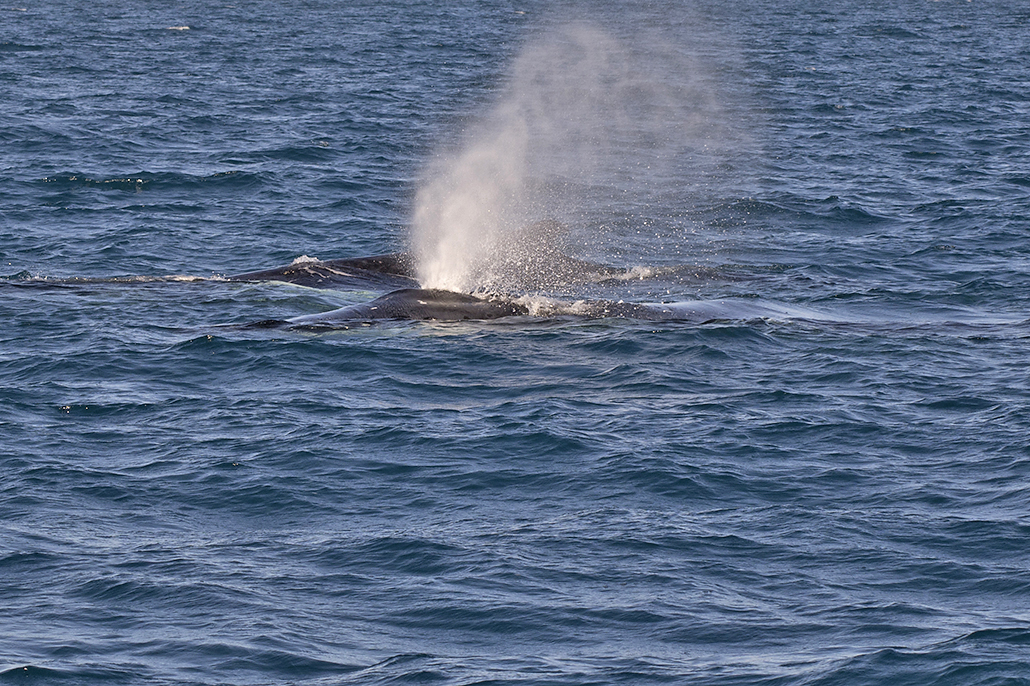
Hervey Bay provides sheltered waters where humpbacks can rest, socialise and investigate their surroundings.
Whale photography tips that help
Photographing a whale from a moving boat is a useful lesson in humility. The whale surfaces where it chooses, the deck moves beneath you and another passenger’s hat can develop an uncanny instinct for entering the frame at precisely the wrong moment.
A few simple settings and habits improve the odds.
Use a fast shutter speed
For breaches and other energetic behaviour, begin around 1/1000 second or faster if the light allows. A slower speed may be sufficient for a resting whale or a tail fluke, but boat movement can introduce blur even when the animal seems still.
Use continuous autofocus and burst mode
Continuous autofocus helps track a moving whale, while a controlled burst gives you several frames through the peak of an action. Avoid holding the shutter down indiscriminately unless you fancy sorting through 700 nearly identical photographs of splash.
Do not zoom in too tightly
Start with a little more room around the whale than you think you need. A breach can rise well beyond the frame, and it is easier to crop later than reconstruct a missing tail.
A flexible telephoto zoom is particularly useful. On a full-frame camera, a lens in the 100–400mm range offers reach while still allowing you to pull back quickly when a whale approaches. A phone or wider lens is valuable for whales close to the boat and for showing the scale of the encounter.
Watch the whale, not the screen
Look for patterns. A whale may surface several times before diving, and the direction of travel can help you anticipate where it will reappear. Listen to the crew, who are skilled at reading behaviour and spotting activity.
Reviewing every image immediately is a fine way to miss what happens next.
Brace yourself safely
Keep your stance wide and stable, use the railing for balance when appropriate and follow crew directions. A neck or cross-body strap adds security, but make sure it cannot snag as you move around other passengers.
Protect your equipment
Carry a lens cloth and a small waterproof bag or cover. Sea spray leaves marks that become surprisingly obvious against dark water or a clean blue sky. Pack a spare battery and memory card, and check both before departure.
Most importantly, take time to look without the camera. A sharp photograph is satisfying; seeing a humpback rise beside the boat with your own eyes is the part you are likely to remember.
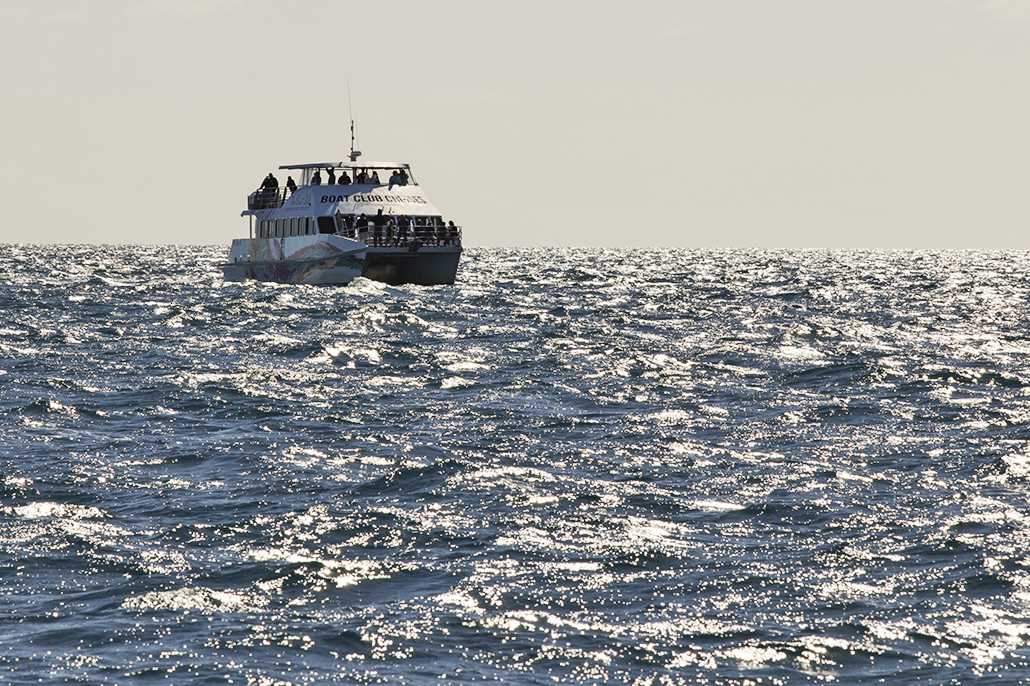
Whale-watching vessels must maintain regulated approach distances, but curious humpbacks sometimes choose to come closer.
What to wear and pack
A calm, sunny morning at the marina can become cool once the boat gathers speed. Dress for conditions on the water, not merely those beside your parked car.
Pack:
- layered clothing;
- a wind-resistant jacket;
- a securely fitted hat;
- sunglasses;
- sunscreen;
- comfortable shoes with non-slip soles;
- a reusable water bottle;
- a camera or phone;
- a spare battery or power bank;
- binoculars, if you enjoy using them;
- a lens cloth;
- a small waterproof bag; and
- any medication you may need.
If you are susceptible to motion sickness, speak with a pharmacist or health professional before the trip and take any recommended medication at the correct time. Waiting until you feel unwell is generally too late.
Some cruises include meals, snacks and drinks; others offer them for sale or expect passengers to bring their own. Check before you pack half the pantry.
Accessibility and comfort
“Accessible” can mean different things on different vessels, so it is worth discussing your particular needs with the operator before booking.
Ask about:
- accessible parking and drop-off points;
- the distance from parking to check-in;
- ramps, steps and gangway gradients;
- whether a wheelchair or walker can remain in use during boarding;
- which decks are accessible;
- accessible toilet facilities;
- seating with back support;
- shade and enclosed areas;
- assistance for hearing, vision or sensory needs;
- dietary requirements; and
- room for a carer or companion.
Whalesong advertises wheelchair ramps, an accessible toilet, communication boards and audio guides. Quick Cat II promotes wheelchair and pram access around its main deck. These features may make either vessel worth investigating, but tide levels, gangway angles and individual mobility can affect boarding on the day.
Explain your requirements clearly when booking rather than assuming the word “accessible” covers them. The operator is best placed to advise what is practical and safe.
Travellers who tire easily may also prefer a shorter cruise, a sheltered seat and accommodation close to the marina. Accessibility is not only about whether wheels can cross a gangway; it is about whether the entire experience is comfortable and enjoyable.
Stay close to the whales
Turn your whale-watching cruise into a relaxing coastal break at Oaks Hervey Bay Resort and Spa. Its spacious apartment-style accommodation and location near the Great Sandy Straits Marina make it a convenient base for early departures—and a comfortable place to unwind afterwards.
Check rates and availability at Oaks Hervey Bay Resort and Spa
Affiliate link: JM may earn a commission if you book through this link, at no extra cost to you.
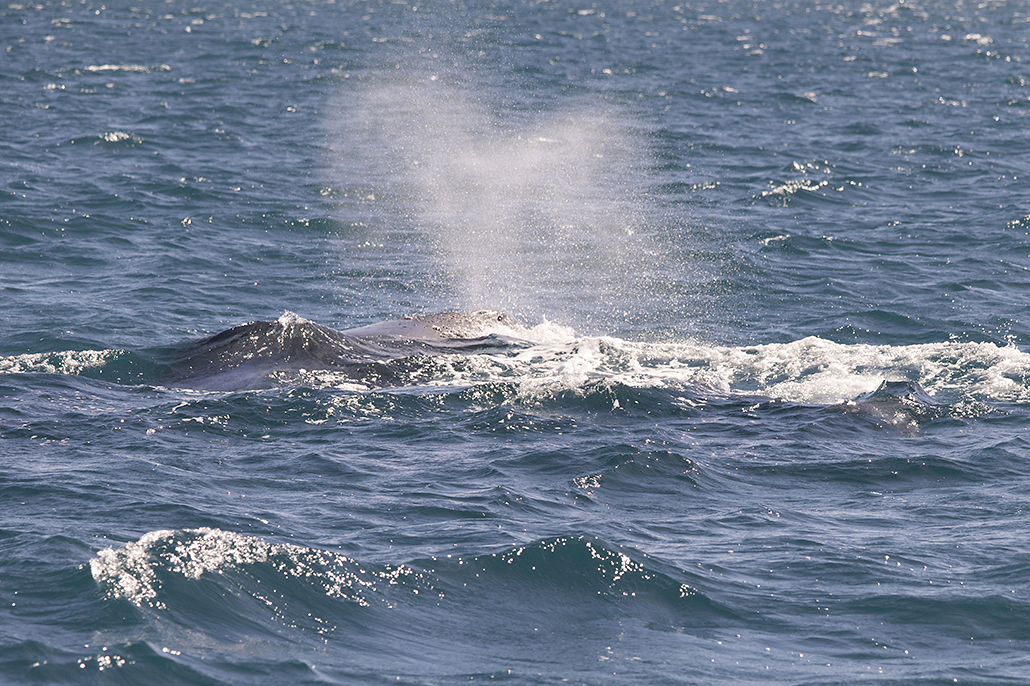
Splashes and sudden bursts of spray can signal energetic whale activity just beneath the surface.
Turn your whale-watching cruise into a coastal escape
Where to stay for a Hervey Bay whale-watching escape
Staying overnight removes the pressure of driving into Hervey Bay immediately before an early cruise and gives you time to enjoy the coast once you return.
The Great Sandy Straits Marina
Accommodation around The Great Sandy Straits Marina is convenient for early whale-watching departures. You will be close to the boats, marina restaurants and the Great Sandy Strait, with less distance to cover at the beginning of the day.
Urangan Esplanade
Stay near the Hervey Bay waterfront and leave time for Urangan Pier, the Esplanade and a leisurely meal after your day on the water.
The Urangan end of the Esplanade suits travellers who want waterfront walks, cafés and easy access to Urangan Pier.
Oaks Hervey Bay Resort and Spa, opposite the waterfront near Urangan Pier, offers self-contained one, two and three-bedroom apartments, two swimming pools and on-site facilities. Its apartment-style accommodation may be especially useful for couples planning a longer stay, families or friends sharing a whale-watching weekend.
Check availability at Oaks Hervey Bay Resort and Spa
Torquay or Scarness
Torquay and Scarness offer a more central Esplanade base, with casual dining, beaches and foreshore paths nearby. Allow extra time to drive to the marina and park before check-in.
Wherever you stay, confirm the cruise departure point. Most tours leave from the Great Sandy Straits Marina in Urangan, but arrangements can differ.
Make a weekend of it
Whale watching may be the reason for the visit, but it need not be the entire itinerary.
After your cruise, you might:
- walk part or all of Urangan Pier;
- visit the Hervey Bay Botanic Gardens;
- have lunch or dinner overlooking the marina;
- follow the Esplanade between Urangan, Torquay and Scarness;
- learn more about the region’s marine life at the Fraser Coast Discovery Sphere;
- add a day trip or longer stay on K’gari; or
- book another cruise and discover just how different two days on the same bay can be.
Allowing two or three nights also gives you some flexibility if strong winds or unsuitable conditions cause a tour to be rescheduled.
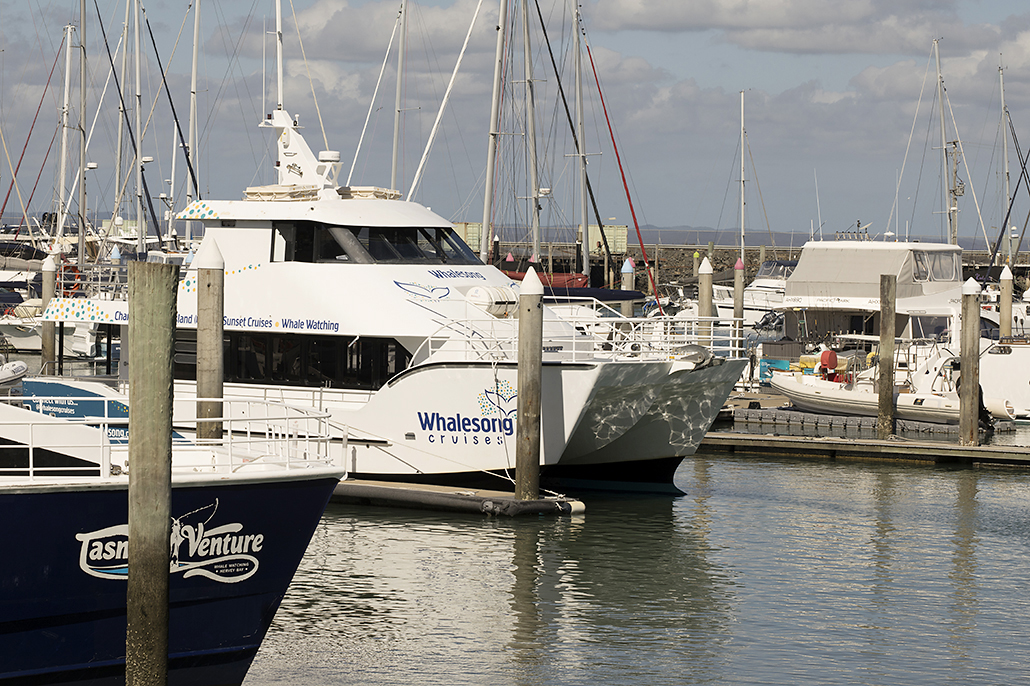
Whalesong Cruises and Tasman Venture at the Great Sandy Straits Marina, where several Hervey Bay whale-watching cruises depart.
Frequently asked questions
When is the best month for whale watching in Hervey Bay?
August generally offers high whale numbers and lively social activity. September is particularly rewarding for mothers and calves. The “best” month depends on the experience you prefer.
Is September a good time to see whales?
Yes. September is often considered the spring sweet spot, when mothers and calves become more prominent while a broad choice of cruises is still operating.
Can I see whales in October?
Yes, particularly in early October, when mothers and calves may still be resting in the bay before continuing south. Numbers and tour availability decline as the month progresses, so check current schedules.
Are whale sightings guaranteed?
Some operators offer a sighting guarantee during specified dates, usually in the core season. The remedy is commonly a complimentary return trip rather than a refund. Read the operator’s current terms, as guarantee periods may not cover the first or final weeks.
Are whales more active in the morning?
There is no reliable daily timetable for whale behaviour. Choose a departure that suits your schedule, comfort and the weather forecast.
Will I get seasick?
Hervey Bay is sheltered by K’gari, but it is still a marine environment and conditions can change. If you are prone to motion sickness, seek advice before the cruise, consider an earlier departure when lighter winds are forecast and choose a seat with fresh air and a view of the horizon.
Are Hervey Bay whale-watching boats wheelchair accessible?
Some vessels advertise wheelchair access and accessible toilets, but facilities and access to individual decks vary. Contact the operator before booking and explain your specific mobility and transfer needs.
How far ahead should I book?
Book as early as possible for weekends, school holidays and the popular mother-and-calf period in September. Early booking also gives you a better choice of vessels and departure times.
What happens if the weather is poor?
The operator may delay, reschedule or cancel a tour if conditions are unsafe. Check the cancellation policy and keep your contact details current. Travel insurance may be worth considering if the cruise is part of a larger trip.
A season of different stories
Hervey Bay’s whale season does not deliver the same performance for four months. It unfolds in chapters.
July announces the first arrivals. August fills the bay with youthful energy and social encounters. September welcomes mothers and calves into their sheltered nursery. October offers the final, sometimes quieter days before the whales continue south.
Whichever chapter you choose, go prepared, but leave room for the unexpected. The weather may change, the whales may ignore the script, and the photograph you planned may never materialise.
Then a calf may breach beside the boat, a curious humpback may rise close enough for you to hear it breathe, and the carefully planned day will become memorable for reasons no itinerary could promise.
In Hervey Bay, the whale-watching season is not merely something to observe. For a few hours on the water, it is something you feel part of.
Useful links and editorial sources
- Fraser Coast Tourism: Whale Watching in Hervey Bay
- Fraser Coast Tourism: Everything You Need to Know Before You Go
- World Cetacean Alliance: Hervey Bay Whale Heritage Area
- Whalesong accessibility information
- Quick Cat II vessel and accessibility information
- Oaks Hervey Bay Resort and Spa
Editorial note: Confirm operator names, operating dates, departure times, prices, inclusions, accessibility arrangements and sighting-guarantee terms before booking. The article was written using information current on 1 August 2026.
Plan your Hervey Bay whale-watching escape
A little forward planning can make your time on the Fraser Coast considerably smoother, leaving you free to concentrate on spotting blows, breaches and the occasional curious whale beside the boat.
Arrange travel insurance
Travel insurance may provide cover for selected unexpected events before or during your Australian holiday. Check the policy details, limits and exclusions carefully to ensure the cover suits your circumstances.
Explore travel insurance with AllClear
Hire a car for the Fraser Coast
A hire car gives you the flexibility to travel between your accommodation, the Great Sandy Straits Marina and other Fraser Coast attractions at your own pace.
Check Avis car hire options and rates
Keep your travel essentials organised
From packing cubes and toiletry bags to camera and tech organisers, Bagsmart offers practical accessories for keeping everything in its place—at least until you begin hunting for that spare camera battery.
Browse travel organisers and bags at Bagsmart
This block contains affiliate links. If you make a purchase or booking through one of these links, JM may earn a commission at no extra cost to you. Always check prices, terms, exclusions and product suitability directly with the provider.
Queensland’s First Dark Sky Reserve Opens in the Sunshine Coast Hinterland
BY DAY, the Sunshine Coast Hinterland is known for rainforest walks, waterfalls, artisan villages and sweeping views over the Glasshouse Mountains. But now, when the sun goes down, it offers something just as spectacular.
In June 2026, the Sunshine Coast Hinterland was officially recognised as Queensland’s first Dark Sky Reserve — only the second in Australia — marking a major milestone for regional tourism and conservation.
- This article contains affiliate links. If you book or buy through them, Jocelyn Magazine may earn a small commission at no extra cost to you. This helps support independent publishing and storytelling.
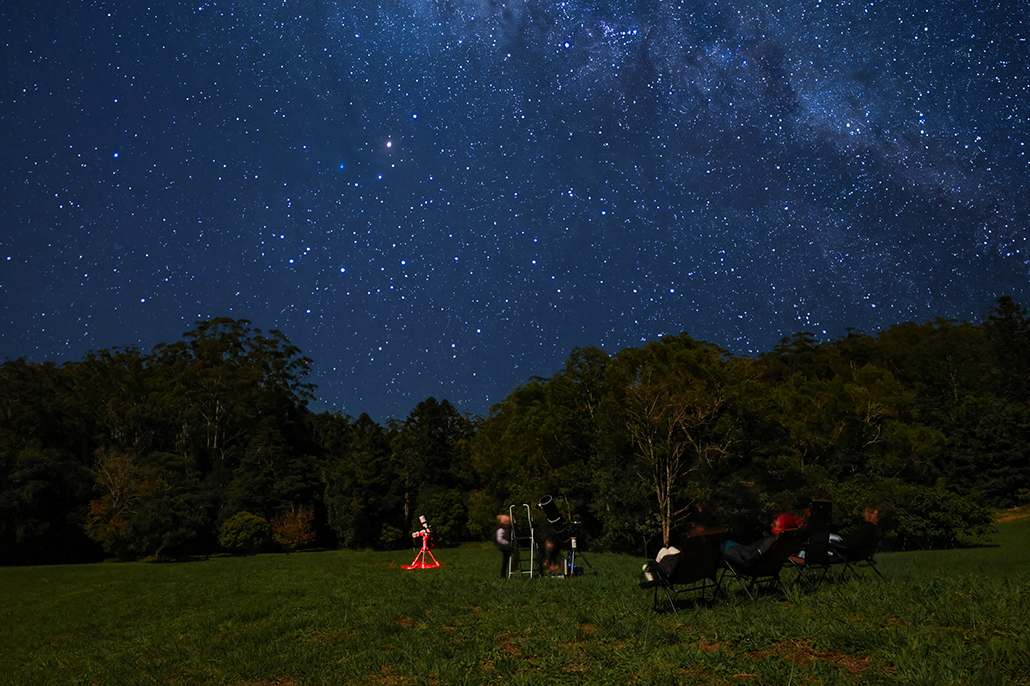
Clear skies and low light pollution make the Sunshine Coast Hinterland one of Queensland’s best new stargazing destinations.
A New Chapter in Queensland’s Nature Tourism
Stretching across 870 square kilometres, the reserve covers parts of the Blackall Range and surrounding hinterland communities including Maleny, Montville, Mapleton, Witta, Flaxton, Kenilworth and Conondale. The designation recognises the area’s exceptionally low levels of light pollution, making it one of the most accessible places in Australia for stargazing.
On clear nights, visitors can see up to 2000 stars with the naked eye; a stark contrast to city centres like Brisbane, Sydney and Melbourne, where light pollution often limits visibility to fewer than ten.
The reserve’s elevated landscape and distance from major urban centres help shield it from skyglow, creating ideal conditions for viewing constellations, meteor showers and the shimmering band of the Milky Way. It also complements the Sunshine Coast’s existing UNESCO Biosphere status, strengthening the region’s reputation as a destination where nature remains front and centre.
For travellers, the appeal is simple: you can spend the afternoon on the coast, then be in the hinterland less than an hour later, wrapped in a blanket beneath one of Queensland’s darkest skies.
To coincide with the reserve’s launch, several new and existing stargazing experiences are stepping into the spotlight.
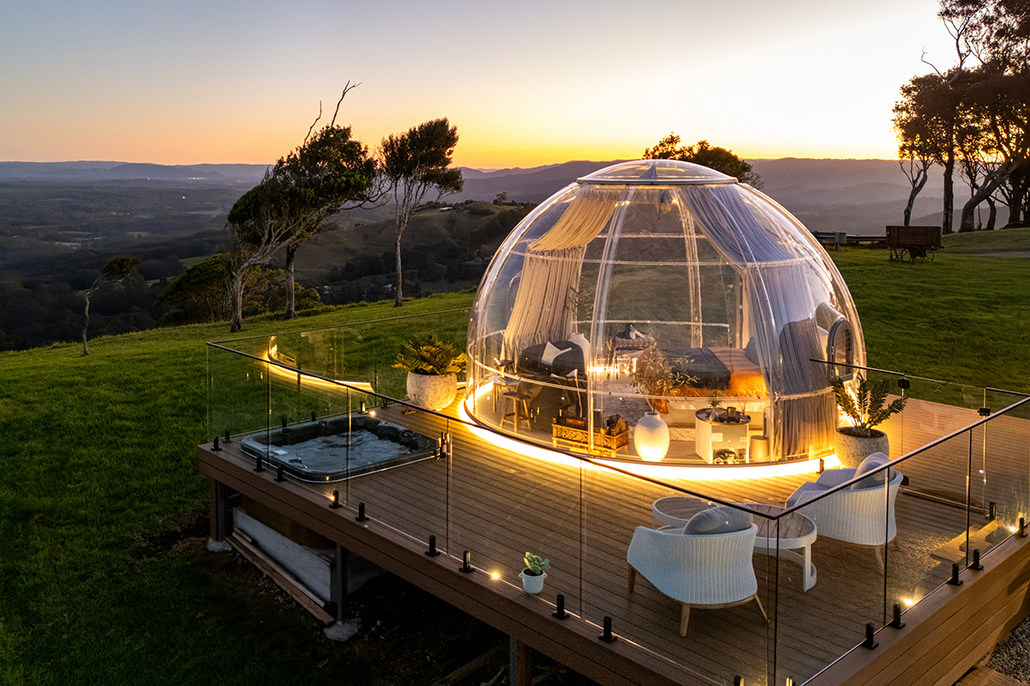
Fall asleep under the stars at Petrichor Estate’s Magical Dome.
Stargazing Essentials
Planning a night under the stars? A few simple extras can make the experience even better.
Think binoculars for closer sky viewing, a red-light torch to protect your night vision, a thermos for something warm, and a beginner’s guide to the constellations.
You can find practical stargazing gear and travel-friendly astronomy books through Amazon Australia before you go.
Where to Experience the Night Sky
Sunshine Coast Stargazing has introduced a new 90-minute small-group experience combining astronomy, astrophotography, storytelling and mindfulness. Hosted by local guides Nate and Kavita, the experience includes telescope viewing, a laser-guided sky tour, warm drinks and treats.
For couples looking to make a weekend of it, Narrows Escape Rainforest Retreat has launched a “Starstruck” package, pairing luxury accommodation with a guided stargazing session, gourmet meals and hinterland picnic experiences.
Other after-dark options include seasonal Night Sky Journeys with Mystic Mountain Tours, while Petrichor Estate’s transparent luxury dome offers a more private way to sleep beneath the stars.
For independent travellers, local lookouts like Balmoral Ridge, Howells Knob and Little Yabba Rest Area provide easy access to the reserve’s expansive night skies.
Whether you’re an astronomy enthusiast, a photographer chasing the Milky Way, or simply someone craving a quieter kind of escape, the Sunshine Coast Hinterland’s new Dark Sky Reserve offers a reminder that some of the best travel experiences begin after dark.
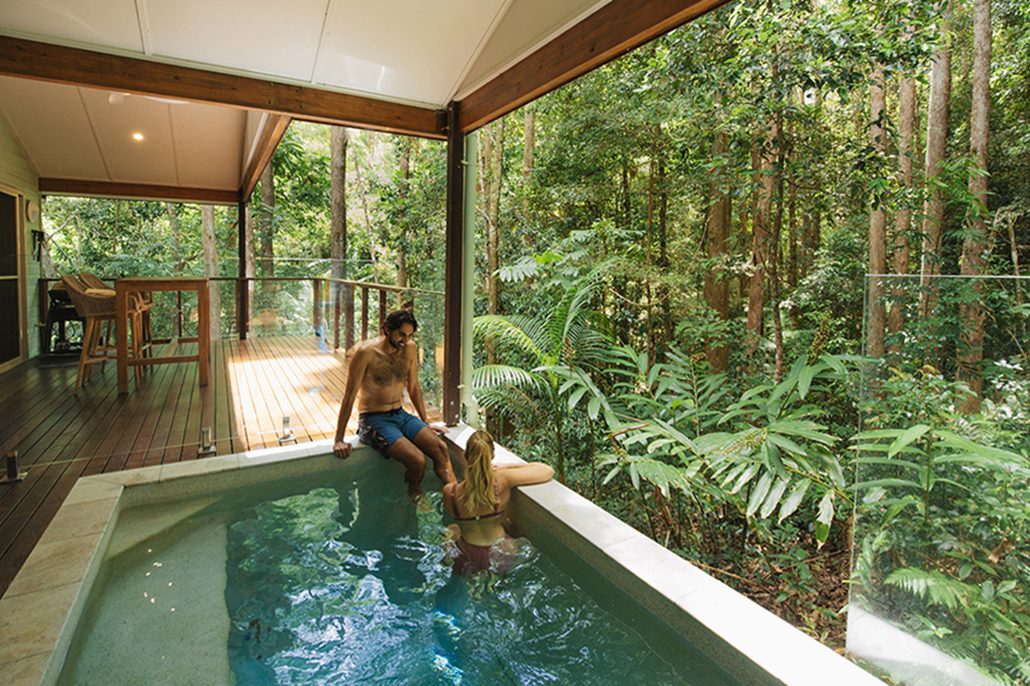
Narrows Escape pairs rainforest luxury with guided stargazing in its Starstruck package.
Before You Chase the Stars
A little planning goes a long way when heading into the hinterland after dark.
🚗 Avis Car Rentals — for flexible road trips and scenic detours through the Sunshine Coast Hinterland.
🛡️ AllClear Travel Insurance — extra peace of mind for regional getaways, especially if travelling with pre-existing medical conditions.
🎒 BagSmart — handy organisers for cameras, binoculars, cables and all the bits that somehow multiply when travelling.
Source material and images courtesy of Visit Sunshine Coast.
Whale season is coming: Hervey Bay’s 2026 season runs July–October, with peak sightings in August–September. If you’re ready to plan, jump straight into Whale Watching Hervey Bay to compare tour operators, departure times and package options. Book early to secure your spot.
Whale Watching in Hervey Bay: A First-Time Visitor’s Guide
TO STAND on the deck of a boat while a 40-tonne humpback whale surfaces nearby has a way of putting everyday worries into perspective. You arrive hoping to see whales. You often leave with a renewed appreciation for the natural world.
Every winter, thousands of humpback whales visit the calm waters of Hervey Bay during their annual migration along Australia’s east coast. For many visitors, it’s a bucket-list experience. For locals, it’s one of the highlights of the year.
If you’re planning your first whale-watching cruise, here are 11 things worth knowing before you go.
- This article contains affiliate links. If you purchase through these links, Jocelyn Magazine may earn a small commission at no extra cost to you.
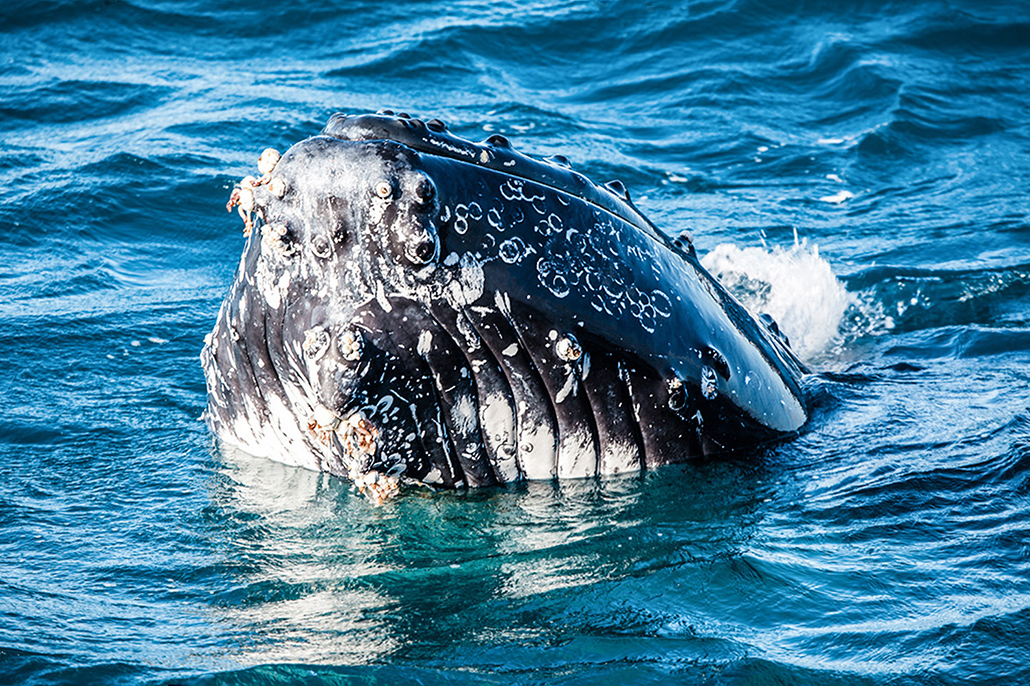
Close-up of a humpback whale surfacing near a whale watching vessel in Hervey Bay, showing barnacles and distinctive markings.
1. Hervey Bay is one of the world’s best whale watching destinations
Whale watching is available in many parts of Australia, but Hervey Bay is unique.
The bay’s sheltered waters provide a resting place for humpback whales during their migration. Unlike many locations where whales simply pass by, whales often spend days or even weeks in the bay, giving visitors exceptional viewing opportunities.
It’s one of the reasons Hervey Bay has earned an international reputation as a premier whale-watching destination.
2. The season runs from July to October
Whales can begin arriving from mid-July, with numbers generally increasing through August and September.
October often brings excellent opportunities to see mothers travelling south with young calves.
While sightings are possible throughout the season, August and September are usually considered peak whale-watching months.
3. Thousands of humpback whales visit each year
The annual migration is one of nature’s great journeys.
Humpback whales travel thousands of kilometres between their Antarctic feeding grounds and the warmer breeding waters of Queensland and further north.
Many pause in Hervey Bay waters along the way, creating one of Australia’s most spectacular wildlife experiences.
4. The whales aren’t just passing through
One of the most fascinating things about Hervey Bay is that whales often stop here rather than simply continuing their migration.
Researchers have observed whales resting, socialising and caring for calves in the protected waters between the Fraser Coast and K’gari.
That means encounters can be longer and more interactive than in destinations where whales remain constantly on the move.
5. Mothers and calves are often the stars of the show
By late season, many visitors are lucky enough to see mothers travelling with young calves.
Watching a calf surface beside its mother or practise breaching for the first time is something few people forget.
These gentle interactions are among the reasons photographers and wildlife enthusiasts return year after year.
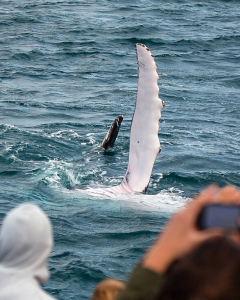
Passengers onboard a whale watching cruise witness a humpback whale surfacing close to the vessel in Hervey Bay.
6. Every whale-watching trip is different
No two cruises are ever quite the same.
One day you might see whales breaching repeatedly. Another day they may approach the vessel, circle beneath the boat or spend time resting near the surface.
Part of the excitement is never knowing exactly what behaviour you’ll witness.
7. Winter is actually the best time to visit
For travellers from southern Australia, this may come as a pleasant surprise.
While much of the country is experiencing cold weather, Hervey Bay often enjoys mild winter days, clear skies and comfortable temperatures.
Whale season coincides with some of the most pleasant weather of the year on the Fraser Coast.
8. You don’t need expensive camera gear
Professional cameras can certainly help, but they’re not essential.
Visitors often capture wonderful memories using smartphones or compact cameras.
In fact, some of the best whale watching experiences happen when you put the camera down for a moment and simply enjoy the encounter.
9. Most tours have excellent sighting success
One of the questions visitors ask most often is whether they’ll actually see whales.
While nature can never offer guarantees, Hervey Bay’s whale-watching operators enjoy very high sighting rates during the season.
Operators often have policies in place should sightings unexpectedly not occur.
10. You may see more than whales
Keep your eyes open throughout the cruise.
Depending on conditions, you may also encounter dolphins, turtles, seabirds and other marine life.
For wildlife lovers, the journey itself can be just as rewarding as the whale encounters.
11. Whale watching has a way of staying with you
Most people book a whale-watching cruise expecting a memorable day on the water.
What often surprises them is the emotional impact.
Seeing a humpback whale in its natural environment creates a sense of scale that’s difficult to describe. Standing beside an animal larger than a bus yet moving with remarkable grace can leave you feeling both humbled and inspired.
It’s one of the reasons so many visitors return to Hervey Bay for whale season year after year.
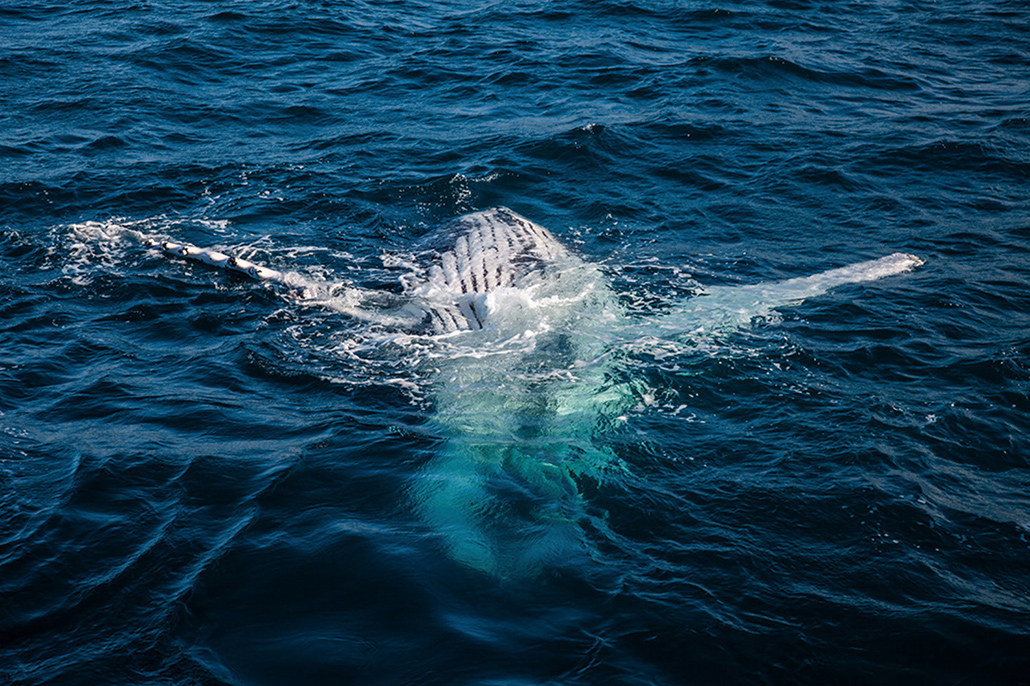
A humpback whale moves just below the waterline in Hervey Bay, offering a glimpse of its striped underside.
Don’t wait until peak season: many tours start filling in August. Visit Whale Watching Hervey Bay to choose your tour below and book now to get the best spot and price.
Planning a Whale Watching Trip to Hervey Bay?
Whether you’re visiting the Fraser Coast for a weekend or a longer Queensland road trip, whale season offers a chance to witness one of Australia’s most remarkable natural spectacles.
Bring a camera, pack a light jacket, and don’t forget to look up from the viewfinder occasionally. Sometimes the most memorable moments are the ones you simply experience.
Make the most of your Fraser Coast getaway with these travel essentials:
Stay Near the Marina
Many whale watching tours depart from Urangan Marina, making nearby accommodation a convenient choice.
Oaks Hotels & Resorts offers a range of accommodation options within easy reach of Hervey Bay’s waterfront, restaurants and tour departure points.
Explore Beyond the Whales
Planning to discover more of the Fraser Coast before or after your cruise? A hire car makes it easy to visit Maryborough, Toogoom, Burrum Heads and other local attractions.
Avis Car Rental offers vehicle hire options for travellers arriving by air, rail or road.
Travel With Confidence
Travel plans don’t always go exactly as expected. Travel insurance may help protect against unexpected disruptions, cancellations and medical expenses.
AllClear Travel Insurance specialises in cover for travellers, including many pre-existing medical conditions.
Disclosure: This article contains affiliate links. If you purchase through these links, Jocelyn Magazine may earn a small commission at no extra cost to you. Thank you for supporting independent publishing.
Photos: Jocelyn Watts
How to Choose Retreat Accommodation in Hervey Bay
A practical, slightly dreamy guide for organising your next group getaway
THERE’S a moment, somewhere between the idea and the booking, when a retreat starts to feel real.
It might begin with a simple thought: What if we brought everyone together? Not just for a holiday, but for something more intentional.
A writers’ retreat. An artists’ gathering. A space to pause, create, and reconnect.
And then comes the big question: Where will everyone stay?
If you’re looking for retreat accommodation in Hervey Bay, the good news is you’re on the right track.
Choosing the right accommodation will shape the entire experience—how people connect, how they unwind, and how easily ideas begin to flow.
*This article contains affiliate links. If you click through and make a purchase, we may earn a commission, at no extra cost to you. It’s how we keep creating helpful stories and guides for you.
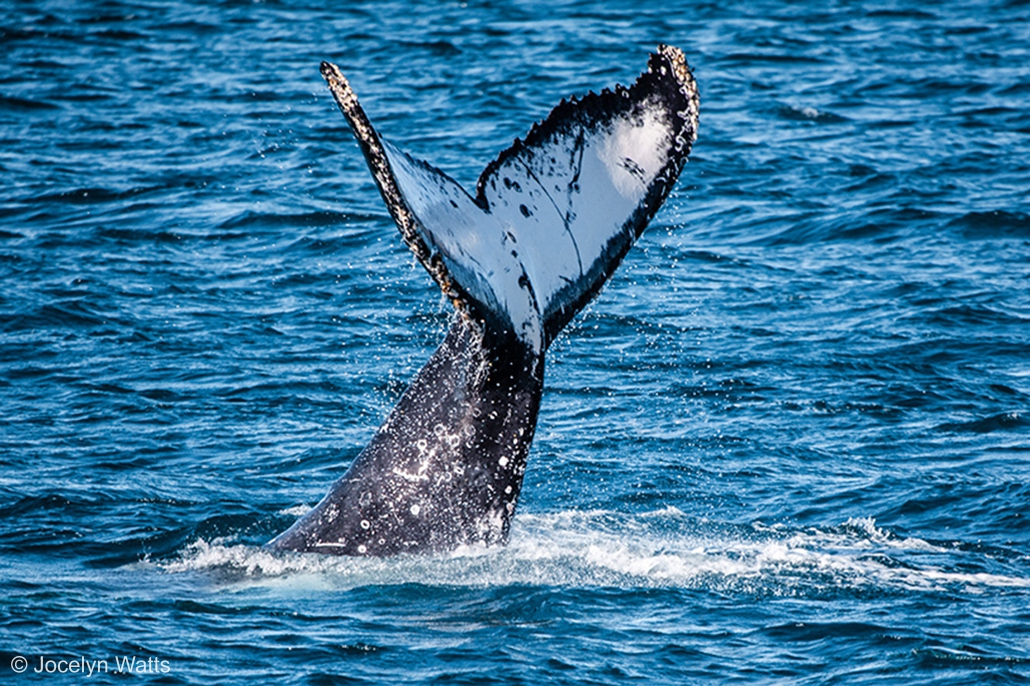
A humpback whale dives beneath the surface, revealing its tail in the calm waters of Hervey Bay, one of the world’s best whale-watching destinations.
Why Hervey Bay Works So Well for Retreats
- Calm, swimmable waters
- Soft coastal light (a dream for photographers and painters)
- A relaxed pace that encourages reflection
- Enough cafés and dining spots to keep things social
It’s the kind of place where mornings start slowly, conversations stretch longer, and ideas seem to land a little more easily.
For a retreat group accommodation in Hervey Bay, the balance between peaceful but not isolated is gold.
Planning your retreat? A few essentials to sort first:
→ Check cover for pre-existing conditions with AllClear Travel Insurance
→ Keep things organised with smart travel gear from Bagsmart
Small things sorted early = a much smoother retreat later.
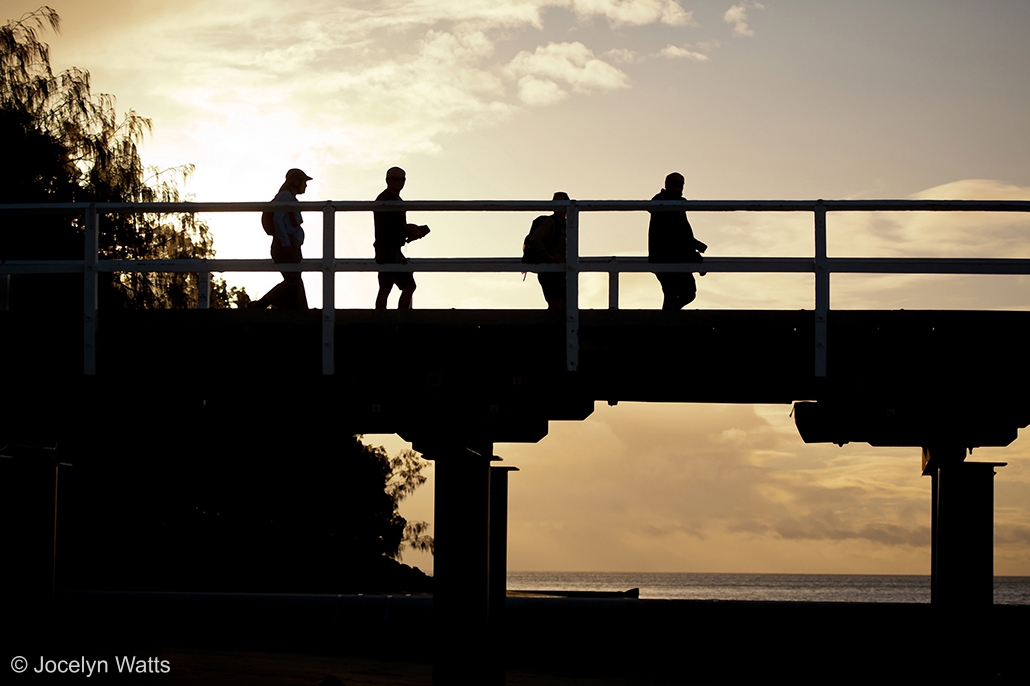
Evening walkers cross Urangan Pier as the sun sets, capturing the unhurried pace of life in Hervey Bay.
The First Big Decision: Together or Nearby?
Before diving into specific places, there’s one key choice to make:
Do you want everyone under one roof, or close by but separate?
Each has its own rhythm.
Option 1: All in One House (Airbnb-style)
- Best for bonding
- Shared meals, spontaneous chats
- Feels like a “real” retreat
Option 2: Apartment Resort (multiple units)
- Private space for each guest
- Flexible budgets
- Still easy to gather
For most creative groups, the sweet spot is often a blend of both: private rooms with shared moments.
Getting around Hervey Bay is easier with your own wheels:
→ Compare local options with Avis Car Rentals
Ideal for group dinners, day trips, or a spontaneous run out to the vineyards.
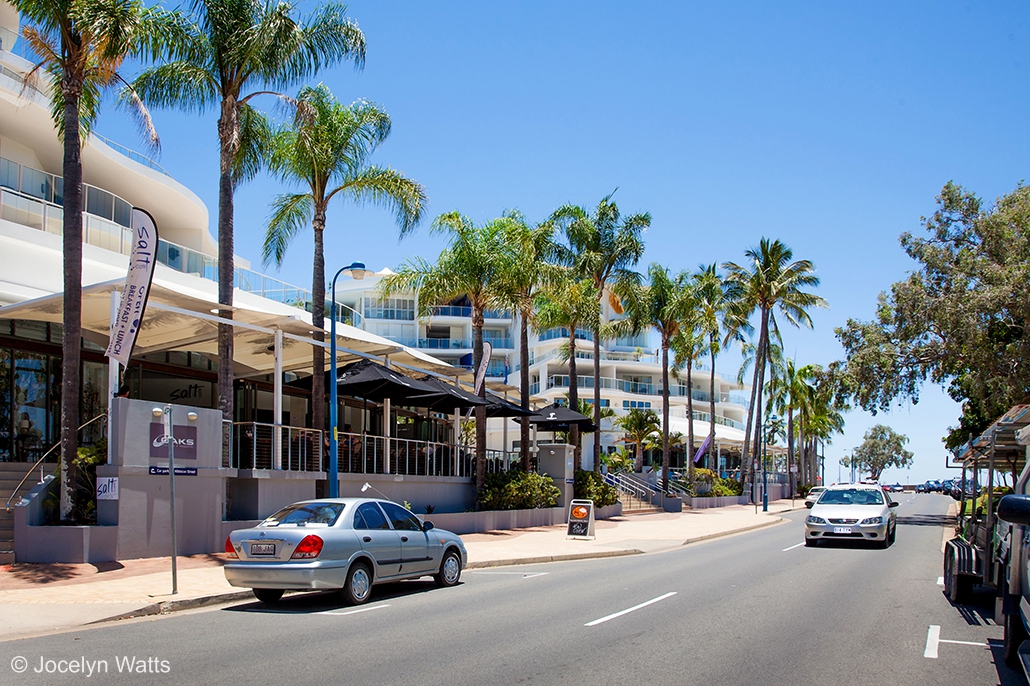
The Hervey Bay esplanade, lined with palm trees, cafés and beachfront accommodation at the Oaks, offers easy access to the water and relaxed coastal living.
The “Easy Yes” Option
Oaks Hervey Bay Resort and Spa
If you want a retreat that’s easy to organise and easy to enjoy, this one ticks every box.
- Book a couple of apartments across the group
- Everyone gets their own room (or shares comfortably)
- Kitchens for casual shared meals
- Balconies for early morning writing or reflection
And then there’s the location—right on the Esplanade. Coffee is a short stroll away. So is dinner. So is that “just one more walk before sunset” feeling.
💡 Why it works: Simple, reliable, and feels like a treat without being over the top.
For a More Immersive Creative Reset
Kingfisher Bay Resort
Set on K’gari (Fraser Island), Kingfisher Bay Resort feels like stepping out of everyday life.
- Bushland villas
- Wildlife wandering through
- A peaceful place that actually restores your thinking
There’s a little more planning involved (ferry transfers), but that’s part of the experience. It creates a sense of arrival, like you’ve gone somewhere meaningful.
💡 Best for: Writing retreats, creative intensives, or groups wanting genuine unplug time.
The Quiet Achievers (Mid-Range Gems)
Not every retreat needs to feel like a luxury escape. Sometimes, the best experiences come from places that simply work well.
Akama Resort
- Spacious, modern apartments
- Relaxed marina location
- Ideal for a central gathering space
Ramada by Wyndham Hervey Bay
- Studio and apartment-style options
- Onsite dining
- Slightly removed from the Esplanade buzz
Mantra Hervey Bay
- Good value without feeling basic
- Flexible configurations for groups
These are the kinds of places where people settle in quickly without fuss or friction.
The “Feels Like a Retreat” Option
Best Western Plus Quarterdecks Retreat
- Standalone villas
- Tropical gardens
- A genuine sense of calm
It naturally encourages a slower pace, which can be exactly what a retreat needs.
The Beachfront Balance
Grand Mercure Allegra Hervey Bay
BreakFree Great Sandy Straits
These options lean into one of Hervey Bay’s biggest strengths: being right by the water.
Morning walks. Ocean air. That slightly salty breeze that somehow clears your head.
💡 Perfect for: Groups who want a natural rhythm to write, walk, talk, repeat.
The Airbnb Alternative: Where Magic Happens
A well-chosen Airbnb can give you:
- A long dining table for shared meals
- Space for conversations that unfold naturally
- A sense of being “away” together
It’s less structured and often more meaningful because of it.
💡 Best for: Creative groups, friendships, collaborative energy.
Make the most of the coastal setting:
→ Travel-friendly tech and Kindle reads via Amazon Australia
Because the right gear makes slow mornings and seaside walks even better.
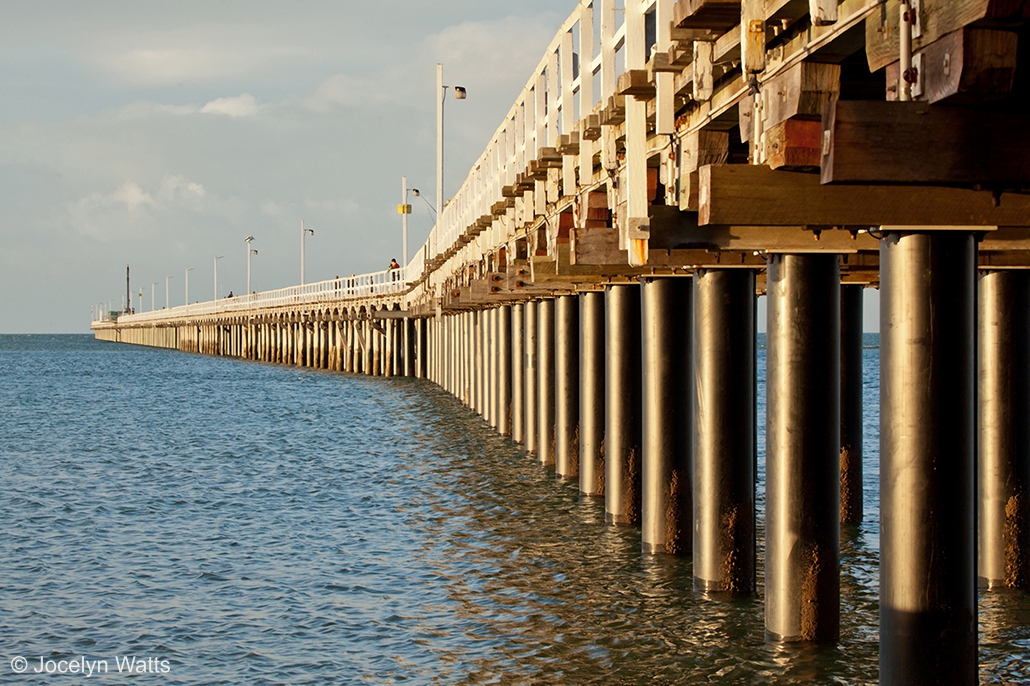
The historic Urangan Pier extends nearly a kilometre into the bay, offering sweeping views and a favourite spot for fishing and walking.
What to Consider for Retreat Accommodation in Hervey Bay
This is where the practical side matters.
Room Configuration
Seven or more people means flexibility is key.
Look for:
- Enough bedrooms
- Multiple bathrooms
Shared Space
Is there:
- A lounge big enough for everyone?
- A dining area for group meals or discussions?
Location
Do you want:
- Walkable cafés and beach access?
- A quieter, tucked-away setting?
Budget Balance
Not everyone travels the same way.
Apartment-style stays can help accommodate different budgets within the same group.
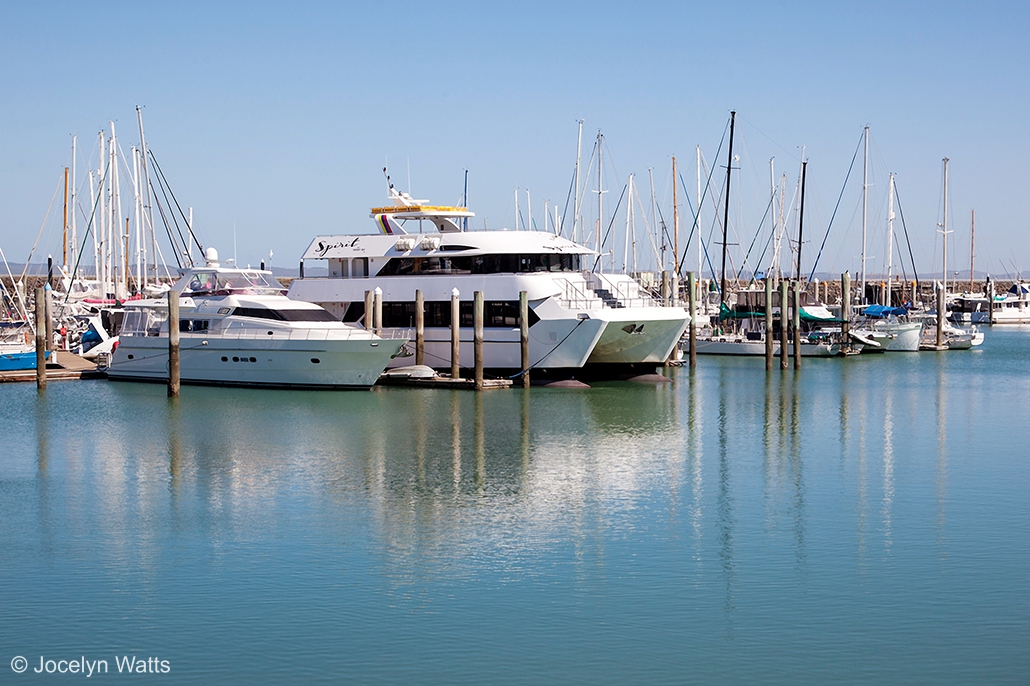
The Hervey Bay marina is the departure point for whale watching tours and island adventures across the Fraser Coast.
The Real Secret? It’s Not Just the Accommodation
Here’s something worth keeping in mind: it’s not just the property that makes the retreat.
It’s also what the space allows.
- Conversations that don’t feel rushed
- Time to think clearly
- A sense of being slightly removed from everyday life
Hervey Bay simply supports that in a very natural way.
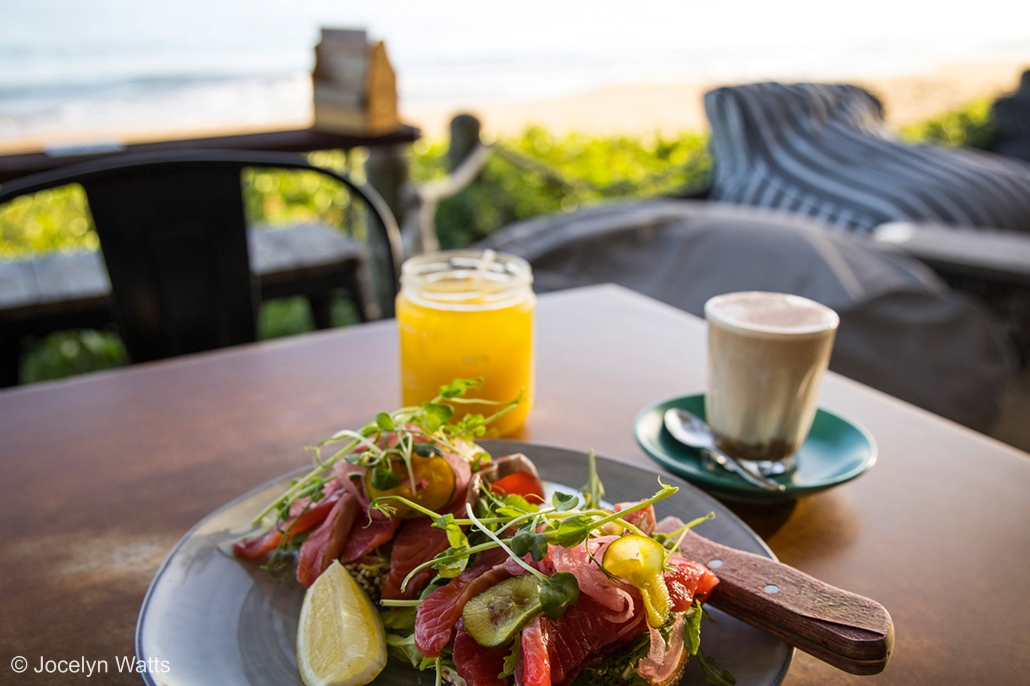
A relaxed breakfast at Enzo’s on the Beach at Torquay where good coffee and fresh flavours are served with ocean views.
Final Thought: Choose the Experience First
If you’re picturing:
- Easy, social, coastal: go with Oaks Hotel Hervey Bay
- Deep, immersive, nature-based: choose Kingfisher Bay
- Connected and intimate: look for a beautiful Airbnb
- Balanced and flexible: consider Akama, Ramada or Mantra
There’s no single “right” option; just the one that aligns with the kind of retreat you want to create.
And that’s really what this is about. Not just booking accommodation… but setting the tone for something people will remember long after they’ve gone home.
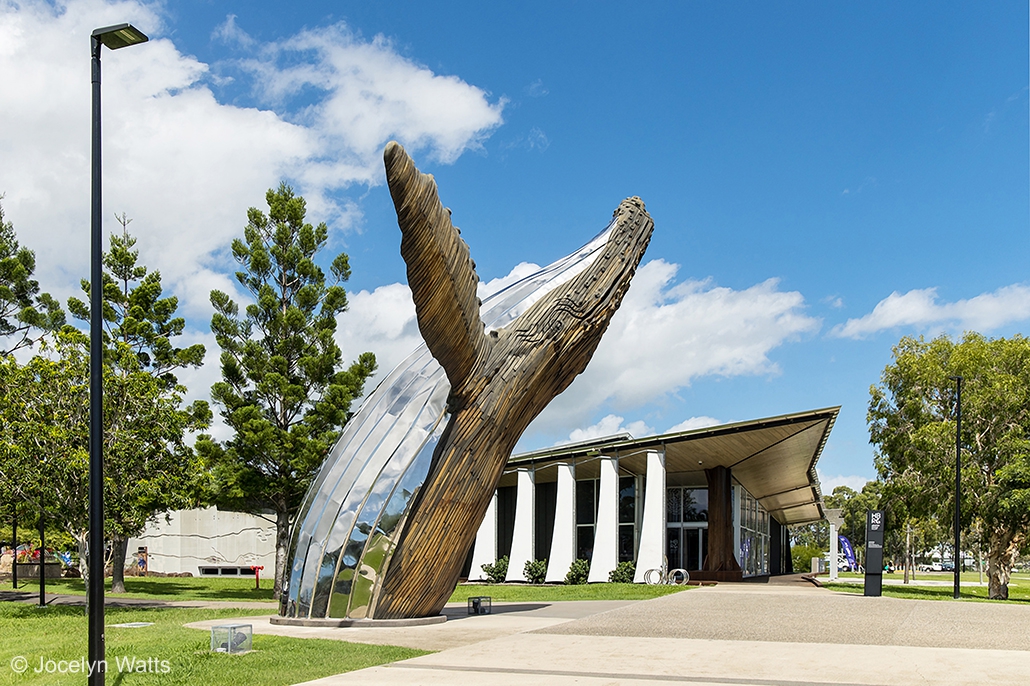
Public art in Hervey Bay reflects the region’s connection to the ocean, with striking whale sculptures near the gallery precinct.
Ready to Plan Your Hervey Bay Retreat?
Whether you’re picturing sunrise writing sessions by the water, long lunches with your group, or simply a change of pace, having the right base makes all the difference.
Start here:
→ Browse coastal apartments and resort stays with Oaks Hotel Hervey Bay
→ Compare a wider range of group-friendly stays via ParkBooker
→ Organise transport with Avis Car Rentals
→ Travel with confidence using AllClear Travel Insurance
Take your time choosing — the right setting doesn’t just host a retreat… it shapes it.
*This article contains affiliate links. If you click through and make a purchase, we may earn a commission, at no extra cost to you. It’s how we keep creating helpful stories and guides for you.
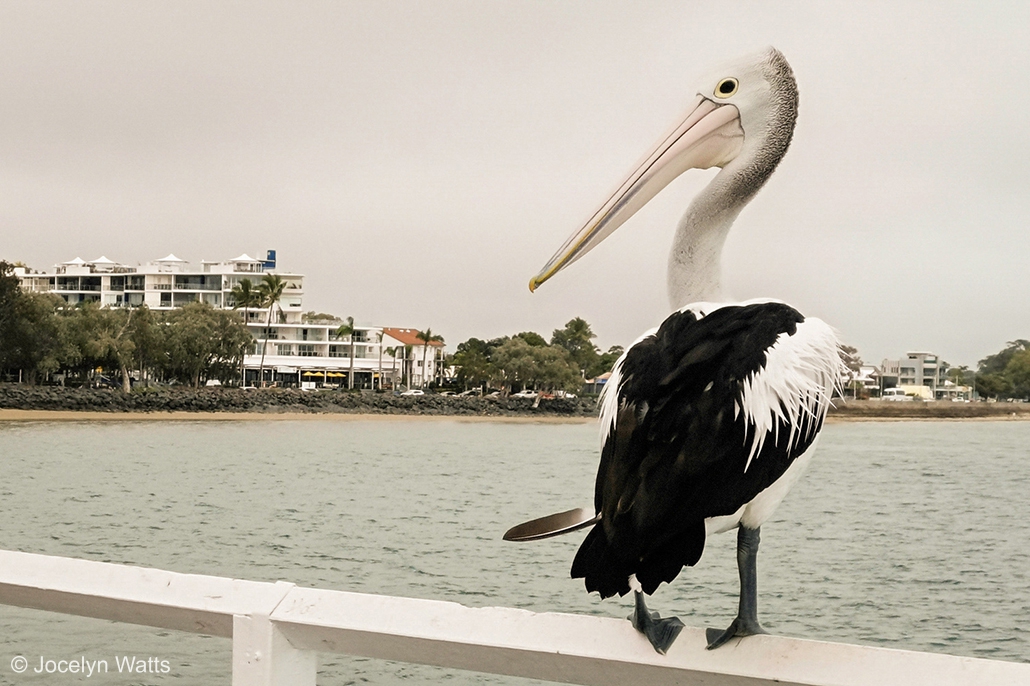
A curious pelican pauses along the waterfront, a common sight around Urangan Pier and the marina.
Fraser Coast Arts Trail: Galleries, Culture and Public Art
VISITORS searching for things to do in Hervey Bay and Maryborough usually discover the Fraser Coast’s beaches, whale watching and island adventures first. But spend a little longer exploring and another side of the region emerges — a thriving local arts scene.
From contemporary exhibitions in Hervey Bay to gallery spaces in Maryborough and cultural traditions linked to nearby K’gari, the Fraser Coast has developed a distinctive creative identity shaped by landscape, history and community.
For travellers who enjoy wandering through galleries, discovering public art or chatting with artists between beach walks and café stops, the region offers a surprisingly rich cultural experience.
If you’re planning a visit — particularly during the cooler winter months when southern travellers chase the Queensland sunshine — here’s how to explore the arts and creative spaces of the Fraser Coast.
*This article contains affiliate links. If you click through and make a purchase, we may earn a commission, at no extra cost to you. It’s how we keep creating helpful stories and guides for you.
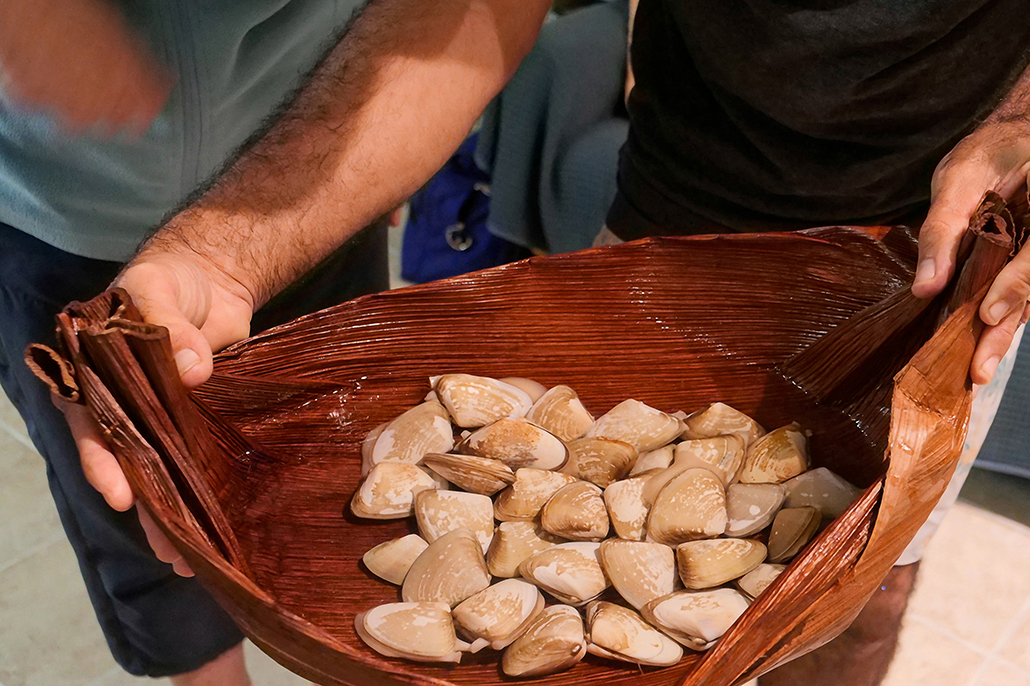
A traditional basket holding eugaries gathered along the shores of K’gari, reflecting the deep connection between Butchulla culture and sea country.
Cultural Traditions of K’gari
Just offshore from Hervey Bay lies K’gari (Fraser Island), the world’s largest sand island and a UNESCO-listed landscape of lakes, forests and sweeping dunes.
For thousands of years this island has been home to the Butchulla people, whose cultural knowledge and connection to Country remain central to the region’s identity.
Visitors taking part in cultural experiences on K’gari may see traditional skills such as basket making using palm fronds or learn about coastal foods gathered along the island’s shores.
These traditions remind travellers that the Fraser Coast’s creative life stretches far beyond gallery walls — it is deeply connected to landscape, culture and story.
Artists and photographers frequently draw inspiration from:
- the vast sand dunes and freshwater lakes of K’gari
- changing coastal light and tidal landscapes
- birdlife, marine life and natural ecosystems
- stories connected to the Butchulla people, the Traditional Owners of K’gari
This deep connection between place and creativity is evident in many local exhibitions. Themes of environment, identity and migration often appear in artworks, reflecting both the physical landscape and the stories embedded within it.
Creative Things to Do in Hervey Bay and Maryborough
The gallery hosts a rotating program of exhibitions featuring regional, national and international artists. The space itself is modern, airy and welcoming, making it easy to spend an hour or two exploring new work.
Exhibitions often include a mix of artistic styles and mediums, from painting and photography to sculpture, installation pieces and multimedia works.
What makes the gallery particularly appealing to visitors is its relaxed coastal setting. After browsing the exhibitions, it’s only a short stroll to the esplanade where cafés overlook the calm waters of Hervey Bay.
Many travellers find that a gallery visit pairs perfectly with a slow morning of coffee, brunch and seaside walking.
The gallery also regularly hosts:
- exhibition openings and talks with artists and authors
- creative workshops and community programs
- cultural events linked to regional festivals
- a gallery shop showcasing locally made work
For anyone interested in discovering the creative heart of the Fraser Coast, this gallery is a good starting point.
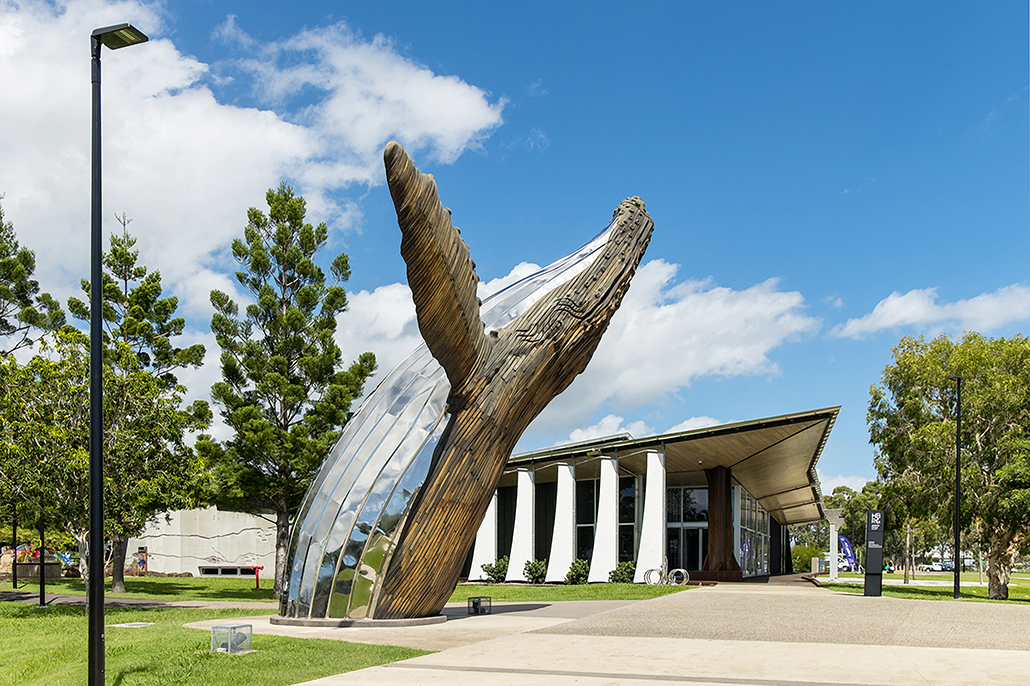
A striking whale sculpture outside Hervey Bay Regional Gallery reflects the Fraser Coast’s identity as both a cultural hub and one of Australia’s most celebrated whale-watching destinations.
Gatakers Artspace: Maryborough’s Creative Hub
Housed within a beautifully restored heritage building, Gatakers Artspace blends history with contemporary creativity. The gallery regularly presents exhibitions by Fraser Coast artists alongside touring exhibitions from across the country.
Visitors exploring Maryborough’s charming heritage streets often stumble across the gallery while wandering between museums, cafés and historic buildings in Wharf Street.
Inside, the gallery spaces showcase a variety of artistic voices and approaches. Exhibitions frequently highlight:
- regional artists and emerging talent
- contemporary visual art
- experimental and multimedia works
- community arts projects
The gallery is also a key part of the local creative community, providing opportunities for artists to exhibit work, connect with audiences and participate in workshops.
For visitors interested in experiencing the cultural character of regional Queensland, Gatakers offers an engaging glimpse into the Fraser Coast’s artistic life.
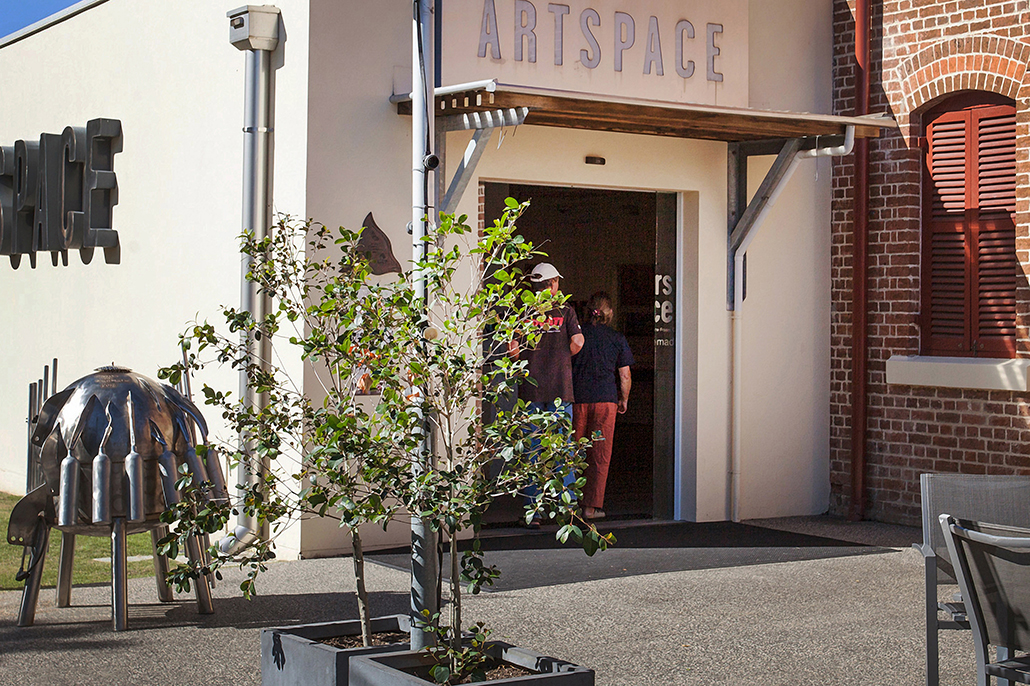
Gatakers Artspace in Maryborough Qld is a key cultural venue on the Fraser Coast, hosting exhibitions, workshops and creative events.
Meet the Fraser Coast Creative Community
One of the pleasures of visiting regional galleries is the chance to encounter the people behind the art.
Exhibition openings on the Fraser Coast tend to be relaxed and welcoming occasions where artists, writers, photographers and curious locals gather to celebrate new work.
Unlike the formality sometimes found in larger city galleries, these gatherings often feel like community events, where conversations happen naturally.
Visitors may find themselves chatting with artists about their creative process or hearing the story behind a particular artwork.
For travellers who enjoy meaningful cultural experiences, these moments offer a genuine glimpse into the region’s creative life.
The Fraser Coast’s arts community is small enough to feel approachable but vibrant enough to continually surprise.
Plan an Arts-Inspired Fraser Coast Visit
If you enjoy combining culture with travel, it’s easy to build a relaxed Fraser Coast arts trail into your itinerary.
A simple day exploring the Fraser Coast’s creative spaces might look like this:
Morning – Hervey Bay
Start with a visit to Hervey Bay Regional Gallery, then wander the nearby foreshore where sculptures and public artworks sit among parks and walking paths.
Afternoon – Maryborough
Drive the short 35 minutes inland to Maryborough to explore Gatakers Artspace before wandering through the town’s beautifully preserved heritage streets.
Along the way you’ll discover antique stores, cafés, historic architecture and creative spaces that give the town its distinctive character.
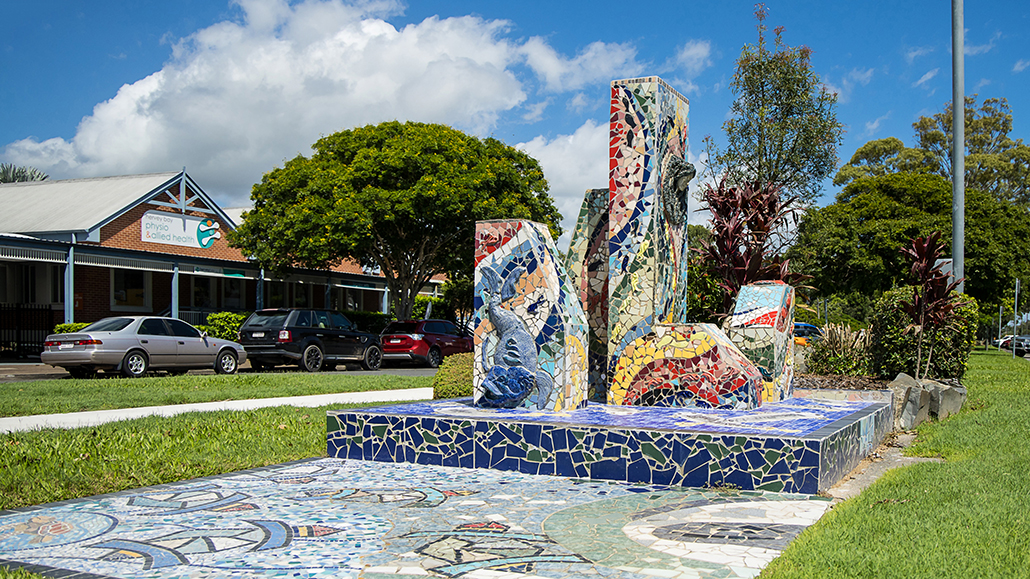
A colourful community mosaic sculpture in Freshwater Street, Hervey Bay, highlights the Fraser Coast’s vibrant public art scene and the creative spirit found throughout the region.
A Creative Coast Worth Exploring
The Fraser Coast may be best known for its whales and extraordinary natural landscapes, but travellers who wander a little further often discover another side of the region — a thriving arts and cultural scene.
From Butchulla cultural traditions connected to K’gari to contemporary exhibitions in Hervey Bay and heritage gallery spaces in Maryborough, creativity appears here in many forms.
Next time you plan a visit to the Fraser Coast, leave room in your itinerary for a gallery or two. You might just discover a new favourite artist — and a deeper appreciation for the creative spirit that shapes this coastal region.
Sometimes the most memorable travel experiences aren’t the ones you plan — they’re the discoveries you make along the way.
Visitors interested in upcoming exhibitions and cultural events can explore the Fraser Coast’s arts programs through the Fraser Coast Regional Council.
Planning a visit to Hervey Bay, Maryborough or K’gari?
These travel partners can help make your Fraser Coast trip easier:
Accommodation
→ Oaks Hotels & Resorts – comfortable places to stay across Queensland
Car Hire
→ Avis Car Rentals – explore the Fraser Coast at your own pace
Travel Insurance
→ AllClear Travel Insurance – cover for Australian and international travellers
Travel Gear
→ BagSmart – practical organisers and travel accessories
Some links may be affiliate links. If you purchase through them, Jocelyn Magazine may earn a small commission at no extra cost to you.
***
About the Author
Jocelyn Watts is the founder and editor of Jocelyn Magazine, where she writes about travel, culture and the stories that shape places across Queensland and beyond.
Creativity has always been part of her life. As the daughter of a home economics teacher, she grew up learning to make things from scratch and, before journalism, she spent several years working as a dressmaker.
Photography runs in the family too. Jocelyn is the daughter of Australian Master Photographer William C. Scott, whose images the captured attention of judges in photographic societies world-wide. That legacy continues to influence her own work as a writer and photographer documenting regional Australia.
These days she’s more likely to be carrying a camera than a sewing machine — still stitching together stories, just with light and words instead of thread.
👉 Read more about her father’s photography in https://jocelynwatts.com/about-jocelyn-magazine/william-c-scott/
Blog Photos: Jocelyn Watts / Jocelyn Magazine
Crocodiles were prehistoric — but they’re not dinosaurs.
CROCODILES tend to make the news only when something has gone terribly wrong. An attack. A close call. A reminder that in parts of Australia, we are not the top of the food chain.
Yet long before headlines and helicopters, crocodiles were already here.
They are reptiles — like lizards, turtles and snakes — and they possess one of the most ancient lineages of any living animal.
When we ask are crocodiles dinosaurs? we’re really asking a deeper question about how life on Earth evolved — and who survived when others did not.
This article contains affiliate links. If you click through and make a purchase, we may earn a commission, at no extra cost to you. It’s how we keep creating helpful stories and guides for you.

Wild places demand awareness and respect, particularly in regions where large crocodiles are known to inhabit the waterways.
Are Crocodiles Dinosaurs?
The short answer is no. Crocodiles belong to a group of animals known as archosaurs; a clade (or evolutionary branch) that also includes dinosaurs and pterosaurs. They share a common ancestor, which is why the confusion is understandable.
But crocodiles branched off the family tree long before what we recognise as dinosaurs emerged.
One of the key differences lies in body structure. Dinosaurs had hind legs positioned directly beneath their bodies; an upright stance. Modern birds, which are now considered living descendants of dinosaurs, share this trait.
Crocodiles do not. Their legs extend more to the side, giving them that distinctive low, sprawling posture. It may look primitive, but it has proven remarkably effective.
So, while crocodiles lived alongside dinosaurs, and while they share ancient ancestry, they are not dinosaurs themselves.
Survivors of Extinction
Around 66 million years ago, the mass extinction event that ended the age of dinosaurs wiped out roughly three-quarters of life on Earth.
Dinosaurs disappeared (with the exception of birds). Pterosaurs vanished. Marine reptiles such as ichthyosaurs and plesiosaurs were lost to history.
Crocodilians survived.
Why? Scientists suggest a combination of factors: adaptable diets, semi-aquatic lifestyles, and the ability to go long periods without food. In evolutionary terms, they were built for endurance.
The modern Saltwater Crocodile is a direct descendant of that resilience.
Where Are Crocodiles Found in Australia?
Crocodiles in Australia inhabit tropical northern waterways.
You can expect them in rivers, estuaries and coastal regions from K’gari (Fraser Island) across northern Queensland and the Northern Territory, through to Shark Bay in Western Australia.
In these regions, warnings are clear and consistent — and they should be heeded.
Crocodiles are intelligent. They learn patterns. If fish are cleaned at the same riverbank repeatedly, they notice. When scraps are thrown into the water, they associate humans with food.
They are not unpredictable monsters. They are highly efficient predators behaving exactly as nature designed them to behave. That is precisely why caution matters.
Crocodile Safety
-
Never swim in waterways where crocodiles are known to inhabit
-
Avoid cleaning fish or discarding scraps in the same location
-
Keep well back from riverbanks and boat ramps
-
Assume crocodiles may be present even if none are visible
In northern Australia, complacency is the real danger.
How Big Are Crocodiles?
The largest measured crocodile in modern times was Lolong, captured in the Philippines at 6.17 metres.
In Australia, there have been claims of even larger individuals. One specimen, known as Krys, was shot near Normanton in 1958 and claimed to measure 8.64 metres. That measurement, however, remains contested.
For context, a fully grown saltwater crocodile regularly reaches five metres; more than enough to ensure that a human encounter is unlikely to end well.
Looking further back in time, prehistoric crocodilians were even larger. The giant Sarcosuchus imperator is believed to have grown up to 12 metres in length — an animal that would have dwarfed most modern predators.
Compared to that, today’s crocodiles are modest.
Crocodiles and Dinosaurs: The Bigger Picture
So, no. Crocodiles are not dinosaurs. But they are something perhaps even more remarkable. They are survivors.
Across millions of years, crocodiles have endured asteroid strikes, continental drift, ice ages and the slow reshaping of oceans and river systems. All the while, they adapted as entire branches of life vanished.
In Australia’s tropical north, they remain a powerful reminder that wild places are not theme parks. They are ecosystems; balanced, ancient and deserving of respect.
As humans continue to expand into crocodile habitat, coexistence depends on knowledge, caution and a willingness to understand the natural world rather than dominate it.
Crocodiles may not be dinosaurs. But in evolutionary terms, they are living relics of a world far older than our own, and still very much in charge of their domain.
Recommended for the Tropical North
Exploring northern Australia means heat, humidity, sudden downpours and genuinely wild landscapes.
Pack light, pack smart
Breathable clothing, a wide-brim hat, insect protection, dry bags for electronics and a good pair of binoculars for wildlife spotting from a safe distance all make travel more comfortable. I visit Amazon Australia for travel essentials.
Don’t overlook travel insurance
Remote roads, river crossings and adventure experiences come with added variables. Comprehensive cover — particularly for regional and adventure travel — offers peace of mind. I recommend comparing policies through AllClear Travel Insurance before heading north.
Taste the landscape
Northern Australia isn’t only croc country. It’s also home to remarkable native ingredients. Kakadu plum, one of the world’s richest natural sources of vitamin C, grows in these same rugged regions. If you’re curious about authentic Australian flavours, explore products made with Kakadu plum and other native botanicals.
Wild places reward preparation, and a little curiosity.
This section contains carefully selected affiliate links. If you choose to purchase, I may earn a small commission at no extra cost to you.
About the author
Peter Woodland is a contributor to Jocelyn Magazine. A former teacher and school librarian, his interests include computing, geography, palaeontology and good food.
This piece was first published in Jocelyn Magazine in 2022. It has been lightly edited to update travel information.
Why Travel Insurance for Pre-Existing Conditions Matters
Perfect health isn’t a prerequisite for meaningful travel. When journeys are shaped around real lives — not idealised versions of them — travelling together becomes calmer, richer, and more rewarding.
THERE was a time when planning a trip meant little more than choosing dates, booking somewhere to stay, and deciding how many books I could reasonably justify packing.
As we approach retirement years, travel planning still begins with excitement, but it also includes a few considerations that don’t always make it into glossy brochures. Things like medications. Energy levels. Comfort. And the unspoken awareness that bodies don’t always behave the way they once did.
That shift doesn’t make travel smaller. If anything, it makes it more intentional.
*This article contains affiliate links. If you click through and make a purchase, we may earn a commission, at no extra cost to you. It’s how we keep creating helpful stories and guides for you.

A little research before departure — because travel insurance for pre-existing conditions is easier sorted at the kitchen bench than at the airport.
Travelling Together Means Planning Differently
Travelling with someone else — especially someone a little older, or managing health conditions — changes the tone of planning in subtle but important ways. You’re no longer just responsible for yourself. You’re also thinking about pacing, contingencies, and what happens if something goes sideways far from home.
That doesn’t mean anxiety takes over. It just means realism has a seat at the table.
- A slightly later start to the day.
- A lift instead of the stairs.
- A café stop instead of pushing on.
These adjustments aren’t compromises. They’re choices that make the trip work better — and often more enjoyably — for everyone involved.
Letting Go of the ‘Perfect Traveller’ Myth
There’s a persistent idea that travel should look effortless. That if you’re doing it properly, you’re energetic, flexible, and unfazed by long days, missed connections, or unfamiliar beds.
But most real travellers don’t fit that mould, especially as we get older.
Joints complain. Sleep can be fickle. Familiar routines become important. And that’s before you factor in diagnosed conditions, ongoing treatments, or the simple truth that no two bodies travel the same way.
Letting go of the “perfect health” expectation is oddly liberating. It allows travel to be shaped around real lives, rather than forcing real lives to perform for travel.
How Travel Insurance for Pre-Existing Conditions Supports Real-Life Journeys
One of the less glamorous aspects of travel is the admin nobody really wants to think about. Insurance. Medication lists. Backup plans. Emergency contacts tucked into a wallet or phone.
It’s not exciting, but it’s deeply enabling.
Knowing that you’ve covered the basics frees up mental space to enjoy where you are. It turns “what if?” into “we’ve thought about that” and then lets you get on with the good part: being away together.
For travellers managing health conditions, or travelling with someone who is, insurance becomes less about price and more about clarity. What’s covered. What needs to be declared. And whether the policy aligns with real circumstances, rather than ideal ones.
That’s where specialist providers like AllClear Travel Insurance come into the picture; not as a dramatic safety net, but as practical support for travellers who don’t tick every easy box.
Peace of Mind Is Part of the Packing List
Travelling together when health isn’t perfect doesn’t mean scaling back dreams. It means redefining what a good trip looks like.
- Sometimes that’s fewer destinations and longer stays.
- Sometimes it’s choosing comfort over novelty.
- Sometimes it’s saying yes to rest days without guilt.
And often, it’s discovering that the best moments aren’t the ones you rushed to tick off, but the ones you lingered over because you could.
- A shared coffee watching the world go by.
- A scenic train journey instead of a long drive.
- A hotel balcony at sunset, doing absolutely nothing.
These are not second-best experiences. They’re often the ones you remember the longest.
Travelling wisely, not fearfully
There’s a difference between travelling cautiously and travelling wisely.
Wise travel acknowledges reality without letting it dominate the experience. It plans for support, not disaster. It chooses reassurance over bravado. And it understands that independence isn’t about pretending you don’t need help; it’s about setting yourself up, so you don’t.
For many of us, that wisdom comes with time. And with it, a deeper appreciation for travel that feels calm, considered, and shared.
Because the joy of travelling together isn’t found in ticking every box. It’s found in making sure everyone arrives home with good memories and the confidence that the trip was shaped around who you are now, not who you used to be.

Comfort, companionship, with a little forward planning.
🌿 Travel Essentials
Planning a trip? A comfortable place to stay and the right travel insurance can make all the difference between a good getaway — and a relaxed one.
For accommodation across Australia and New Zealand, I often look at Oaks Hotels & Resorts — practical, well-located and easy to settle into.
And for travellers managing pre-existing conditions or simply wanting thoughtful cover, AllClear Travel Insurance specialises in policies designed for real-life bodies and real-life trips.
→ Browse accommodation with Oaks
→ Explore travel insurance options with AllClearThese are affiliate links, which means Jocelyn Magazine may receive a small commission at no extra cost to you.
Explore dinosaur trails less travelled
Looking for dinosaur trails in Australia that go beyond the usual tourist circuit? This Dinosaur Trails Australia road trip begins at Lightning Ridge in northern NSW, home to rare opalised dinosaur fossils from the Cretaceous period. From Lightning Ridge to Queensland’s dinosaur country, this is a prehistoric journey for curious travellers, grey nomads and lovers of regional Australia.
HAVE you ever wanted to take a journey in the footsteps of giants? One that few people travel, yet is full of prehistoric wonder.
Well, now’s your chance to explore Australia’s fascinating world of dinosaur trails.
But if you’re already a dedicated traveller, you may have ticked all the well-known trails off your list.
So why not invent one of your own? May I suggest a slightly different trail?
If you’re a grey nomad or any other southern self-contained gadabout and you’re heading north to sunny Queensland, start your trail at Lightning Ridge in far northern NSW.
This article contains affiliate links. If you click through and make a purchase, we may earn a commission, at no extra cost to you. It’s how we keep creating helpful stories and guides for you.
Lightning Ridge: Australia’s Opalised Dinosaur Fossils

Cretaceous Australia. Photo: Creative Commons
Lightning Ridge is the source of some of Australia’s most spectacular dinosaur fossils; spectacular because they are opalised.
The district is also one of Australia’s productive opal-mining regions, adding another dimension to your visit.
Most dinosaur discoveries at Lightning Ridge date from the Early to Mid Cretaceous periods, between 145 and 110 million years ago.
At that time, a vast, relatively shallow inland sea covered central Australia, with Lightning Ridge lying near its south-eastern shore.
The opal fields have yielded several important dinosaur fossil finds. Most recently, palaeontologists announced the discovery of the small ornithopod dinosaur Weewarrasaurus pobeni in 2019.
About the size of a dog, this small dinosaur likely travelled in family groups or herds for protection. Two fragments of jawbone and several teeth provide the evidence we have of it today.
Savour the Outback at Home
Before setting out on Dinosaur Trails Australia — or after you’ve returned from Lightning Ridge — savour a true taste of Australia. Kakadu plum grows wild in Australia’s remote regions and has long been valued for its natural properties. It’s a small but meaningful way to stay connected to the landscapes that shape our prehistoric story.
Dinosaur fossils found in an opal mine
Before that discovery, miners unearthed fossils from what appears to have been a herd of larger ornithopod dinosaurs deep underground in an opal mine.
This dinosaur, Fostoria dhimbangunmal, is related to the well-known Muttaburrasaurus from north-western Queensland.
Researchers have identified more than 60 bones from four individuals of the species.
Its species name comes from a local Aboriginal word meaning ‘sheepyard’, a reference to the locality that yielded the fossils.
Numerous other dinosaur fragments and bones still await identification in the district. Perhaps the most tantalising is ‘Lightning Claw’.
Only a handful of fossils provide clues to this mysterious dinosaur, leaving scientists without enough evidence to reconstruct it fully or give it an official scientific name.
Researchers believe Lightning Claw was a large theropod — a megaraptor — and perhaps one of the largest examples of a dinosaur group that appears only rarely in Australia’s fossil record.

Lightning Claw. Photo: Creative Commons
Things to Do in Lightning Ridge (Opals, Fossils & Outback Experiences)
Lightning Ridge has several caravan parks. Check out the fossicking heaps at the Tourist Information Centre.
The John Murray Gallery is a must, and a good meal can be had at the Lightning Ridge Bowls Club.
Try the Car Door Tours; an economical, quaint way to see the sights.
When you get to Lightning Ridge, ask about the new Australian Opal Centre.

The Car Door Tours at Lighting Ridge are a must-see attraction. Photo: Jocelyn Watts

John Murray Gallery mural at Lightning Ridge. Photo: Jocelyn Watts
Travel Gear That Travels Well
If you’re upgrading luggage or packing tools for your next rail or road journey, choose lightweight pieces designed for regional travel.
Planning a Dinosaur Trail Road Trip in Australia
So, you’re looking for a destination that’s off the beaten path, why not explore some of Australia’s lesser-known dinosaur trails?
These areas are home to prehistoric creatures that once roamed the earth and offer an unforgettable experience for travellers of all ages.
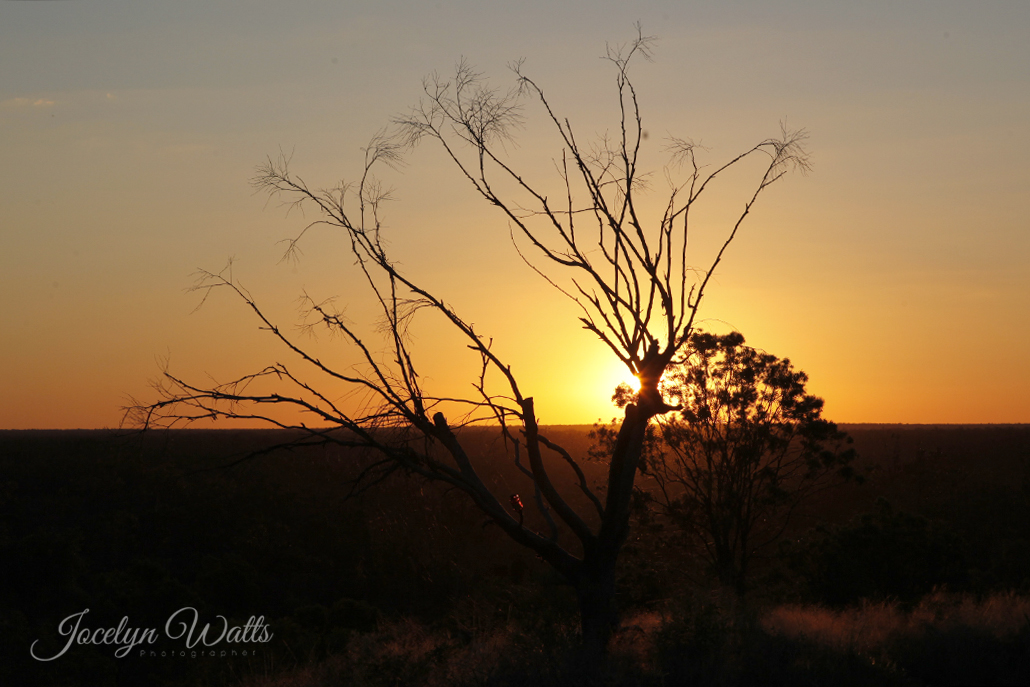
Dinosaur Trails Australia: Sunset at Lightning Ridge
Travel Insurance for Regional Australia
For rail journeys and extended road trips, comprehensive cover provides peace of mind — especially for mature travellers.
If you go: Dinosaur Trails Australia – Lightning Ridge
Location: Lightning Ridge, northern New South Wales
Distance from Brisbane: Approx. 720 km (8–9 hours by car)
Distance from Sydney: Approx. 770 km (around 9 hours by car)
Best time to visit: Autumn and winter (April–September) offer cooler, more comfortable conditions. Summers can be intensely hot.
Road access: Sealed highways lead into town. Suitable for caravans, motorhomes and self-contained travellers. Always check local road conditions after heavy rain.
Allow: 2–3 days to explore fossil displays, opal fields and outback attractions at a relaxed pace.
Highlights:
-
Fossil displays at the Visitor Information Centre
-
Opal fossicking areas
-
The John Murray Gallery
-
Car Door Tours
-
Progress on the Australian Opal Centre
Map: View Lightning Ridge on Google Maps:
https://www.google.com/maps/place/Lightning+Ridge+NSW
From here, your journey along Dinosaur Trails Australia continues north into Queensland’s prehistoric heartland. In Part Two, explore Winton, Hughenden and Muttaburra along the Queensland Dinosaur Trail, where some of Australia’s most significant fossil discoveries await.
***
About the author
Peter Woodland is a contributor to Jocelyn Magazine. A former teacher and school librarian, his interests include computing, geography, palaeontology and good food.
This piece was first published in Jocelyn Magazine in 2022. It has been lightly edited to update travel information.