Tag Archive for: volunteering

Why I Walked: RFDS Oceans to Outback 2025

SOME walks are about fitness.
Some are about clearing your head.
This one was about gratitude.

In October, I took part in the RFDS Oceans to Outback Challenge 2025, walking 113 kilometres from my adopted home on the coast in Hervey Bay towards my birthplace in the red-heart country of central Queensland, while raising funds for the Royal Flying Doctor Service.

It was my first Oceans to Outback event. My goals were modest — to walk 90 kilometres and raise $500. By the time I put my feet up at the end of the month, I’d exceeded both comfortably, finishing with 113 kilometres walked and $1,922 raised. More than the numbers, though, it was the meaning behind the walk that stayed with me.

From ocean air to red dust
RFDS Oceans to Outback 2025 charity walk supporting the Royal Flying Doctor Service, Queensland, Australia.

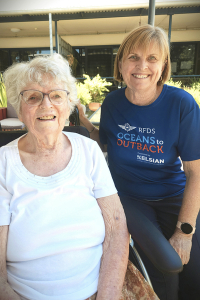
Jocelyn visited her mother, Del Scott, at Barcaldine, Qld.

I finished the challenge in Barcaldine, where I was born, and where my mother — now 94 — lives in permanent care at the hospital. On one of my final days, we shared a barbecue lunch there, surrounded by familiar faces and long-held memories.

Many locals remember Mum, Delpine (Del) Scott, from her years teaching at the high school — music, art, geography and home economics — over a career that spanned around 25 years.

Together with my late father, William (Bill) Scott, she was also deeply involved in Barcaldine’s cultural life, helping establish the folk museum that still stands today. In 2017, Mum received the Australia Day Volunteer of the Year Award — a recognition that reflected a lifetime of quiet contribution.

Over the past decade, the RFDS has transported Mum several times from Barcaldine to Rockhampton following serious fractures — moments when the care she needed simply wasn’t available locally. Each time, the RFDS bridged the distance between vulnerability and treatment.

That’s not an abstract idea to me. It’s a lived experience.

When distance matters

In September 2001, my late husband Don Watts and I were driving the long road from Maryborough to Barcaldine after learning my father was critically ill with pneumonia. The Flying Doctor had been called to transfer him to Brisbane, but he was too weak to travel. He passed away as we approached Rockhampton.

Dad was the first baby born at Muttaburra Hospital after Dr Arratta arrived there in 1925 — a small detail, perhaps, but one that anchors our family story firmly in regional Queensland and its medical history.

Over our married life, Don and I lived in eight regional Queensland towns and cities. Some had strong medical services. Others didn’t. At one point, a close friend in Maryborough flew as a pilot with Angel Flight Australia, which brought home just how vital these services are in a country as vast as ours.

Out here, healthcare isn’t about convenience. It can be the difference between life and death.

A walk of gratitude

Friends who’ve lived rurally often say they’d love to return, but hesitate as they get older, worried about access to medical care. I understand that hesitation completely.

So this walk became a way of saying thank you — for Mum, for Dad, and for countless others who rely on services like the RFDS when distance and urgency collide.

It was also a way of connecting with people across Australia who understand, in one way or another, what it means to live far from care.

Along the way, I was buoyed by messages, shared posts, encouragement and generous donations. Every step felt supported.

By the time I pulled on my walking shoes for a short half-kilometre stroll to the railway station and boarded the Spirit of the Outback for the 1,000-kilometre journey home in Hervey Bay, my heart was full — and my goals for next year had already formed. Whatever my final tallies, rounded up, will become my targets for 2026.

RFDS Oceans to Outback 2025: Why This Story Belongs Here

This story sits within Good Causes because it reflects a core belief behind Jocelyn Magazine: that thoughtful living extends beyond our own front door.

Sometimes that looks like volunteering. Sometimes it’s sharing stories that matter. And sometimes it’s simply putting one foot in front of the other for a cause that supports regional Australia.

If this piece helps shine a light on the work of the Royal Flying Doctor Service — and why it remains essential across vast distances — then the walk has done its job.

Curious About the Work of the RFDS?

If you’d like to learn more about the Royal Flying Doctor Service, the Oceans to Outback Challenge, or watch the RFDS television series, you can explore their official links below.

Royal Flying Doctor Service
RFDS Oceans to Outback Challenge
RFDS television series online
My RFDS Oceans to Outback Facebook Page

Good Causes exists because thoughtful living extends beyond our own front door. Sometimes that looks like volunteering. Sometimes it’s storytelling. And sometimes it’s simply showing up.

Supporting Regional Healthcare More Broadly?

If you’re interested in other ways charities support healthcare across Australia, you can also explore the current Mater Lotteries prize home — a house lottery that helps fund maternity, neonatal and cancer care.

→ View the current Mater Lotteries prize home

(Affiliate link — supporting Jocelyn Magazine at no extra cost to you.)

What can Alice’s curious croquet match teach us?

Most of us have been in situations where we have had to adapt to new and challenging circumstances.

We can say the same for Alice in Alice’s Adventures in Wonderland, an 1865 English novel by Lewis Carrol, when she faces the Queen of Heart’s version of croquet.

While she had encountered many curious creatures and wacky situations, she never imagined she’d have trouble playing croquet.

But when the Queen of Hearts, the main antagonist, introduces Alice to the peculiar version of the game played in that world, she struggles to adjust.

The uneven ground, the live hedgehogs as balls, and the live flamingos as mallets, not to mention the ever-changing arches (known today as hoops) made of playing cards, made the game quite a challenge.

In the end, Alice came out victorious. What can we learn from her experience, especially as we navigate life’s difficulties? Let’s explore.

Alice in Croquetland - Illsutration

Messages in Alice’s croquet challenge

First, let’s talk about the terrain.

Alice in Croquetland - Illustration

Alice found the croquet ground in Wonderland extremely ridged, uneven, and unpredictable.

Every time she tried to aim for a particular arch or hoop, the ground would tilt or move, making it almost impossible to hit her target.

She also encountered strange creatures and plants that would pop up unexpectedly, adding to the chaos.

Doesn’t that sound like life sometimes?

We may have a plan or goal in mind, but the terrain of life can change in a flash.

The financial market may dip, health issues may arise, or family situations may shift.

Like Alice, we need to stay alert, flexible, and resourceful. We may need to change our plans or find alternative paths to our goals, but as long as we keep moving forward, we can still succeed.


Second, let’s talk about the equipment.

Alice in Croquetland - illustration of Alice playing croquet with a flamingo

Alice was surprised to find that the croquet balls were actually live hedgehogs, and the mallets were live flamingos.

She had to learn how to handle these unconventional tools and adjust her technique accordingly.

Our lives may also throw us some unexpected tools or challenges.

  • We may have to learn how to manage our finances with new investments or rules.
  • We may have to adapt to new technologies or industries if we want to keep working or volunteering.
  • We may have to find new hobbies or passions to fill our days.

Whatever it is, we need to keep an open mind and be willing to learn.

With practice and patience, we can become adept at using what we have.


Third, let’s talk about the rules.

The Queen of Hearts, as we know, was notorious for changing the rules of the game as she pleased.

Alice found this frustrating and unfair, but she also learned to be strategic and creative in her gameplay.

She used the unpredictable nature of the game to her advantage, anticipating the Queen’s next move and finding loopholes in the rules.

Our worlds may also come with unwritten or shifting rules.

  • We may have to navigate changing social expectations or cultural norms.
  • We may have to balance our own desires with the needs or expectations of our family or friends.
  • We may have to negotiate new roles or relationships in volunteer work or community organizations.

Again, like Alice, we need to be strategic, adaptable, and creative. We may not always agree with the rules, but we can still succeed within them.


Fourth and last, let’s talk about the arches (known today as hoops).

Alice in Croquetland - illustration of croquet

Ladies and gentlemen in vintage clothes, playing croquet against old English village view.

Various playing cards, which had a mind of their own (literally) formed the arches in Wonderland.

They would move, shrink, grow, or disappear at a whim, making it difficult for Alice and the other players to hit their targets.

But Alice soon realized that she didn’t have to hit the arches directly.

She could aim for nearby objects or creatures that would trigger the cards to move or adjust, creating a new opening for her.

Life may also present us with moving or disappearing arches.

  • We may have to redefine what success means to us.
  • We may have to let go of some goals or expectations that are no longer workable or fulfilling.
  • We may have to embrace new opportunities or challenges that we didn’t consider before.

Like Alice, we need to be creative, flexible, and willing to try different approaches. We may not always hit the bullseye, but we can still work towards our goals.

Embracing Change

Alice’s croquet challenge may seem like a silly or whimsical story, but it contains valuable lessons for us as we navigate our lives.

  • We need to stay alert and flexible in the face of changing terrains, equipment, and rules.
  • We need to be curious and willing to learn new things.
  • We need to be strategic and creative in our gameplay, using all the resources at our disposal. And,
  • We need to be adaptable and open-minded, finding new ways to hit our targets even when the arches move or disappear.

With these lessons in mind, we can play the game of life with confidence and joy. Who knows, we may even shout “Off with their heads!” at some point (figuratively, of course).

Alice in Croquetland - playing croquet today

Playing croquet in today’s world.

Want to find out about playing croquet in Australia?

Visit the Australian Croquet Association website and follow the links to find a club near you.