Tag Archive for: Queensland history

From Table Centrepiece to Design Motif: Pineapples as Prestige

A tropical fruit, a rented centrepiece, and a quiet marker of wealth — the story behind the pineapple is stranger, and more revealing, than it first appears.

HAVE you ever wondered why pineapple motifs are a recurring theme? I have.

They appear on shirts (think Hawaiian), in artworks, on jewellery and ornaments — even worked into architectural details. Pineapples have become a familiar decorative flourish, but their presence is anything but accidental.

In Maryborough, Queensland, pineapples even feature in one of the mosaics adorning Kent Street. The accompanying blurb suggests the city’s municipal benefactor, George Ambrose White — who donated funds for the construction of the Maryborough Town Hall in the early 1900s — made his money from pineapples, among other ventures, including gold.

So how did a tropical fruit come to represent wealth, prestige and influence?

Pineapples as prestige - seen in mosiacs in Maryborough, Qld.

Maryborough storyteller Ian Brown tells Eriko Badri and daughter Sana from Bundaberg about the pineapple motifs in the city’s mosaic.

Why Pineapples Became a Symbol of Wealth

The pineapple belongs to the Bromeliad family and is native to South America, most likely originating in southern Brazil and Paraguay.

It was introduced to Europe in the 15th century by Christopher Columbus, who encountered the fruit in Guadeloupe. By that time, pineapples had already spread throughout South and Central America.

In Europe, however, pineapples proved notoriously difficult to cultivate. And therein lies the answer.

Because they were so rare and challenging to grow, pineapples became powerful symbols of wealth and status. At their peak, a single pineapple could sell for the equivalent of $8,000 in today’s money.

Those fortunate enough to acquire one often displayed it as a centrepiece at lavish social gatherings. In fact, pineapples were so prized that they could be rented for an event, then returned — still uneaten — to their owner.

The motif soon found its way into architecture and interior design. The wealthy adorned their homes and public buildings with carved pineapples as symbols of prosperity and hospitality.

Architect Christopher Wren famously chose gilded pineapples to crown the North Towers of St Paul’s Cathedral in London. King Charles II also embraced the symbolism, commissioning official portraits in which pineapples appear prominently.

It is believed that Barbara Palmer, mistress of King Charles II, was the first to successfully cultivate pineapples in Europe, growing them in a hothouse in the late 1600s.

Closer to home, pineapples are grown across several Queensland regions, including the Sunshine Coast, Wide Bay, Yeppoon, coastal North Queensland and the Atherton Tableland. In the 2012–13 season, Australia’s pineapple processing sector produced 39,000 tonnes of fruit for canning and juicing, valued at $12.5 million (Queensland Government, Department of Agriculture and Fisheries).
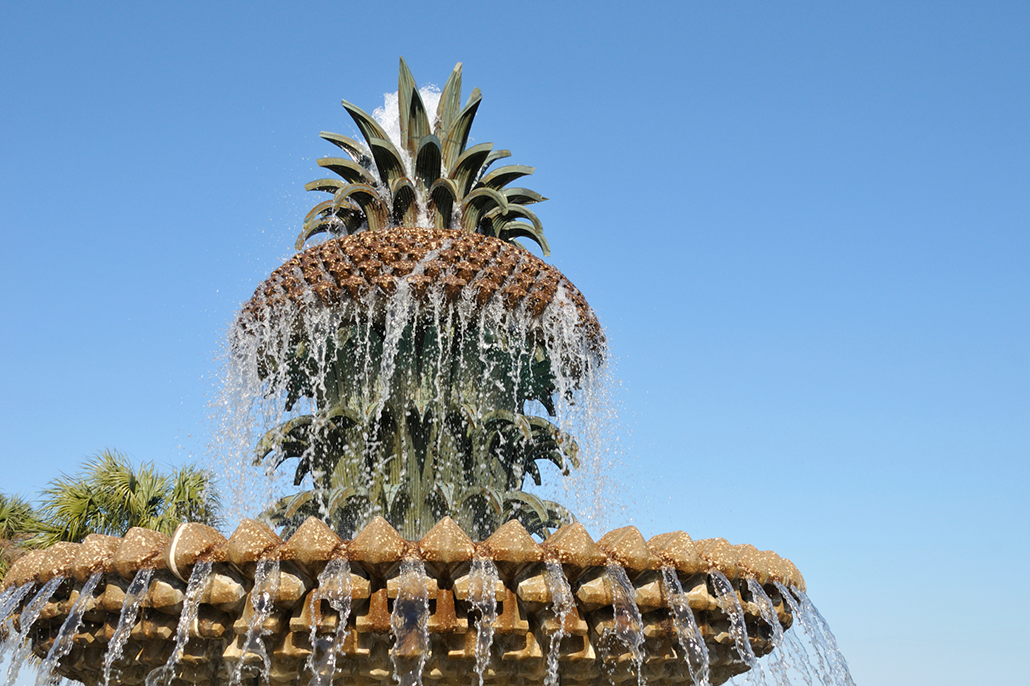
pineapples as prestige - The Pineapple Fountain in Charleston is a familiar landmark in a historic Atlantic port city, long associated with trade, travel and hospitality.

The Pineapple Fountain in Charleston, United States, is a familiar landmark in a historic Atlantic port city, long associated with trade, travel and hospitality.


Notes

  • This article draws on historical sources and publicly available records relating to food history, agriculture and cultural symbolism.
  • It was first published in the Maryborough Herald in 2020, when Jocelyn was editor. Following the closure of the paper, the original article is now available via The Courier Mail’s site. It has been lightly edited for Jocelyn Magazine.

About the author

Peter Woodland is a contributor to Jocelyn Magazine. A former teacher and school librarian, his interests include computing, geography, palaeontology and good food.


Curious about how everyday foods carry hidden histories? You might also enjoy this Food History piece exploring the cultural and colonial story of the macadamia nut.

In October 2014, I stood among hundreds of Butchulla people on K’gari as a temporary Federal Court sat on Country to formally recognise native title over the island then known as Fraser Island.

Covering the determination as both a journalist and photographer, I witnessed a historic moment that followed nearly two decades of legal effort and cultural advocacy.

Since then, the island’s traditional name, K’gari, has been officially restored, reflecting another important step in recognising the enduring connection between the Butchulla people and Country.

I’ve republished this article largely as it appeared at the time, with minor edits for clarity, as a record of a significant day in the island’s modern history.

You can explore more stories about K’gari, its people and landscapes throughout Jocelyn Magazine.

K’gari Native Title 2014: A Win for Culture and Country

CHEERS and tears of jubilation filled a temporary federal courtroom on Fraser Island (K’gari) on October 24, 2014,  as Justice Berna Collier officially recognised the Butchulla people as the island’s native title holders.

It was an emotional day for the 450 Butchulla people who gathered to witness the historic occasion.

Butchulla elder Fiona Foley said the decision had been 18 years in the making.

“We’re very excited to finally get this recognition and see so many Butchulla people here at once,” Aunty Fiona said.

“I never thought this day would happen in my lifetime.”

The Native Title Consent Determination recognised the ongoing traditional laws and customs of the Butchulla people, while also specifying the title rights and interests over about 1640 square kilometres of the national park.

Excluded zones include Kingfisher Bay and Eurong resorts, Orchid Beach and Happy Valley.

Some of the Butchulla people’s rights and interests included maintaining areas of cultural significance, teaching, and participating in rituals and ceremonies.

Queensland South Native Title Services CEO Kevin Smith said this momentous occasion closed the chapter on a long struggle for legal recognition and opened another that involved the management and leverage of recognised legal rights.

“Today is a day of celebration, but the work starts tomorrow with what the Butchulla people will do with their title,” Mr Smith said.

“It could be as simple as coming for song and dance, or it could be working on eco-tourism.”

Mr Smith said a decision on the island’s name would be made sometime in the future.

“Locals might still know it as Fraser Island, but affectionately, the traditional name K’gari needs to catch on,” Mr Smith said.

COURIER MAIL PHOTO GALLERY

Son says Aunty Olga is here in spirit

AUNTY Olga Miller’s spirit was sure to be smiling over yesterday’s proceedings, according to her proud son, Glen Miller.

“I’m a member of the Wondunna clan, and we’re in the middle of Wondunna country now,” he said.

“Mum filed the first native title claim on Fraser Island 18 years ago, and the Butchulla clan filed a year later.

“We’ve been waiting 18 years for this decision, so it’s a pretty historic day.

“As the judge said, it’s sad that some of those elders are not here today to share this with us, but I’m sure they’re with us in spirit.

“Ever since I was a child and could understand English, Mum talked about the island and what it meant.

“Finally Butchulla people are recognised as traditional owners. I know it’s symbolic,c but symbolism means a lot to Aboriginal and non-Aboriginal people alike.

“This decision gives us a foothold on which to go forward.

“Unfortunately the title claim process is ridiculously lengthy, so to finally get this under such difficult circumstances makes today even more special.”

The late Aunty Olga Miller was a well-known Fraser Coast historian, author and artist. Her work is featured in many of the Fraser Coast’s public places.

K’gari native title 2014 agreement rights

The Butchulla People’s Native Title Consent Determination includes non-exclusive rights to:

  • Access, be present on, move about on, and travel over the area;
  • Camp and live temporarily in the area as part of camping, and for that purpose, to build temporary shelters;
  • Hunt, fish and gather on the land and waters of the area for personal, domestic, and non-commercial communal purposes;
  • Take, use, share, and exchange natural resources from the land and waters for personal, domestic, and non-commercial communal purposes;
  • Take and use the water for personal, domestic, and non-commercial communal purposes;
  • Conduct and participate in rituals and ceremonies, including those relating to initiation, birth, and death;
  • Be buried on and bury native title holders within the area;
  • Teach the physical, cultural, and spiritual attributes of the area;
  • Hold meetings in the area.
  • Light fires for personal and domestic purposes, including cooking, but not to hunt or clear vegetation.

Editor’s Note (2026): Since this article was first published in 2014, Fraser Island has officially resumed its traditional Butchulla name, K’gari. The native title determination remains a significant milestone in recognising the cultural connection of the Butchulla people to Country.