
From professionally styled interiors to digitally furnished rooms, real estate photography has always involved presentation. But where should we draw the line between showing a property’s potential and misleading buyers?
Tag Archive for: Jocelyn Watts Photographer
K’gari rewards a little preparation. From sand driving and tides to Wongari, permits, medical supplies and groceries, here’s what I’d want every first-time visitor to know before crossing the Great Sandy Strait.
One day gives you the highlights. Two lets you explore. Three gives you time to slow down. Here’s how to plan a realistic K’gari itinerary without turning your island escape into a race.
Planning a K’gari escape from Hervey Bay? Discover your options for taking barges, tours, our own 4WD, day trips and overnight stays, plus why slowing down around Kingfisher Bay can be part of the experience.
Follow Ancient Pathways on K’gari
THE FIRST thing you notice when you step onto K’gari (Fraser Island) is the light. It seems softer somehow, even on a bright Queensland day. The salt air feels different, too, as though the island breathes alongside you.
In October 2025, I joined a K’gari cultural adventure led by Butchulla Traditional Owner Luke Barrowcliffe. The experience formed part of a pilot program. A group of French visitors and a handful of Aussie relatives joined me.
We weren’t simply sightseeing. We were retracing the memory of ancient pathways linking the mainland and the island, inland lakes and sandy trails. These routes connected communities with the seasonal rhythms of the sea.
This was a journey across Country, where the land itself did much of the talking, if you listened.
This article contains affiliate links. If you click through and make a purchase, we may earn a commission at no extra cost to you. It’s how we keep creating helpful stories and guides for you.
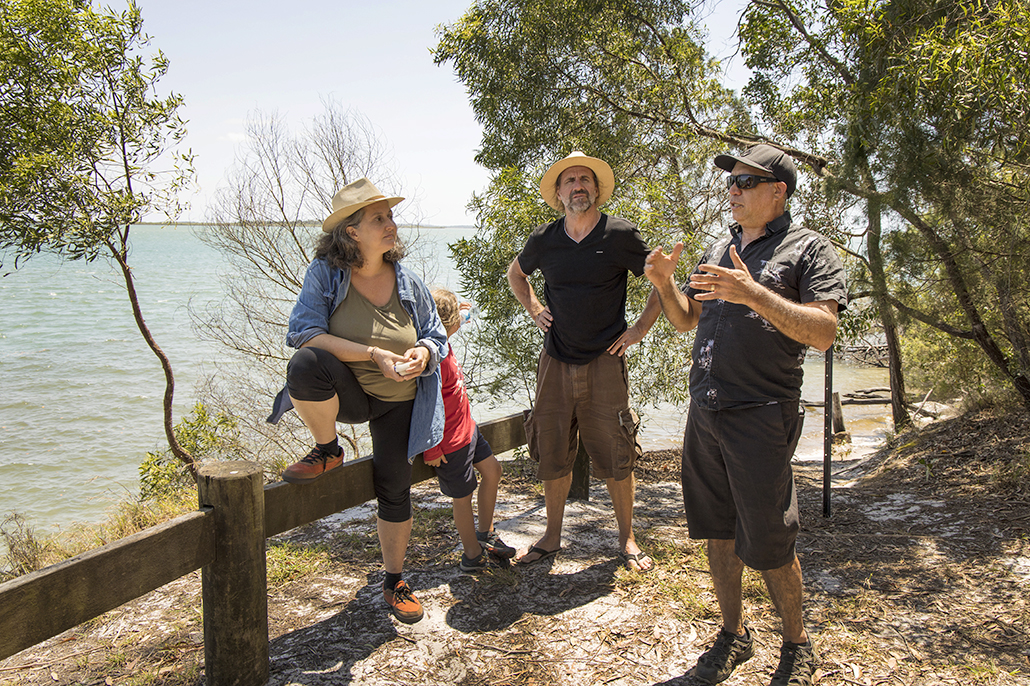
K’gari Cultural Experience guide Luke Barrowcliffe explains how Indigenous people once crossed from the mainland to Ungowa on their journey to the Tailor Festival.
The Heart of a K’gari Cultural Experience
Luke explained that the journey had its origins in Butchulla Country near Bauple Mountain, with pathways eventually taking people across the Great Sandy Strait to K’gari.
Indigenous families travelled this way to the island’s eastern beaches for the annual Tailor fishing season, when vast schools of fish gathered. It became one of the island’s great seasonal events: a time of community, harvesting, sharing and plenty.
Standing there, I imagined thousands of years of footsteps crossing the same terrain. It was hard not to feel the weight of continuity. Culture moves not only through language and art, but through the land itself.
From Ungowa to Eurong: Reading the Landscape
Luke points out fresh bearded dragon tracks along the bush trail.
Our K’gari cultural experience took us across the island from Ungowa, winding inland towards Eurong. Along the way, the landscape shifted from stringybark and scribbly gum forest to softer sand and coastal heath.
A casual visitor might simply see bush. Luke showed us how to read the landscape as a living map.
Palm trees can indicate freshwater just beneath the sand. Certain plants have medicinal or ceremonial properties. Tracks tell stories about who, or what, has crossed the sand and how recently.
It was a reminder that Country is more than landscape. It is memory, science and story all at once.
The French visitors listened intently. At times they whispered translations to each other; at others, they simply absorbed their surroundings. It felt as though K’gari’s meaning could cross cultural boundaries, even without a shared language.
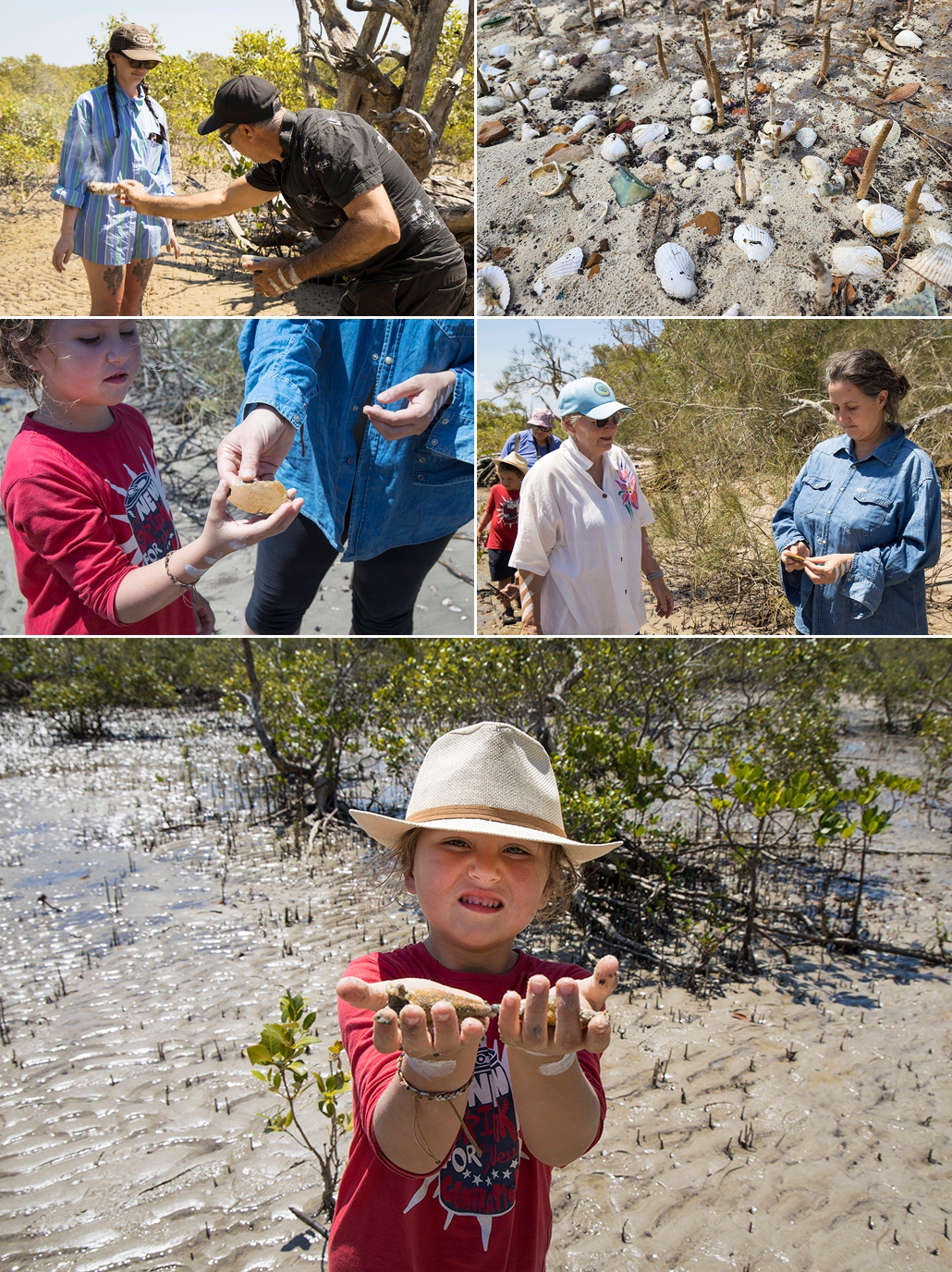
Before stepping onto sacred ground, Luke performs a smoking ceremony near ancient shell middens — traces of generations who lived, gathered, and shared on K’gari.
Bush Tucker: Food as Knowledge
As we walked, Luke pointed out native plants traditionally used as food, medicine or materials. Some flavours can seem sharp or bitter to an unfamiliar palate, while others are surprisingly familiar.
Bush foods weren’t simply “snacks along the way”. They formed part of the seasonal knowledge required to live with the land, rather than against it.
The tucker still features today, although often in a different context. Many native ingredients, once closely tied to place and purpose, are now available in modern forms. Sustainability and community benefit remain important considerations.
Ethical suppliers such as Kakadu Plum Co. stock native herbs, spices and teas, making it possible to bring some of these flavours into everyday cooking. Nothing, however, compares with learning about the plants where they grow.
Food, as Luke reminded us, is knowledge. And knowledge is a responsibility.
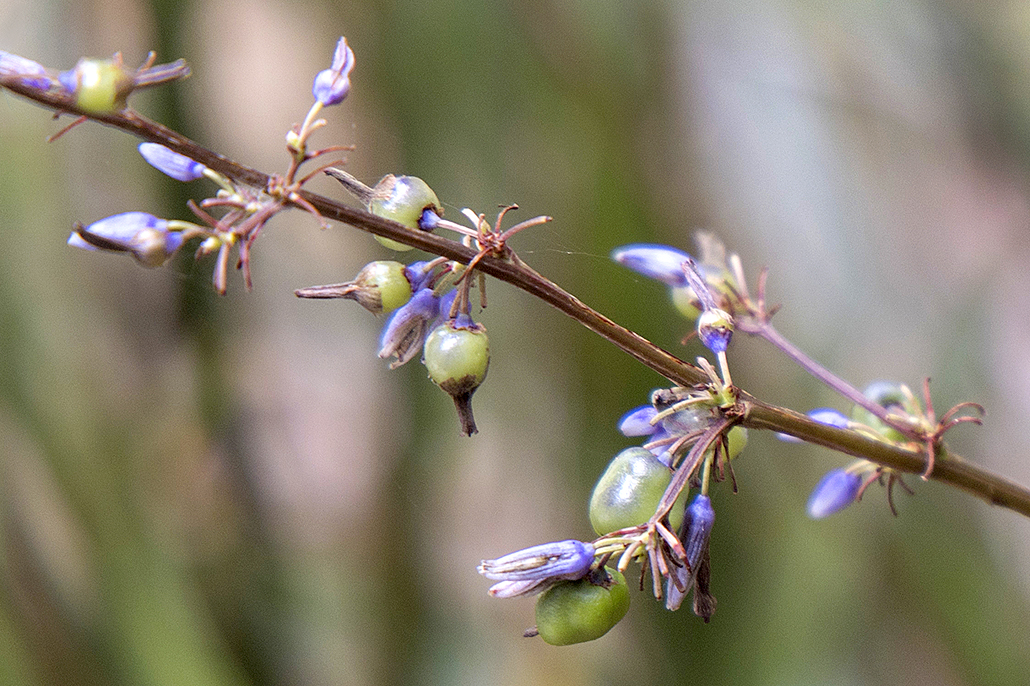
Flax lily (Dianella species) — its small purple berries were eaten in moderation by Indigenous Australians, while the leaves were used for weaving and making string.
The Tailor Season Pilgrimage
Eventually, our path opened onto the coastline, that iconic stretch from Eurong along the sand highway towards Indian Head and the Champagne Pools. The ocean felt immense, folding endlessly onto the beach with patient insistence.
This place was, and remains, the heartbeat of Tailor season.
Luke described how people once gathered here in large numbers to fish, share, celebrate and reconnect with community. Modern anglers continue the pilgrimage each year, drawn by the same run of fish and the timeless rhythm of tide and season.
Different equipment, different stories. The pull of the sea remains the same.
It struck me that culture can continue even when expressed in new forms. Continuity isn’t always dramatic. Sometimes, it’s simply a fishing rod where once there was a spear.
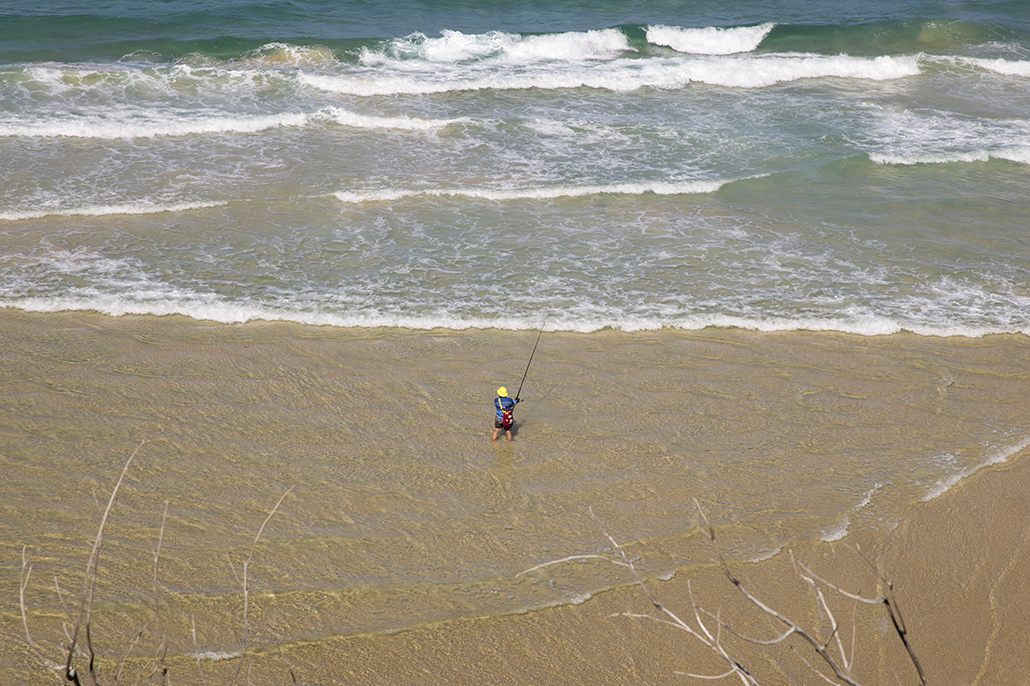
Today’s anglers still make the annual pilgrimage to fish for tailor on K’gari, continuing a tradition once carried out with spears along the same shoreline.
Take Only Memories
One of the most meaningful parts of our K’gari cultural adventure came from what wasn’t said. There were respectful, considered pauses when nobody needed to fill the space.
We were guests on Country. With that comes a responsibility to listen, observe and leave no trace except, perhaps, a changed perspective.
At one point, the French group fell silent as we took in the layered cliffs of Indian Head rising above us. Stories belong to this place. Some are shared, some are held close, and others are not meant for tourists’ ears.
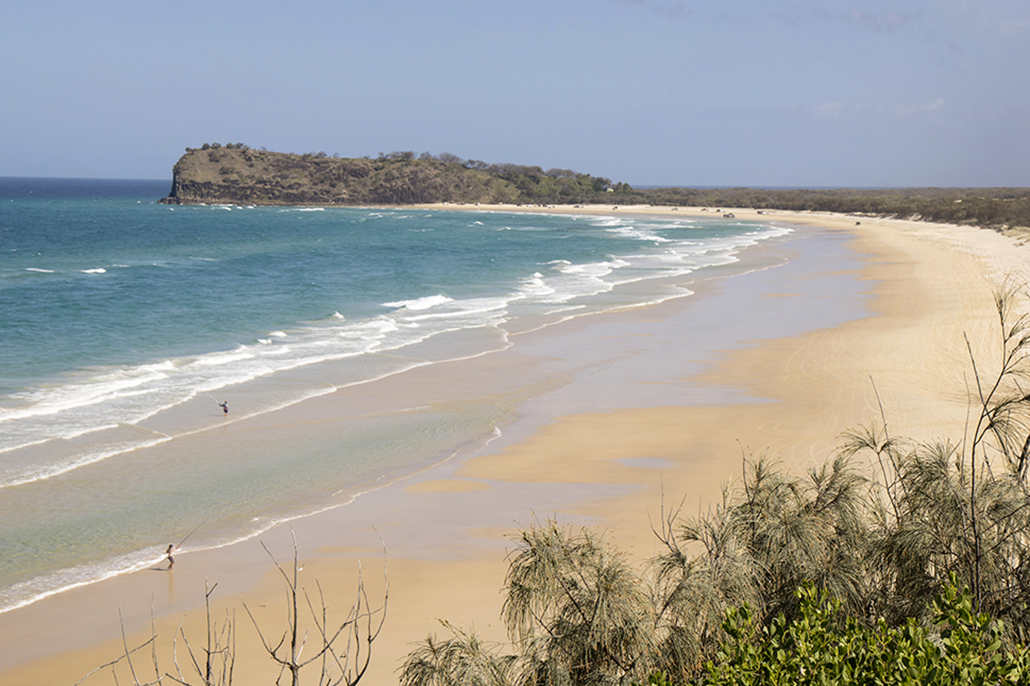
Indian Head, a striking headland on K’gari, holds stories that stretch far beyond its sweeping ocean views.
Champagne Pools: Saltwater, Sunlight and Reflection
Our final stop was the Champagne Pools, where the ocean breaks over volcanic rock and the water bubbles and fizzes like a natural spa.
Luke explained that Butchulla people once used the Champagne Pools as natural fish traps, capturing fish as the tides ebbed and flowed.
The water was cool and clear. Soon, the mood shifted from contemplation to something joyfully human: laughter, splashes and shared delight in the simple pleasure of being alive in a beautiful place.
Yet the island’s presence remained. The rocks, tides and wind seemed connected to something much older, right down to the water wrapping around our ankles.
At that moment, I realised this wasn’t simply another K’gari cultural experience. It was an invitation to see differently.
That’s not something you pack in your backpack and take home. It’s something you carry with you and allow to change you a little.
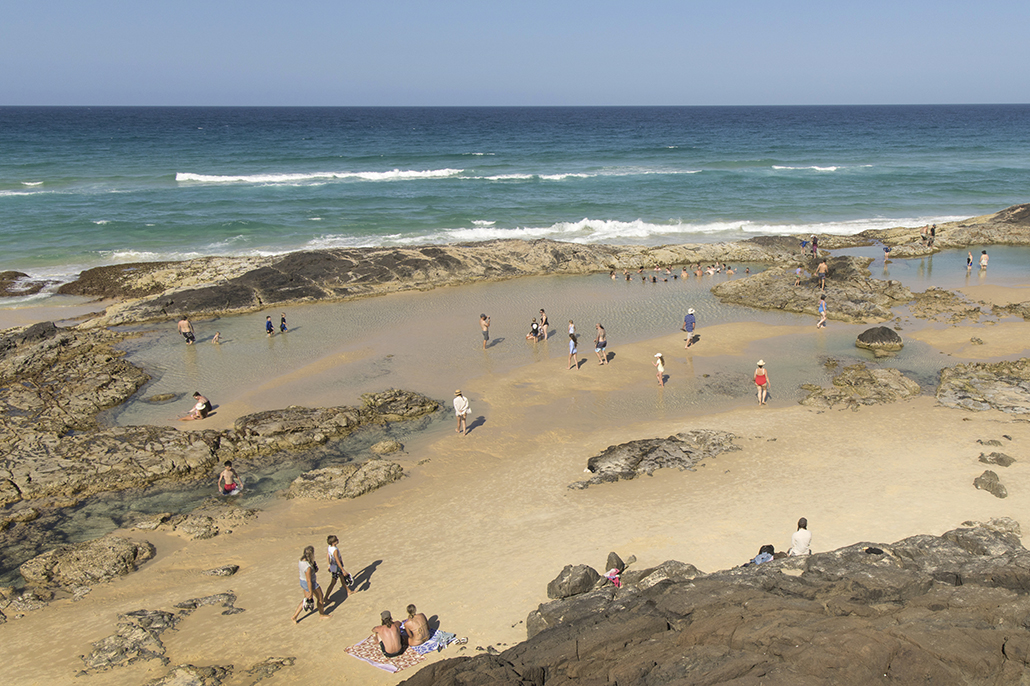
The Champagne Pools on K’gari — once used as fish traps — where ocean waves bubble over rock ledges to create one of the island’s popular natural swimming spots.
K’gari: More Than Paradise, It’s About Presence
K’gari is not just paradise, although it is certainly that. It’s a place of story, relationship and deep time.
Walking this ancient route with Luke wasn’t simply about learning facts. It was about learning how to be present.
- To walk gently.
- To listen deeply.
- To remember that every place has a history, and every history has a heartbeat.
Perhaps the best way to honour that is simply to pay attention.
For another perspective on Butchulla culture and traditions, read about my earlier experience with Luke in Peek into My K’gari Cultural Adventure.
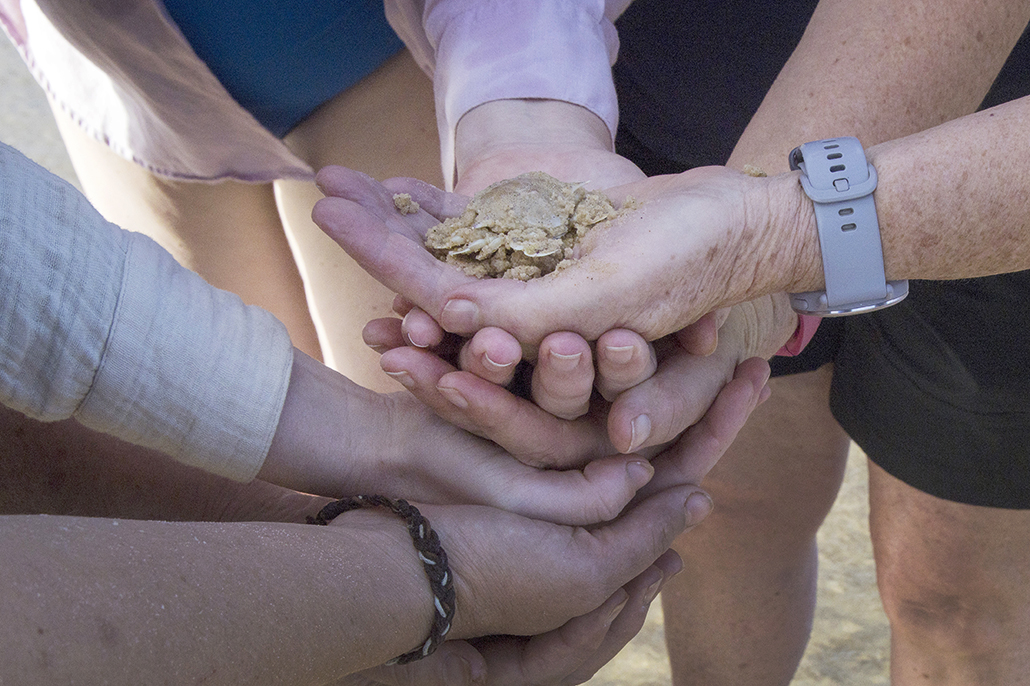
As the tour drew to a close, Luke invited us to make a wish on a small ‘wishing crab’ — a gentle ritual of hope before returning it to the sea.
Interested in a K’gari Cultural Adventure?
Would you like to discover K’gari through the stories, knowledge and traditions of a Butchulla Traditional Owner?
Contact Luke Barrowcliffe at info@brownbitterncommercial.au to enquire about upcoming cultural experiences and booking arrangements.
Exploring K’gari with someone whose family connections span generations offers a perspective that goes far beyond conventional sightseeing.
First time visiting K’gari? Read Your First K’gari Trip: Prepare Before You Cross for practical planning advice.
Tips for Travellers
Preparing for Your K’gari Adventure
A little preparation makes exploring K’gari more enjoyable. Check island conditions, pack light and protect yourself from the sun.
These resources may help you plan a comfortable, worry-free adventure:
→ Travel insurance: Explore options for pre-existing medical conditions with AllClear.
→ Packing organisers: Keep your gear tidy with Bagsmart.
→ Australian-inspired skincare: Discover native botanical products at Kakadu Plum Co.
→ Island essentials: Find sun-smart gear and travel accessories at Amazon Australia.
DISCLOSURE
- This experience, and/or my experiences, are being run as an independent Traditional Owner tourism operation. Being recognised as Native Title common law holders for K’gari and the surrounding mainland and sea Country provides all Butchulla descendants with the opportunity to run their own commercial enterprises on their traditional homeland Country and share their culture more broadly. Luke Barrowcliffe is in the process of building his commercial operations structure so he can host these experiences more often and make them bookable online. Native Title rights and interests also provide Traditional Owners with the legal freedom to incorporate bushfood and medicine tastings into our experiences; this is an exclusive element of Butchulla culture tours that mainstream operators are not afforded.
Jocelyn Watts thanks Luke Barrowcliffe for hosting her on this K’gari Cultural Experience.
Photography by Jocelyn Watts
___
References & Further Reading
Queensland Parks and Forests — Traditional Owners: Butchulla People
Background on Butchulla Country, traditional custodianship and the long cultural connection with K’gari.
Traditional Owners — Butchulla People
Queensland Government WetlandInfo — K’gari (Fraser Island)
Information about traditional pathways to K’gari, seasonal travel and the Tailor fishing gatherings.
Great Sandy Strait and Surrounding Catchments — K’gari
Butchulla Native Title Aboriginal Corporation — Welcome to Butchulla Country
Information from the Traditional Owners about Butchulla Country, including K’gari and its connection with the mainland.
Butchulla Native Title Aboriginal Corporation
Discover 5 Ways to See K’gari (Fraser Island)
IN A WORLD that rarely seems to slow down, finding somewhere to truly switch off can feel like a luxury.
Thankfully, the World Heritage-listed K’gari (Fraser Island), off Queensland’s Fraser Coast, offers an extraordinary escape.
As the world’s largest sand island, K’gari is a place of freshwater lakes, ancient rainforests, colourful sand cliffs and seemingly endless beaches.
Its name means paradise in the language of the Butchulla people, the island’s Traditional Owners. And it’s not difficult to understand why.
If you’re looking for things to do on K’gari, these five experiences offer a wonderful introduction to its natural beauty, history and cultural heritage.
- This article contains affiliate links to selected travel and lifestyle partners. If you make a purchase through one of these links, I may earn a small commission at no extra cost to you. This helps support Jocelyn Magazine and the independent stories I share here.

From above, the brilliant white shores and deep blue waters of Boorangoora (Lake McKenzie) reveal the lake’s extraordinary natural beauty. Photos: Jocelyn Watts.
A brief history of K’gari
K’gari is Butchulla Country, with the Traditional Owners maintaining a deep cultural connection to the island across thousands of years, possibly tens of thousands.
Central to Butchulla culture are three enduring principles: what is good for the land comes first; do not take or touch anything that does not belong to you; and if you have plenty, you must share.
These principles offer visitors a thoughtful way to approach the island today.
Officially returned to its traditional name in 2023, K’gari has been recognised as a UNESCO World Heritage site since 1992.
Its remarkable landscape has developed over hundreds of thousands of years, creating an extraordinary combination of sand dunes, freshwater lakes, towering forests and wildlife.
Five of the best things to do on K’gari
1. Discover the beauty of Boorangoora (Lake McKenzie)
Few places capture K’gari’s natural beauty quite like Boorangoora, better known as Lake McKenzie.
This spectacular perched freshwater lake is famous for its brilliant white silica sand and extraordinarily clear water, which shifts through shades of turquoise and deep blue.
Fed by rainfall rather than streams or rivers, the lake sits above the surrounding groundwater level, supported by natural layers of sand and organic material.
Whether you’re enjoying the scenery, taking photographs or simply sitting beside the water, Boorangoora deserves a place on your K’gari itinerary.
2. Explore Eli Creek and the coloured sands

Thousands of years of natural processes have shaped K’gari’s spectacular layered sand cliffs.
On K’gari’s eastern side, freshwater flows towards the ocean at Eli Creek, one of the island’s best-loved natural attractions.
A boardwalk winds through coastal vegetation alongside the creek, while its clear, flowing water provides a refreshing contrast to the sandy shoreline.
Further along the eastern beach, the landscape changes again.
At The Pinnacles, layers of yellow, ochre, red and brown sand create striking natural formations.
These colours developed as iron-rich minerals stained the sand over thousands of years, with wind and rain gradually exposing the remarkable patterns.
It’s a wonderful reminder that K’gari’s beauty isn’t limited to its beaches and lakes.
3. Experience 75 Mile Beach and the Maheno shipwreck

The SS Maheno is one of K’gari’s most recognisable historic landmarks.
K’gari’s eastern shoreline is unlike an ordinary beach. It’s also a recognised driving route, where tides and changing conditions determine how and when vehicles can travel.
Along this remarkable stretch of coastline stands the rusting skeleton of the SS Maheno, a former luxury liner driven ashore during a cyclone in 1935.
The shipwreck has become one of K’gari’s most recognisable landmarks, particularly for photographers.
Further north, the volcanic headland of Tukkee Wurroo (Indian Head) rises dramatically above the coast. The surrounding waters are known for marine life, including dolphins, turtles and migrating humpback whales.
Access restrictions apply around the headland, so visitors should check current park notices before planning a visit.

K’gari’s magnificent eastern shoreline stretches towards a distant headland, with 4WD vehicles travelling along the sand.
4. Walk among the ancient rainforests
One of K’gari’s most extraordinary natural features is its rainforest.
Despite growing on sand, some of the island’s rainforest trees reach heights of around 50 metres, creating a lush landscape that seems almost impossible in such an environment.
Central Station, once a forestry settlement, is among the best-known places to experience this remarkable ecosystem.
Here, walking tracks and sections of boardwalk lead visitors through towering trees, ferns and palms, with the clear waters of Wanggoolba Creek adding to the tranquillity.
It’s a completely different experience from K’gari’s beaches and dunes, and one that reveals just how diverse the island really is.
5. Discover K’gari through Butchulla culture

Native berries offer an insight into the traditional knowledge of plants and natural resources.
There’s another way to discover K’gari that goes beyond its famous landmarks: experiencing the island through the knowledge and stories of its Traditional Owners.
Butchulla-guided cultural experiences offer visitors an opportunity to learn about Country, traditional practices, native plants, wildlife and the cultural significance of the island’s landscape.
I experienced this first-hand while walking Country with Butchulla guide Luke Barrowcliffe.
What might otherwise have been another beautiful island journey became something much more meaningful. Familiar landscapes took on new significance as Luke explained the connections between people, place and generations of knowledge.
For visitors who want to understand K’gari rather than simply admire it, a cultural experience is well worth considering.
Where is K’gari and how do you get there?
K’gari lies off Queensland’s Fraser Coast, approximately 300 kilometres north of Brisbane and across the Great Sandy Strait from Hervey Bay.
Visitors can reach the island by vehicle barge from River Heads, near Hervey Bay, or from Inskip Point, near Rainbow Beach.
Organised tours provide another option, particularly for those without a suitable 4WD, while flights from the mainland offer a different way to experience the island.
If you’re planning to drive yourself, a suitable high-clearance 4WD is essential. Vehicle permits, tidal conditions and current track restrictions all need consideration before travelling.
Planning your own K’gari adventure?
Whether you have a single day or several nights, K’gari rewards visitors who allow time to appreciate its extraordinary landscapes.
You can explore the practicalities of getting there in Hervey Bay to K’gari: Plan Your Island Stay, discover what to see in K’gari Itinerary: 1, 2 or 3 Days, or prepare for your first visit with Visiting K’gari for the First Time: Essential Guide.
However you choose to discover K’gari, some of the most memorable experiences may be the simplest: walking beneath the rainforest canopy, watching the light change over a freshwater lake or standing beside an ocean that seems to stretch forever.
K’gari’s spectacular scenery has even attracted Australian filmmakers. Discover how the island became a star of the romantic comedy He Loves Me Not, with exclusive behind-the-scenes insights from producer Jeremy Stanford.
Enjoy the journey and leave this extraordinary island just as beautiful as you found it.
Tips for Travellers
Preparing for Your K’gari Adventure
A little preparation makes exploring K’gari more enjoyable. Check island conditions, pack light and protect yourself from the sun.
These resources may help you plan a comfortable, worry-free adventure:
→ Travel insurance: Explore options for pre-existing medical conditions with AllClear.
→ Packing organisers: Keep your gear tidy with Bagsmart.
→ Australian-inspired skincare: Discover native botanical products at Kakadu Plum Co.
→ Island essentials: Find sun-smart gear and travel accessories at Amazon Australia.
Photography by Jocelyn Watts
Visit the photo gallery.
Learn How K’gari Cultural Tours Connects Past and Present
I THOUGHT I knew K’gari (Fraser Island) well. Then I spent two days on a K’gari cultural adventure with Butchulla guide Luke Barrowcliffe. That experience deepened my understanding of the Butchulla people’s enduring connection to Country.
K’gari is the world’s largest sand island and a UNESCO World Heritage Site. Visitors come for its pure wongari (dingo) population and the haunting wreck of the SS Maheno. During World War II, the island also served as a secret training ground for Z Force commandos.
After three decades working in Fraser Coast media, I knew these stories and many more.
In 2014, I witnessed 450 Butchulla people gather to hear Justice Berna Collier recognise their native title.
Four years earlier, I spent a week with veteran photographer Darran Leal, capturing K’gari’s remarkable wildlife and landscapes.
Yet my understanding of the island’s Indigenous culture barely scratched the surface.
That changed when Luke shared his knowledge, stories and deep connection to Country.
Luke’s family ties to K’gari run deep. His cultural mentor, Aunty Olga Miller, is a respected historian, artist and author. His mother, NaiNai Bird, illustrated several of Aunty Olga’s books. These include Fraser Island Legends and Legends of Fraser Island.
With Luke leading the way, I saw familiar places through a different lens. His storytelling connected the island’s landscapes with generations of Butchulla knowledge, traditions and history.
Read on to join me as I revisit those two unforgettable days.
*This article contains affiliate links. If you click through and make a purchase, we may earn a commission, at no extra cost to you. It’s how we keep creating helpful stories and guides for you.
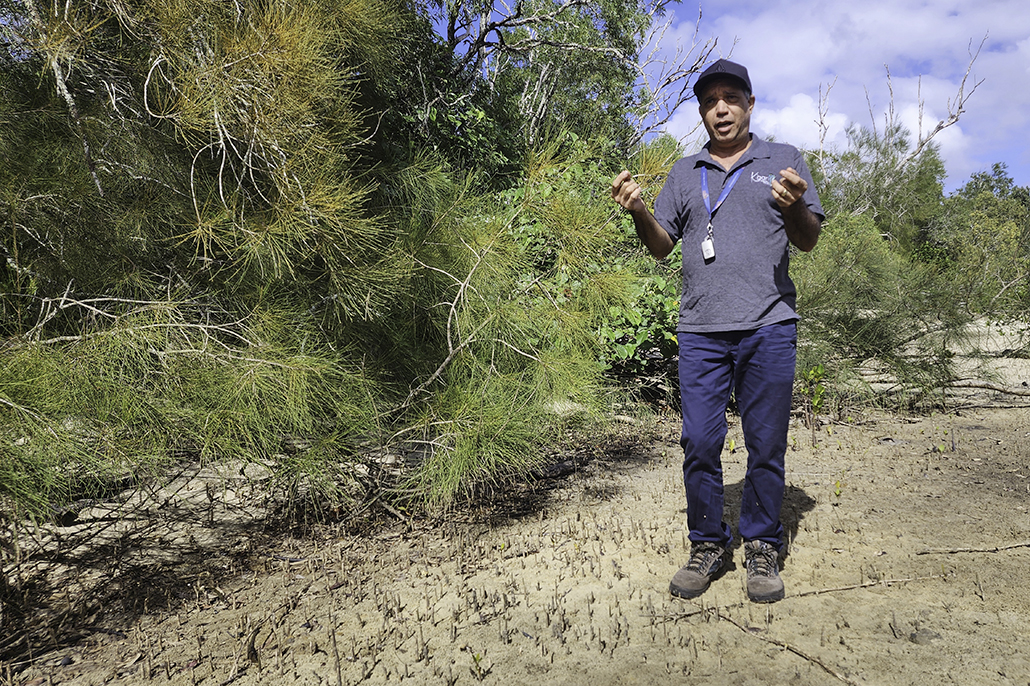
Butchulla man and tour guide Luke Barrowcliffe welcomes us to K’gari. Photos: Jocelyn Watts
An Unexpected Adventure on K’gari
I joined the adventure almost by chance. My friends Jill Byrnes and Jan Hollier needed a third person for a customised trial experience. The outing formed part of plans for a new venture.
Luckily, I had time to spare. They didn’t need to ask twice.
We boarded the barge at River Heads and crossed the scenic Great Sandy Strait towards kangaroo. The panoramic views whetted our appetite for the adventure ahead.
At Kingfisher Bay Resort, we stopped briefly for coffee and last-minute supplies. Then, we set off to discover more of K’gari’s Butchulla heritage and natural wonders.
Discovering Ancient Shell Middens
Luke led us to a secluded site where ancient shell middens lay among the mangroves.
“This is not a spot where people would usually come,” Luke said.
“It’s among mangroves, but mangroves were a productive source of food for our mob. Here, Aboriginal people gathered to feast on shellfish. They threw the shells away, which built up over thousands of years. All around Australia’s coastline, you’ll find middens like these.
“What’s also interesting is these middens have a lot of stone artefacts amongst them. There’s also ceramics and glass from the transition period of contact with Europeans.”
We examined shells, stones, ceramics and glass in an assortment of colours and shapes. Each discovery offered another glimpse into K’gari’s long human history.
We could have lingered much longer, but more discoveries awaited us.
For further reading on shell middens, explore this Queensland Museum research paper.

Aboriginal Shell Middens on K’gari.
Making String from Cottonwood Fibre
As we headed back to the car, Luke gathered small branches from a cottonwood tree. He had plans for another activity later in the day.
We would strip the bark with our thumbnails to reveal the inner fibre. Then we would use the fibres to make string for weaving baskets from palm fronds.
“It’s the inner bark you’re aiming for,” he said. “Use your thumbnail to peel back the fibre. You’ll need pieces that are about a metre long. Your nail acts like a scraper. Our women used to grow their nails long for tasks like this, and for handling prickly, toxic items.”
My nail-biting habit left me poorly equipped for the task. Fortunately, a small kitchen knife came to my rescue.
Ungowa: First Encounters and a Picnic by the Strait
Our next stop was Ungowa, on K’gari’s south-western shore. Towering eucalyptus trees provided shade, while sweeping views stretched across the Great Sandy Strait to the mainland.
Luke shared a Butchulla account of the first European ships appearing in the Strait. This was long before Ungowa became a regular mainland access point and a base for the forestry department.
“Our mob couldn’t comprehend what they were seeing. They knew beforehand that something was coming, though, because the message had been passed up the coast from Sydney. Each group, on seeing the ship, sent a smoke signal to neighbouring groups that something strange was in the ocean. They’d never seen a ship like that. They were spooked and superstitious.”
Today, Ungowa offers visitors a peaceful place to picnic and enjoy the scenery. On a clear day, views extend towards Bauple Mountain near Tiaro.
We settled beneath the eucalyptus trees to enjoy a picnic lunch prepared for our group. The menu featured roast beef sandwiches with quandong relish, native bush tomatoes and warrigal greens.
One unexpected highlight was Sobah’s Lemon Aspen Pilsner, a non-alcoholic craft beer made with native ingredients on the Gold Coast. Its refreshing citrus flavour added another Australian bush-food dimension to our lunch.
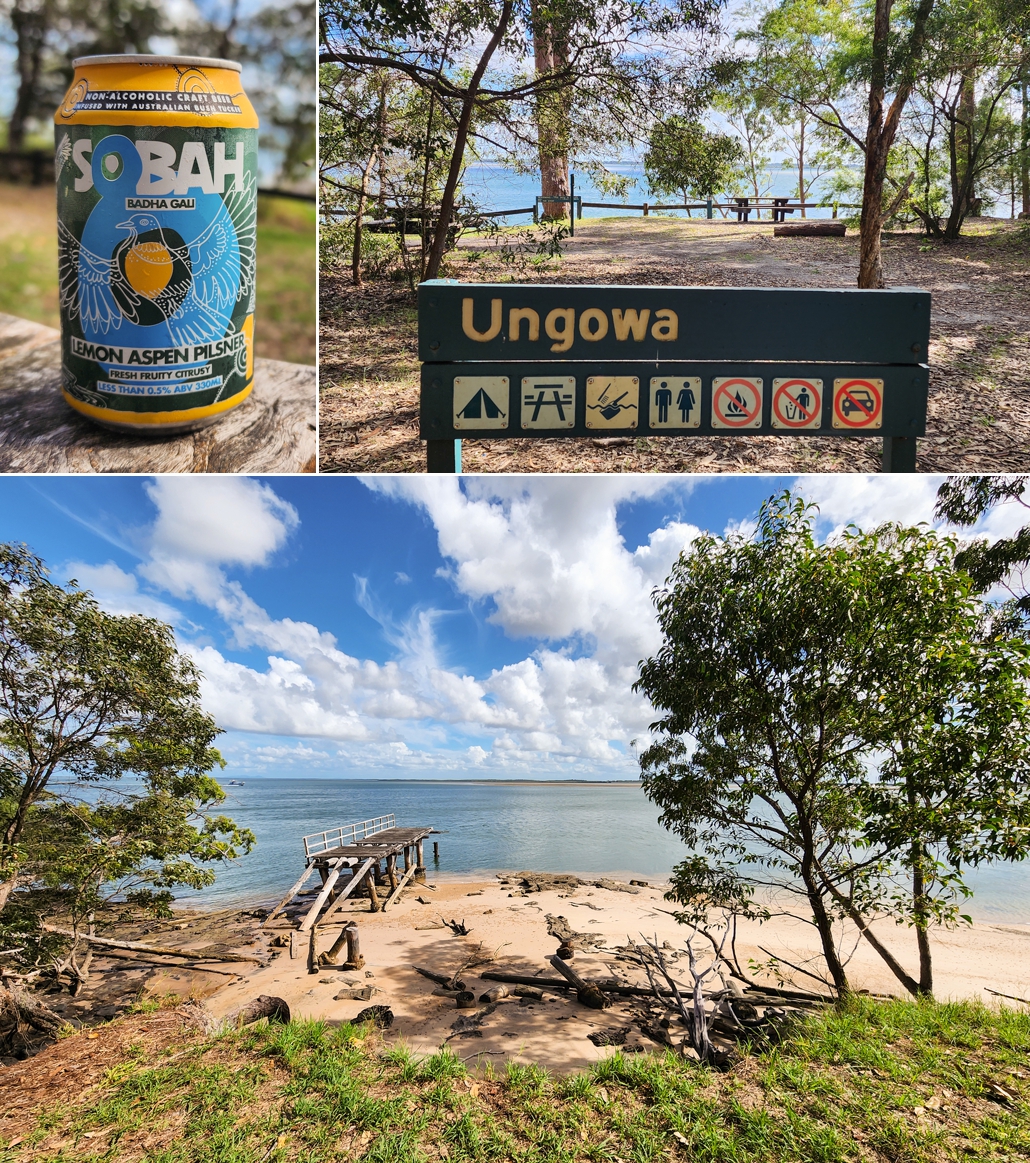
The breathtaking view from Ungowa on K’gari, gazing towards the mainland.
Ancient Trees and the Ghostly Maheno

A scar tree photographed during my K’gari cultural adventure with Butchulla guide Luke Barrowcliffe.
After lunch, Luke showed us a scar tree, and we stopped to photograph it. Its scars offered a glimpse into generations of Aboriginal knowledge and craftsmanship.
Traditionally, Aboriginal people removed bark or wood to make canoes, shelters, shields, containers and tools. Many of these trees continued growing long after the material was removed.
Next, we explored Central Station, once a busy logging camp in K’gari’s timber industry. During the early 20th century, workers harvested valuable timber, including satinay and kauri pine.
Today, lush rainforest surrounds the historic site, showcasing the island’s remarkable ecosystem.
“Experts estimate the creek here has been running for over 2000 years,” Luke said. “Rainwater is filtered through the sand for over 100 years before it comes back up through the spring.”
At Central Station, we also gathered native fruits, including crab apples, to add to our menu.
“Look for yellowish berries fallen on the ground,” Luke said. “We know a lot of our edible fruits and berries are ripe once they have fallen onto the ground.”
The crab apples tasted tart, rather like green apples. Their sharp flavour makes them suitable for sauces, jams and jellies when balanced with sweetness.
We also sampled small, reddish lilly pilly berries and midyim berries. The latter surprised me with their cinnamon-like flavour, which seemed perfect for cooking.
By mid-afternoon, we headed towards 75 Mile Beach on K’gari’s eastern coast.
As we approached the Maheno shipwreck, its rusting hull emerged through the misty rain like a ghostly sentinel.
The remains of the once-proud ocean liner stood against the vast beach, creating a haunting and unforgettable scene. I found myself reflecting on the power of nature and the passing of time.
Just before sunset, we travelled along the beach towards The Haven, our accommodation for the night. Along the way, we looked for a suitable spot to gather eugaries (also known as pipis) for dinner.
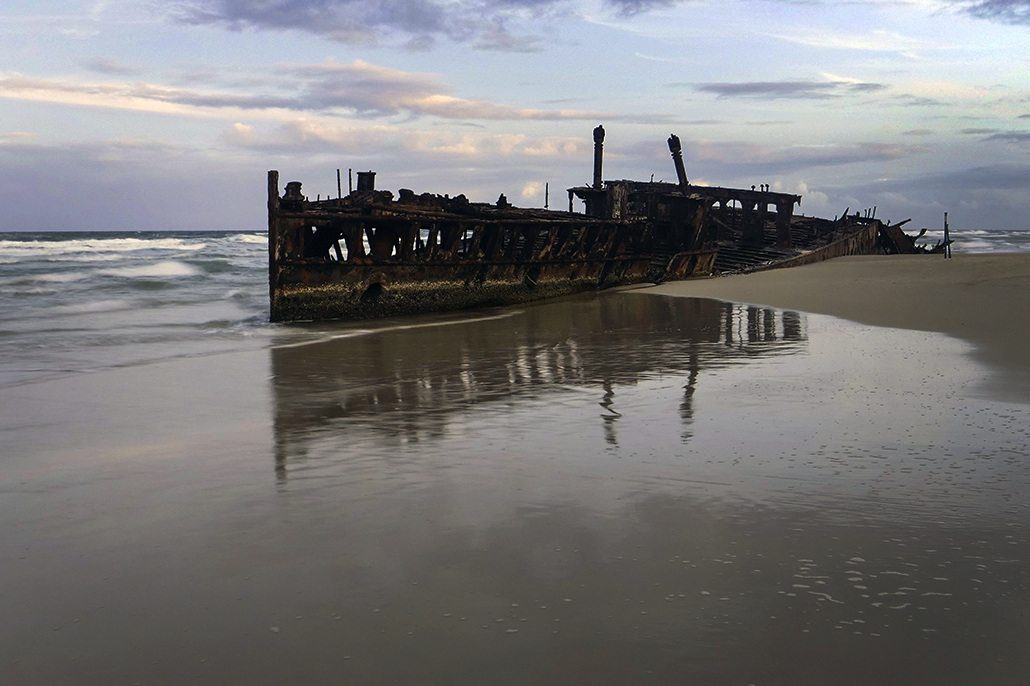
The Maheno shipwreck at dusk on K’gari (Fraser Island), Queensland.
The Eugarie Twist: Dancing for Dinner on K’gari
Finding eugaries takes a certain knack, and Luke had mastered it. He twisted his feet from side to side in the wet sand, then scooped up the shellfish. They would become our dinner that evening.
I couldn’t help thinking of the Twist dance craze of the 1960s. Who knew gathering dinner could look so much like dancing?
Jan soon joined Luke, but Jill and I were less enthusiastic. Jill tried digging with a piece of cuttlefish, without success.
I kept my camera safely away from the sand and photographed the action instead.
Between them, Luke and Jan collected dozens of eugaries. They stored their catch in a palm-frond basket, tied with string made from cottonwood fibre.
On our drive back to The Haven after sunset, Luke spotted a bandy-bandy snake in the headlights. By the time we stopped, it had disappeared into the dunes. My Samsung Galaxy S22 Ultra never got its chance.
The bandy-bandy’s striking black-and-white bands make it one of Australia’s most distinctive snakes. When threatened, it may raise and loop its body in a dramatic defensive display before retreating.
Back at The Haven, Jill, Jan and I relaxed over our BYO red wine. Luke, meanwhile, turned his attention to dinner.
He prepared a delicious eugarie risotto, finished with lemon-scented myrtle powder and native parsley.
After our afternoon on the beach, every mouthful tasted especially good.

Tour guide Luke Barrowcliffe and Jan Hollier collect eugaries for dinner.
Morning Feast: Pancakes and Finger Lime Marmalade
Luke was still in chef mode the next morning, mixing batches of apple and cinnamon pancake batter.
He served the pancakes with a tempting selection of Australian native spreads. These included roasted macadamia spread, riberry jam, desert quandong jam, rainforest plum jam and bush apple spread.
There was also native honey and marmalade made with Australian finger limes.
Naturally, so many delicious choices called for more pancakes!
My favourite was the Australian Finger Lime Marmalade. It combined the familiar taste of traditional marmalade with a distinctly Australian twist.
The first mouthful delivered a bright citrus burst, followed by a gentle sweetness that balanced the tartness. Refreshing, tangy and delicious!
We could also add sliced banana, Greek-style yoghurt, lilly pilly berries or bush crab apple berries. Native tea and wattleseed-infused coffee completed the breakfast menu.
Well fed and ready for another adventure, we climbed back into the 4WD.
We followed 75 Mile Beach along K’gari’s eastern coast, heading towards Waddy Point, the Champagne Rock Pools and Indian Head Lookout.
Luke explained that Butchulla Traditional Owner operators had different commercial access arrangements from other tourism operators. These included opportunities to share traditional cultural practices and experiences with visitors.*
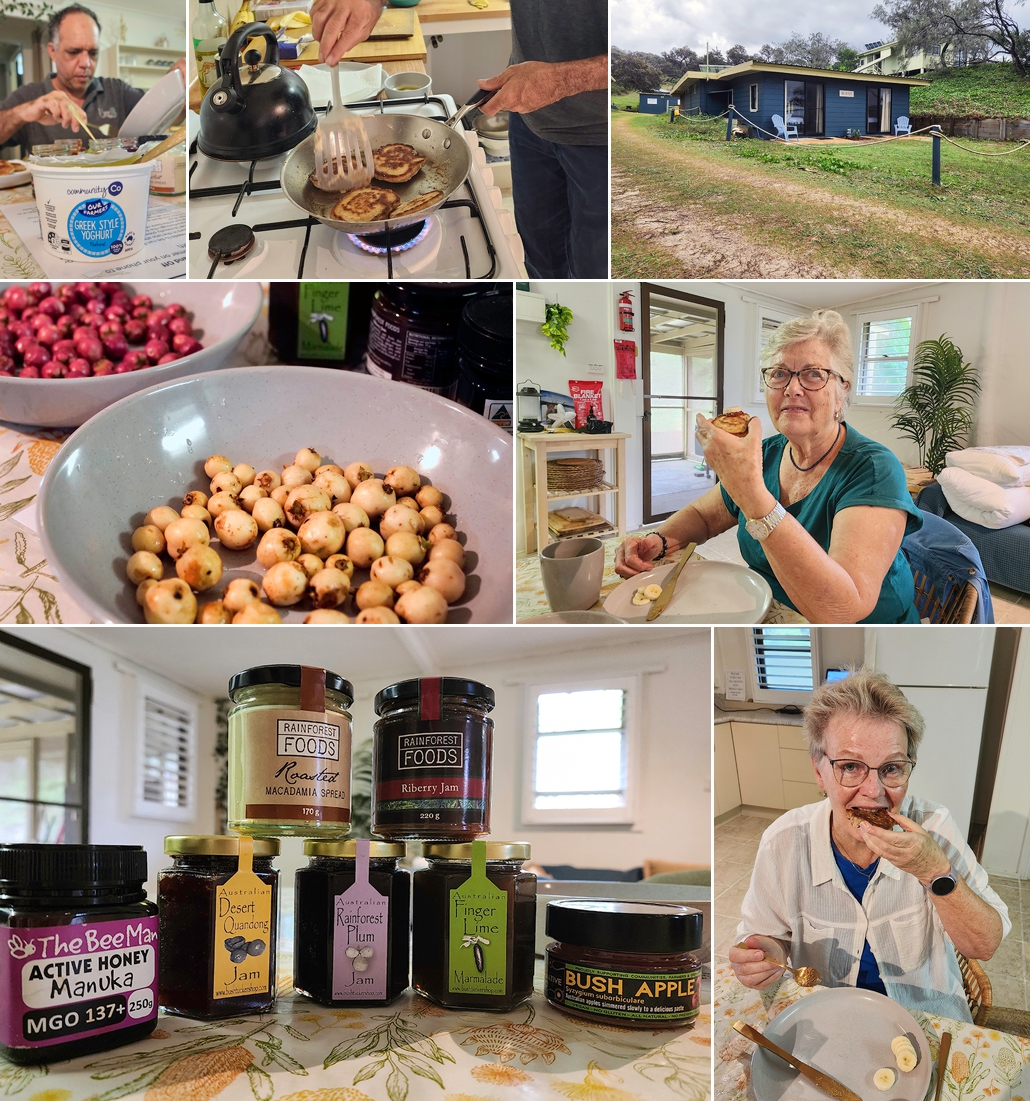
Jan Hollier and Jill Byrnes enjoy delicious pancakes for breakfast at The Haven, topped with Australian spreads, banana, and Greek yoghurt, accompanied by native berries.
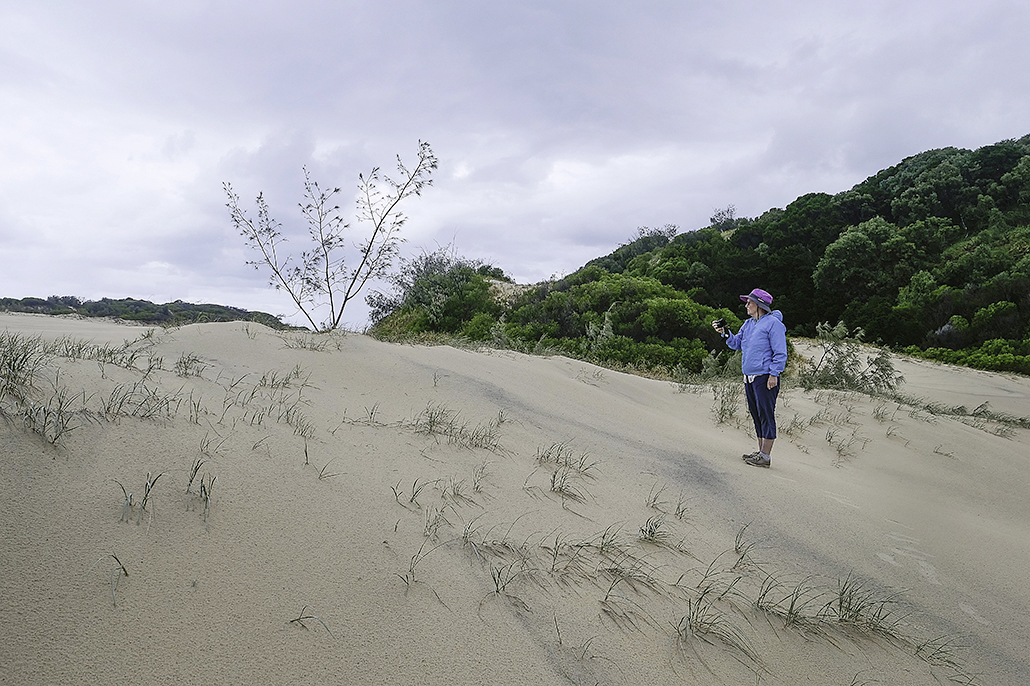
Jill Byrnes captures dunes at Waddy Point.
Butchulla Traditions and a Spiritual Connection to Country
We drove through Happy Valley, a small seaside settlement nestled among the dunes on K’gari’s eastern coast.
The village offers a café, shops and holiday accommodation. Its location makes it a convenient base for visiting the Maheno Shipwreck, Eli Creek and The Pinnacles.
Along the way, Luke spoke about his ancestors travelling to this part of K’gari for seasonal tailor festivals.
The abundant fish provided food and brought families together. Luke described these journeys as part of the Big Walk, connecting Aboriginal communities across Country.
“The walks were not just physical journeys but also opportunities for gathering knowledge, sharing stories through song and dance, and taking part in ceremonies,” he said.
These gatherings strengthened cultural knowledge and connections between people and Country.
Listening to Luke, I reflected on our shared human desire to travel, discover new places and feel a sense of belonging. Yet these traditional journeys carried cultural meaning far beyond simply exploring somewhere new.
Near Indian Head, Luke shared a childhood memory that revealed the headland’s spiritual significance to the Butchulla people.
“When I was young, I was taught that I wasn’t allowed to touch that rock because of its spiritual power,” he began.
“Only initiated men could go on the rock or touch it. Every time we came up here, Auntie Olga would be on at me, saying don’t touch that rock!
“I was under 16 and hadn’t done any ceremonial stuff. So, I waited until I had done the ceremony, then walked up the headland with hiking boots on.
“Not feeling anything, I believed I couldn’t connect with the spiritual power of the rock. But as we were driving back down the beach, I was near the Maheno and my feet started tingling and buzzing. I was full of jittery energy. I’ve never had another experience like that.”
His story offered a deeply personal insight into the spiritual relationship between the Butchulla people and their ancestral Country.
As at October 2026, the walking track at Tukkee Wurroo (Indian Head) remains closed because of severe erosion. Visitors should check the Queensland Parks alert before planning a walk.
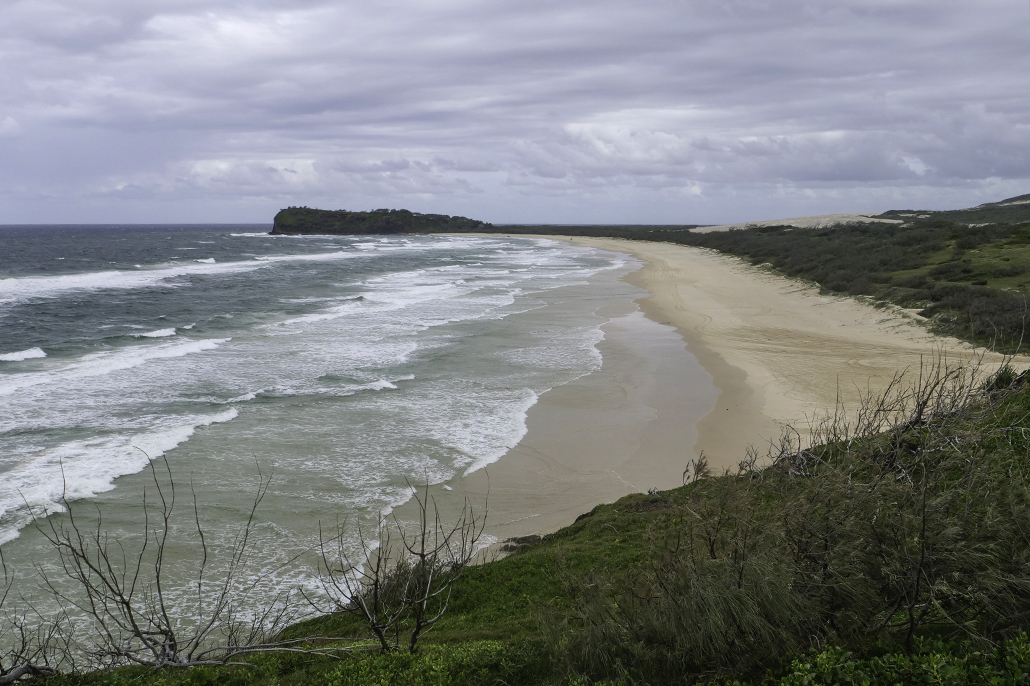
The sweeping view from the lookout near the Champagne Rock Pools towards Indian Head.
Fish Traps, Coffee Rock and Sacred Country
At Champagne Pools, near Indian Head, Luke explained how the natural rock formations helped Butchulla people catch fish during tailor season.
“In traditional times, we might have built the wall on the northern side to improve the traps’ functionality to trap a greater number of fish as the tide rose.”
On our return journey, Luke explained how K’gari’s remarkable sand dunes formed over time.
The University of the Sunshine Coast describes the dunes as “part of the longest and most complete age sequence of coastal dune systems in the world and are still evolving.”
Luke also pointed out dark brown coffee rock exposed along the beaches. He explained how layers of ancient organic matter had hardened over time, forming distinctive rock formations. Coastal erosion had since exposed some of these layers.
“The coffee rock is an interesting geological process that has taken millions of years to form, and then millions of years more of weathering as the rocks become exposed.”
Our conversations then turned to Butchulla creation stories and the cultural significance of different places on the island.
Luke described traditional men’s and women’s areas, including special birthing sites that hold cultural significance for the Butchulla people.
“Aboriginal society was gender-segregated, so we had men’s and women’s areas. Traditionally, all the children (girls and boys) grew up under the guidance and care of the woman, until the boys were old enough (10-12 years of age) to learn to be hunters and warriors with the men.
“Outside of having specific gendered areas, even in our communal areas, men, and women would remain in their groups. This is quite different to how we live today.”
These stories, and many more, kept us engrossed throughout the journey back across K’gari.
By the time we reached the barge at dusk, I had gained a deeper appreciation of the island’s remarkable heritage.
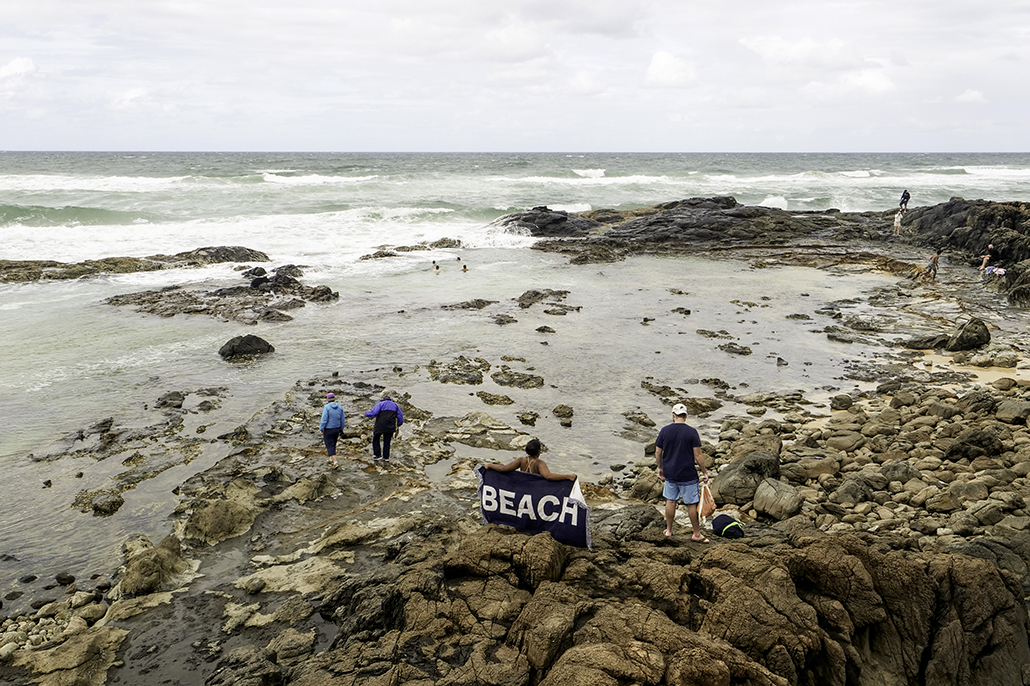
Sightseers swim in the Champagne Rock Pools, which once served as fish traps for the Butchulla people.
Reflections on Culture, Nature and Connection
As we farewelled K’gari, I reflected on everything Luke had shared during our two-day adventure.
His storytelling and knowledge revealed layers of Butchulla history and culture I had never fully appreciated.
We explored natural fish traps at Champagne Pools and discovered the cultural significance of places like Central Station and Indian Head. Watching wongari (dingoes) roam the beaches also reminded me of K’gari’s extraordinary wildlife and natural beauty.
I left with wonderful memories, countless photographs and a deeper appreciation of the connections between people, culture and Country.
Before this adventure, I thought I knew K’gari. After those two days, I realised how much more there was to discover.
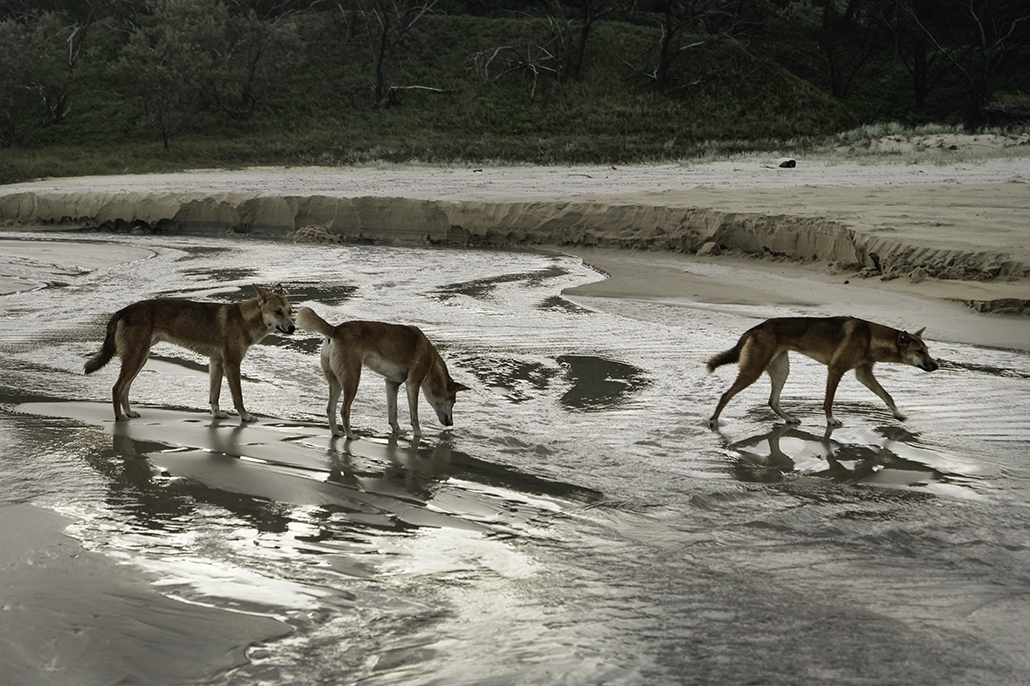
Wongari (dingoes) roam along the beaches of K’gari at dusk.
Interested in a K’gari Cultural Adventure?
Would you like to discover K’gari through the stories, knowledge and traditions of a Butchulla Traditional Owner?
Contact Luke Barrowcliffe at info@brownbitterncommercial.au to enquire about upcoming cultural experiences and booking arrangements.
Exploring K’gari with someone whose family connections span generations offers a perspective that goes far beyond conventional sightseeing.
First time visiting K’gari? Read Your First K’gari Trip: Prepare Before You Cross for practical planning advice.

Sunset as we departed K’gari, onboard the barge heading towards River Heads.
Tips for Travellers
Preparing for Your K’gari Adventure
A little preparation makes exploring K’gari more enjoyable. Check island conditions, pack light and protect yourself from the sun.
These resources may help you plan a comfortable, worry-free adventure:
→ Travel insurance: Explore options for pre-existing medical conditions with AllClear.
→ Packing organisers: Keep your gear tidy with Bagsmart.
→ Australian-inspired skincare: Discover native botanical products at Kakadu Plum Co.
→ Island essentials: Find sun-smart gear and travel accessories at Amazon Australia.
Photography by Jocelyn Watts
View the photo gallery
* DISCLOSURE — LUKE BARROWCLIFFE
The following statement was provided and approved by Butchulla guide Luke Barrowcliffe at the time of this experience.
This experience, and/or my experiences, were run as an independent Traditional Owner tourism operation. Being recognised as Native Title common law holders for K’gari and the surrounding mainland and sea Country provides all Butchulla descendants with the opportunity to run their own commercial enterprises on their traditional homeland Country and share their culture more broadly. Luke Barrowcliffe is in the process of building his commercial operations structure so he can host these experiences more often and make them bookable online. Native Title rights and interests also provide Traditional Owners with the legal freedom to incorporate bushfood and medicine tastings into our experiences; this is an exclusive element of Butchulla culture tours that mainstream operators are not afforded.
___
References & Further Reading
Queensland Parks and Forests — Traditional Owners: Butchulla People
Background on Butchulla Country, traditional custodianship and the long cultural connection with K’gari.
Traditional Owners — Butchulla People
Queensland Government WetlandInfo — K’gari (Fraser Island)
Information about traditional pathways to K’gari, seasonal travel and the Tailor fishing gatherings.
Great Sandy Strait and Surrounding Catchments — K’gari
Butchulla Native Title Aboriginal Corporation — Welcome to Butchulla Country
Information from the Traditional Owners about Butchulla Country, including K’gari and its connection with the mainland.
Butchulla Native Title Aboriginal Corporation
Behind the Scenes of He Loves Me Not on K’gari
WHEN Australian filmmakers, Fraser Coast Films, chose K’gari (Fraser Island) as the setting for a romantic comedy, they found much more than beautiful scenery.
The island’s sweeping beaches, freshwater lakes and natural beauty became central to He Loves Me Not, a film written and produced by Jeremy Stanford and directed by Tam Sainsbury.
Filming centred around Kingfisher Bay Resort, bringing together established Australian actors, a dedicated production crew and local Fraser Coast residents. But shooting a film on an island presented some unusual challenges, from transporting equipment by barge to working within a relatively isolated environment.
I was fortunate enough to be involved as an extra, making a brief appearance in one of the beach scenes; very much a blink-and-you’ll-miss-it moment!
During filming, I also spoke with Stanford about the experience of bringing the production to K’gari. He shared exclusive insights into the logistical challenges, creative decisions, community involvement and the importance of allowing the island itself to become part of the story.
Since then, He Loves Me Not has reached international audiences through streaming and video-on-demand services, introducing viewers to one of Queensland’s most remarkable natural landscapes.
But what was it really like bringing this romantic comedy to life on K’gari?
From the archives: This interview was originally published in October 2023, while filming was under way. Stanford’s answers have been preserved in their original context, offering a behind-the-scenes snapshot of the production.
- This article contains affiliate links. If you click through and make a purchase, I may earn a commission at no extra cost to you. This helps support Jocelyn Magazine.

The cast of He Loves Me Not. Top row, from left: Rhiannon Fish as Holiday, Lincoln Lewis as Adam and Georgie Parker as Marissa. Bottom row: Sean Perez as Mikey, Naomi Sequeira as Jemma and Bonnie Sveen as Tracey. Candice Hill, who plays Bella, is not pictured. Photos: Contributed.
Exclusive Interview: Jeremy Stanford Q&A
What are the challenges and advantages of filming on K’gari?
Let’s start with the challenges. Because it’s being filmed on an island, everything we have, we have to bring over with us.
We had a lot of cars to bring, plus camera equipment, lighting equipment, sound equipment, costumes, and the art department; all of that had to come over on the barges and we had to find somewhere to put it.
So, at the moment, it’s in everybody’s villas or hotel rooms being sorted through. We’re cramped and living in each other’s pockets.
Another challenge is that if we don’t have something we need, we have to go to the mainland to get it.
Those are the logistical challenges where we have to think ahead. A lot of pre-planning went into putting this shoot together.
The advantages are that we’re all staying and living in the same place, and working in the same place.
So, at night we’ll come back and we’ll finish the day, have dinner, and we can start talking about what is going to happen the next day; pre-planning.
People are getting to know each other and having dinner. It’s a really collegiate kind of environment to make a film.
Usually, people will just get in their cars and go home, but for us, we just go back to our hotel rooms.
Has the local environment influenced any creative decisions?
When we conceived this film, we came over to K’gari and spoke with the managing director of Kingfisher Bay Resort to make sure they were happy to partner with us, and for us to come here and make this film.
We didn’t put pen to paper before we got their okay. Once they said they were interested and they wanted to be part of it, we created the script literally around the resort.
So, Tam (Sainsbury) and I were literally by the pool talking about story ideas and where we could set each scene. We walked around the resort and went to Lake McKenzie and Pile Valley.
We drove around the island, and the film came out of it. As a result, we want K’gari itself to be a character in the film. So, we’ve put some of the history of the island into it, and the locations, plus we wanted to put some indigenous story into it as well.
So, we partnered with the Butchulla people, and there’s a planned Welcome to Country in the film that talks a little about their story and the indigenous history of the island too. That way, we create a really rounded picture of what this place is.

The steps leading down to Lake McKenzie (Boorangoora) on K’gari, where I walked behind the leading lady as a film extra in He Loves Me Not. Photo: Jocelyn Watts.
How many extras are involved in the filming of He Loves Me Not?
There are about 25 extras. Of those, three people are regulars coming over from Hervey Bay. They’re playing part of the reality TV film crew, so they’ll be standing around with clipboards and that kind of thing.
As much as possible, we’ve tried to use local people for extra work, but we’ve also got one guy coming up from the Sunshine Coast. That’s a longer story because he’s also helping the crew.
Other than that, all of our extras are Fraser Coast people.
We put their names on a spreadsheet, and if there’s a day where we need extras, they’ll get a phone call and a time to show up, and they can come and be part of the film.
What can audiences expect in terms of visuals or special effects?
Because it’s a romantic comedy, there aren’t a lot of special effects, but what they can expect is a beautiful love story, a bit of comedy and some very beautiful backdrops.
How has your previous work influenced your approach to this project?
I have been a writer for many years now, and I wrote the last film, 13 Summers, quite a few years ago. When I finished that film, I went off and worked as a novelist.
I’ve written three novels now, and that really influenced the way I write. I think when you write novels, your grasp of language and the way to express it on the page really skyrockets.
So, with writing this film, I could write it quickly because I felt like I had quite a bit of experience with the pen in hand. I think that’s what’s happened for me in the last couple of years.
How has the local community responded to this movie being filmed on K’gari?
We’ve really had a lot of support from Hervey Bay, from the Fraser Coast.
I think the idea there’s a film company on the Fraser Coast now is quite exciting to many people.
They’re eager to get involved, and we’ve had many people sponsor us and get involved with putting product placements, using their clothing or the products they want put into the film.
It’s really heartening because we really couldn’t do it without the community. At the moment, we’re just a start-up company, so we need that help, and they’ve been incredible.
Are there any initiatives to give back to the community from this production?
As much as possible. We want to include local businesses in the film.
So that was why we reached out for sponsorship, and we thought if we could partner with local businesses, we could put them in the film, and we could really showcase the Fraser Coast.
Also, we’ve been engaging with TAFE. We’d like to train some students in make-up, hair styling, catering, and set construction. There are a lot of skills we need as a film company.
Will He Loves Me Not be marketed in the same way as 13 Summers?
Yes, it’s made for a similar market. Because it’s a romantic comedy, it will have a different audience, but it is being made for the streaming market, too.

Kingfisher Bay Resort is featured in Fraser Coast Film’s production, He Loves Me Not. Photo: Shutterstock.
A Film Made Possible by Community
Beyond the beautiful K’gari landscapes, what stands out from Stanford’s account is the cooperation required to bring a regional film production to life.
From local businesses offering support to Fraser Coast residents stepping in as extras, He Loves Me Not drew on the enthusiasm, skills and goodwill of the community.
Kingfisher Bay Resort was more than a filming location. Its surroundings helped inspire the script, while the island’s isolation created an unusually close working environment for cast and crew.
For me, being involved, however briefly, offered a glimpse of the people and planning behind the finished production.
It’s also a reminder of what regional Australia can offer the film industry: distinctive locations, talented people and stories that deserve a wider audience.
And in He Loves Me Not, K’gari is not simply scenery. It becomes a character in its own right.
Where to Watch He Loves Me Not
The Australian romantic comedy He Loves Me Not, directed by Tam Sainsbury and starring Rhiannon Fish and Lincoln Lewis, has reached audiences internationally through streaming and video-on-demand services.
Availability varies by country and provider, with options including streaming, rental and purchase.
For Australian viewers, check current viewing options on JustWatch.
Be sure to look for the Australian romantic comedy directed by Tam Sainsbury, as another film shares the same title.
Discover the Real K’gari
One of the pleasures of watching a film made somewhere familiar is recognising its landscapes and imagining what went on beyond the camera.
And if He Loves Me Not leaves you dreaming of a visit, the real K’gari offers plenty of opportunities to experience its beauty for yourself.
From the tranquil surrounds of Kingfisher Bay to its freshwater lakes, towering forests and sweeping beaches, the island has a story to tell long after the credits roll.
For inspiration, explore 5 Ways to Discover K’gari or read Hervey Bay to K’gari: Plan Your Island Stay to start planning your own escape.
Visiting for the first time? Read Your First K’gari Trip: Prepare Before You Cross for practical advice before setting off.
Planning Your Own Island Escape
Inspired by the island scenery in He Loves Me Not? A little preparation can make your own K’gari experience more enjoyable.
Whether you’re visiting Kingfisher Bay Resort, exploring the island’s natural attractions or spending a few days discovering its beaches and forests, practical travel essentials can make a difference.
→ Explore travel insurance with All clear
→ Browse travel organisers with Bagsmart
→ Discover Kakadu Plum Co
→ Browse sun-smart gear and island travel essentials with Amazon Australia
Feature Photo: Writer and co-producer Jeremy Stanford relaxes at the Sunset Bar on K’gari, captured by Jocelyn Watts.
In 2010, I joined a K’gari photography workshop led by Australian wildlife photographer Darran Leal.
I spent a week exploring the island, then widely known as Fraser Island. The experience became a feature for the Fraser Coast Chronicle, capturing shifting light, early starts and lessons in seeing differently.
Revisiting the story now, those memories feel surprisingly fresh. K’gari’s dunes, forests and sweeping beaches still inspire wonder, even as cameras and photographic techniques have evolved.
What stays with me most isn’t the equipment or camera settings. It’s the reminder that photography involves more than pressing a shutter. It’s about paying attention.
This is that story: a week of walking, watching and learning to slow down. Long before ‘slow travel’ became a popular phrase.
Darran Takes Photographers for a Walk on the Wild Side
Originally published in the Fraser Coast Chronicle in 2010. References to tour schedules and business activities reflect that period.
DARRAN Leal has locked eyes with lions in Africa and anacondas in the Amazon. But facing his wife’s stare after returning from a K’gari (Fraser Island) expedition with a salt-covered 4WD was far more daunting.
“Don’t tell Julia,” Darran Leal called out as the tyres of their 4WD sank deeper into the sand.
He was already regretting his decision to stop five seconds too long on the island’s boggy beach. All for the sake of a better photograph!
Darran asked his passengers to honour the old adage, “What happens on tour, stays on tour.”
Too late. This photojournalist was already aboard!
Darran had Buckley’s chance of escaping Julia’s salt patrol anyway. A self-confessed clean fanatic, she knew her husband’s ways. She waited with fresh water and towels for his return.
Her efforts earned her early morning cups of tea before he headed off on more photographic adventures.
At the time, Darran and Julia operated Safari Wise Australia, a licensed travel agency specialising in photography tours and workshops. Their destinations included the USA, Africa, South America and beyond.
Since February that year, Darran had visited Norfolk Island, Tasmania, the Kimberley and Fraser Island.
His remaining 2010 itinerary included Cape Town, Namibia, Bhutan, the American West and Yellowstone National Park.
- This article contains affiliate links. If you click through and make a purchase, we may earn a commission at no extra cost to you. It’s how we keep creating helpful stories and guides for you.

A pied oystercatcher carries its shellfish catch along the shoreline of K’gari (Fraser Island). Photo: Jocelyn Watts.
Darran’s International Wildlife Photography Recognition
When I caught up with Darran during K’gari’s ninth annual Bird Week in May 2010, his photographs had already travelled worldwide.
His work had appeared in books, magazines and commercial products across the globe.
In 2008, his photograph Leaf Drop earned a Highly Commended award in the prestigious Wildlife Photographer of the Year competition.
Darran had also appeared on television and published six books. His commercial clients included Qantas, Warner Brothers, the Queensland Government, Australia Post and Steve Parish Publishing.
“My life has never been one of sitting around and waiting for things to happen,” the former Queensland National Parks and Wildlife Service photographer said.
“Rather, I get out and explore, touch, catch, view, experience and savour every unique moment. I don’t specialise in one area but shoot everything from the smallest insect to the grandest landscape or unique culture.”

Wildlife photographer Darran Leal gets down to eye level with a crab on K’gari (Fraser Island), making the most of the golden morning light. Photo: Jocelyn Watts.
Keep It Simple, Says Darran
Despite his international success, Darran believed great photography didn’t require complicated techniques.
“I take the KISS (Keep It Simple Shooter) principle seriously,” he told photographers attending his week-long workshop on Fraser Island.
“We have the technology now; just understand light and metering and let the camera do the work.”
Darran said he captured most of his images using hand-held cameras and techniques learned 30 years earlier.
By rarely using a tripod, he could react quickly and capture fleeting moments.
However, transforming an idea into a finished photograph often required months, sometimes years, of preparation.
Darran and Julia, who had worked in travel for 28 years, researched remote destinations before each expedition.
After returning home, Darran spent countless hours processing, cataloguing and printing his photographs.
“The most gratifying aspect of my work, after all of the expense of equipment and travel and the many hours in the field, is to hear someone else enjoying that same split second with me.”
Darran’s passion for photography was infectious.
From Beginner to Bird Photographer
Ivor Davies, former group general manager of Kingfisher Bay and Eurong resorts, was among those he inspired.
He admitted he had little photography experience before Darran began running workshops during K’gari’s annual Bird Week.
The event attracted birdwatchers from across Australia.
An artist and former military chef, Ivor bought some of Darran’s second-hand camera equipment and developed his photography skills.
He eventually began presenting photography sessions for birdwatchers and assisting Darran with his island excursions.
Ivor drove the 4WD, helped students with their cameras and provided tea, coffee, biscuits and muffins during breaks.
During Bird Week, Darran and Ivor devoted their days to teaching photography and exploring K’gari’s remarkable landscapes.
They presented theory sessions, helped participants photograph birds and wildlife, and led excursions through rainforests and along beaches.
Photographic opportunities were everywhere.
Travelling in a group certainly proved useful during our 2010 workshop.
Despite his experience exploring some of the world’s most remote wilderness areas, Darran made one small miscalculation.
He stopped five seconds too long on wet beach sand.
Watching the 4WD recovery became another unexpected highlight of the workshop. Naturally, everyone reached for their cameras.
Another wonderful photo opportunity; although perhaps not one Darran wanted us showing Julia!
For information about Darran Leal’s photography workshops and international adventures, visit World Photo Adventures.

Red-browed Finch.
K’gari: The Traditional Name Restored
On 7 June 2023, Queensland officially restored the island’s traditional name, K’gari, recognising its deep cultural significance to the Butchulla people.
The K’gari (Fraser Island) World Heritage Area had previously been renamed in 2021.
Where Is K’gari?
K’gari lies off Queensland’s Fraser Coast, approximately 300 kilometres north of Brisbane.
Vehicle barges depart from Inskip Point, near Rainbow Beach, and River Heads, near Hervey Bay.
Visitors planning to drive on the island need a suitable high-clearance 4WD and the required vehicle access permit.
For current travel information, visit Queensland Parks.
Looking for More K’gari Inspiration?
Planning your next island adventure? Explore 5 Ways to Discover K’gari for more travel ideas.
For a deeper understanding of Butchulla heritage, read about my K’gari cultural adventure.
Tips for Travellers
Preparing for Your K’gari Adventure
A little preparation makes exploring K’gari more enjoyable. Check island conditions, pack light and protect yourself from the sun.
These resources may help you plan a comfortable, worry-free adventure:
→ Travel insurance: Explore options for pre-existing medical conditions with AllClear.
→ Packing organisers: Keep your gear tidy with Bagsmart.
→ Australian-inspired skincare: Discover native botanical products at Kakadu Plum Co.
→ Island essentials: Find sun-smart gear and travel accessories at Amazon Australia.
If it’s your first trip to K’gari, you might also like to read Your First K’gari Trip: Prepare Before You Cross
Photography by Jocelyn Watts
View the photo gallery
In October 2014, I stood among hundreds of Butchulla people on K’gari as a temporary Federal Court sat on Country to formally recognise native title over the island then known as Fraser Island.
Covering the determination as both a journalist and photographer, I witnessed a historic moment that followed nearly two decades of legal effort and cultural advocacy.
Since then, the island’s traditional name, K’gari, has been officially restored, reflecting another important step in recognising the enduring connection between the Butchulla people and Country.
Here, I’ve republished this article largely as it appeared at the time, with minor edits for clarity, as a record of a significant day in the island’s modern history.
You can view my photographs from the historic 2014 native title determination in this Courier-Mail photo gallery. More stories about K’gari, its people and landscapes can be found throughout Jocelyn Magazine.
K’gari Native Title 2014: A Win for Culture and Country
CHEERS and tears of jubilation filled a temporary federal courtroom on Fraser Island (K’gari) on October 24, 2014, as Justice Berna Collier officially recognised the Butchulla people as the island’s native title holders.
It was an emotional day for the 450 Butchulla people who gathered to witness the historic occasion.
Butchulla elder Fiona Foley said the decision had been 18 years in the making.
“We’re very excited to finally get this recognition and see so many Butchulla people here at once,” Aunty Fiona said.
“I never thought this day would happen in my lifetime.”
The Native Title Consent Determination recognised the ongoing traditional laws and customs of the Butchulla people, while also specifying the title rights and interests over about 1640 square kilometres of the national park.
Excluded zones include Kingfisher Bay and Eurong resorts, Orchid Beach and Happy Valley.
Some of the Butchulla people’s rights and interests included maintaining areas of cultural significance, teaching, and participating in rituals and ceremonies.
Queensland South Native Title Services CEO Kevin Smith said this momentous occasion closed the chapter on a long struggle for legal recognition and opened another that involved the management and leverage of recognised legal rights.
“Today is a day of celebration, but the work starts tomorrow with what the Butchulla people will do with their title,” Mr Smith said.
“It could be as simple as coming for song and dance, or it could be working on eco-tourism.”
Mr Smith said a decision on the island’s name would be made sometime in the future.
“Locals might still know it as Fraser Island, but affectionately, the traditional name K’gari needs to catch on,” Mr Smith said.
Son says Aunty Olga is here in spirit
AUNTY Olga Miller’s spirit was sure to be smiling over yesterday’s proceedings, according to her proud son, Glen Miller.
“I’m a member of the Wondunna clan, and we’re in the middle of Wondunna country now,” he said.
“Mum filed the first native title claim on Fraser Island 18 years ago, and the Butchulla clan filed a year later.
“We’ve been waiting 18 years for this decision, so it’s a pretty historic day.
“As the judge said, it’s sad that some of those elders are not here today to share this with us, but I’m sure they’re with us in spirit.
“Ever since I was a child and could understand English, Mum talked about the island and what it meant.
“Finally Butchulla people are recognised as traditional owners. I know it’s symbolic,c but symbolism means a lot to Aboriginal and non-Aboriginal people alike.
“This decision gives us a foothold on which to go forward.
“Unfortunately the title claim process is ridiculously lengthy, so to finally get this under such difficult circumstances makes today even more special.”
The late Aunty Olga Miller was a well-known Fraser Coast historian, author and artist. Her work is featured in many of the Fraser Coast’s public places.
K’gari native title 2014 agreement rights
The Butchulla People’s Native Title Consent Determination includes non-exclusive rights to:
- Access, be present on, move about on, and travel over the area;
- Camp and live temporarily in the area as part of camping, and for that purpose, to build temporary shelters;
- Hunt, fish and gather on the land and waters of the area for personal, domestic, and non-commercial communal purposes;
- Take, use, share, and exchange natural resources from the land and waters for personal, domestic, and non-commercial communal purposes;
- Take and use the water for personal, domestic, and non-commercial communal purposes;
- Conduct and participate in rituals and ceremonies, including those relating to initiation, birth, and death;
- Be buried on and bury native title holders within the area;
- Teach the physical, cultural, and spiritual attributes of the area;
- Hold meetings in the area.
- Light fires for personal and domestic purposes, including cooking, but not to hunt or clear vegetation.
Editor’s Note (2026): Since this article was first published in 2014, Fraser Island has officially resumed its traditional Butchulla name, K’gari. The native title determination remains a significant milestone in recognising the cultural connection of the Butchulla people to Country.
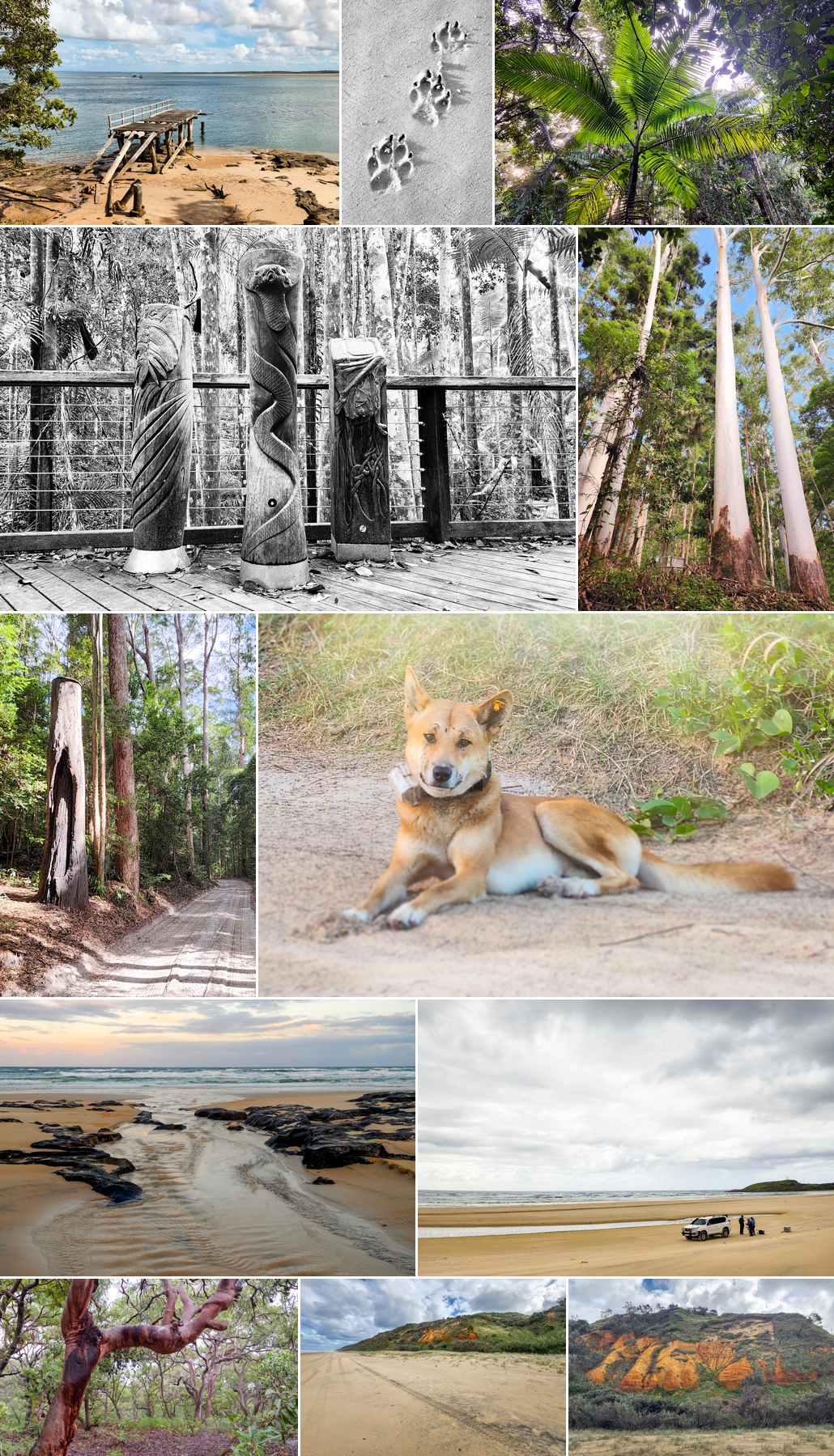
Photography by Jocelyn Watts